
In a nutshell
Fashion brands don’t have a technology problem with visual content — they have a fragmentation problem. This is a case study in what happens when a multi-brand fashion group consolidates content production under a single AI-powered partner: faster execution, lower internal workload, and early cost savings after one season.
⏱ Time to Read: appr. 5 min
Fashion brands keep adding SKUs, keep adding channels, and keep being told to produce more visual content per product. Almost none of them have scaled their production process to match. In our latest Marketplace Universe webinar, together with PIXELMODA, the AI-powered content production company, we sat down with Gilmar, the Italian fashion group behind Iceberg, Iceberg Jeans, Paolo Pecora Milano and N°21, for a real case study on what closing that gap looks like on the inside — and what it can do for sales, returns and internal workload.
Why More Visual Content Directly Moves the Sales Needle
According to Wyzowl, a video marketing agency that publishes an annual industry benchmark survey, product pages with video convert up to 80% better than those without, across industries. Fewer surprises at delivery also means fewer returns: Narvar’s State of Returns 2024, an annual returns-behavior study among online shoppers, found that 42% of online fashion returns come down to wrong size or fit — a problem that richer, multi-angle imagery is built to solve.
The catch is cost. Fabio Lotto, Managing Director at PIXELMODA, put the industry’s average time-to-market between two and four weeks, from initial shooting to the product going live. Traditional studio production doesn’t scale with SKU volume, and budgets get cut before content does.
“It doesn’t make sense not to have a video for each SKU anymore,” Lotto said during the webinar — once the initial content investment is made, adding one costs next to nothing.
PIXELMODA’s answer combines AI-assisted production — where AI guides a real photo shoot in real time without altering the output — with AI-generated content, where images and video are created or extended algorithmically from a base shoot. Used together, Lotto says the company can bring clients from receiving products to published, approved images in as little as one day, three days on average. He cites returns reductions of 5% to 30% depending on how aggressively a brand expands its content, and cost savings of up to 90% on video specifically.
Gilmar’s Problem Wasn’t Technology — It Was Fragmentation
Gilmar’s starting point is a familiar one for multi-brand groups. Four brands, overlapping seasonal calendars, and a virtual showroom that needed finished images within two days of a shoot. Behind that deadline sat a seasonal roster of 28 external suppliers, on top of the models, stylists and photographers needed to shoot everything at once. Every brand team in the company was pulled into logistics rather than design work each season.
The spread matters strategically: a marketplace built around €5 stamp trades doesn’t need the same trust infrastructure as one selling €2,000 watches. That’s the thread the rest of this piece pulls on.
It’s also worth being explicit about why the top end of that range exists at all. A growing share of collectibles buyers aren’t purchasing to enjoy the object day to day — they’re treating it as an alternative asset, the same logic that applies to art or classic cars. A sealed trading card box or a rare vintage watch can gain value faster than more conventional investments in the right market window, and that reframes what a marketplace needs to provide: not just “does this work”, but “will this hold or gain value, and can I prove what I actually own.” That’s a fundamentally different promise than most e-commerce categories are built to make.
👉 Marketplace Universe Insight: The bottleneck in fashion content production is rarely the shoot itself. It’s the number of handoffs — between suppliers, between brands, between markets — that a growing SKU count forces into an already tight seasonal window. Solving for “more content” without first solving for fragmentation just multiplies the coordination problem.
How Gilmar Restructured Its Production Around One Partner
Gilmar consolidated its content production under PIXELMODA as a single operational partner, covering shooting, styling, post-production and upload support across all four brands. Rather than jumping straight to fully AI-generated models, Gilmar chose a more conservative first step: real fit-model shoots combined with AI face-swapping. Valentina Fornara, Communication & Marketing Manager at Gilmar, explains that this keeps styling and posing under the creative team’s direct control while still cutting cost and coordination effort — the face swap alone, she notes, is a significant shift from a budget standpoint when producing across multiple brands and markets in parallel.
The result, in Fornara’s words, is a production calendar with “no last-minute changes” and full visibility into what ships when. Lotto estimates Gilmar’s cost reduction will land at 40–50% once the model is fully rolled out — a meaningful shift for a brand that was shooting internally before.
👉 Marketplace Universe Insight: The brands getting the most out of AI content production right now aren’t the ones going furthest, fastest. They’re the ones treating AI-generated content as an extension of an existing production process rather than a wholesale replacement for it — and expanding step by step as trust in the output builds.
The Results After One Season
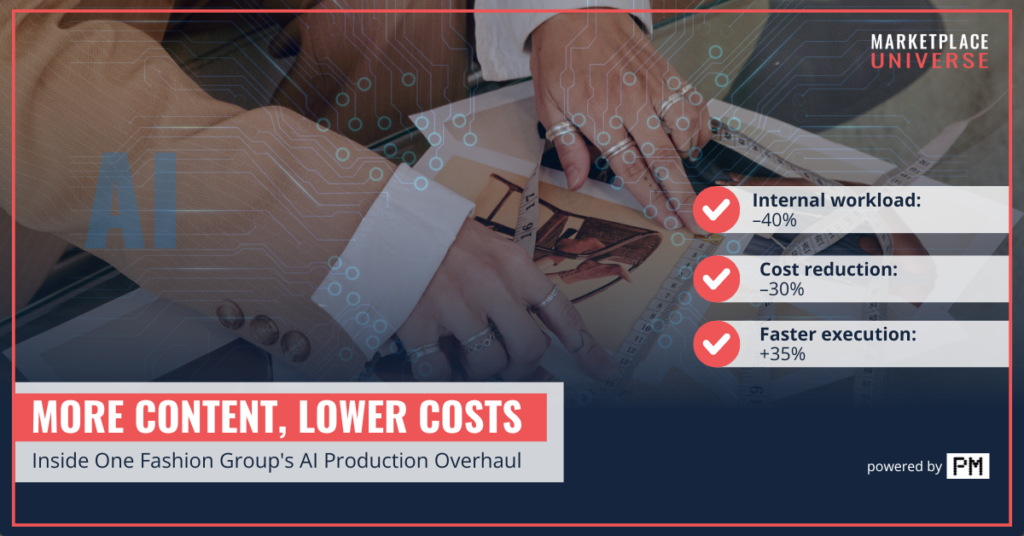
Comparing the new model against equivalent in-house production, Gilmar recorded the following after one season:
- Faster execution: +35%
- On-time content availability: +40%
- Internal workload: –40%
- Time-to-market: –30%
- Scalability: +50%
- Cost reduction: around –30%
These are early-season figures from a single client comparison rather than an industry benchmark, and Gilmar frames the shift as ongoing — video content and further AI-generated formats are the next step, not yet in production.
What This Means for Brands Beyond This One Case
The pattern that emerges from the webinar: brands don’t need to choose between AI-assisted production (real shoots, AI-optimised) and AI-generated content (synthetic models, backgrounds, video) — most clients combine both, adjusting the mix by SKU priority, market and budget. Zalando’s own campaign production illustrates the direction of travel: according to Reuters, more than 70% of its campaign visuals are now AI-generated, cutting lead times from weeks to days.
Key Learnings
- Video content converts significantly better than static images alone, though the size of the effect varies by category and brand.
- Fragmentation, not photography cost, is usually the real constraint on scaling fashion content across multiple brands and channels.
- A phased approach — starting with fit-model shoots and AI face-swapping rather than full virtual models — lets brand teams keep creative control while still cutting cost.
- Time-to-market of one to three days is achievable with AI-assisted workflows, against an industry average of two to four weeks.
- Early results from a single client are directional, not proof of a universal outcome — the right benchmark is your own current process, not an industry average.
PIXELMODA is an AI-powered visual content production company for fashion and luxury brands, combining human photography talent with proprietary and AI technology across image and video production. More at pixelmoda.net.
👉 Want the full picture? Watch the complete webinar recording here.
07.07.2026 – Written by Ricarda Eichler, Journalist and Author for OHN