
In a nutshell
TikTok Shop is a shoppable content feed with a full EU marketplace running behind it — commerce built on discovery rather than search. This piece lays out how it actually works: how brands sell through content, creators and the Shop Tab, what it really costs beyond the headline 9% commission, how the European markets differ, and how established brands can make it work.
⏱ Time to Read: appr. 10 min
What TikTok Shop Is — and Why It Isn’t Just Another Marketplace
Picture a creator unboxing a moisturiser on camera. She shows the texture on the back of her hand, explains why it suits oily skin, answers a comment or two. A small product tag sits in the corner of the video the whole time; tap it, and the product page, cart, checkout and payment open inside the app — no redirect, no separate marketplace to visit. The viewer never set out to buy a moisturiser. They were watching, and the shop came to them.
That is TikTok Shop: commerce built into the content people already open TikTok for. Products live inside short videos and LIVE sessions, are promoted by an affiliate ecosystem of creators, and sit in a Shop Tab that acts as an always-on storefront. All the machinery of a marketplace runs behind it — listings, orders, payouts, fulfillment, returns — but the way a customer reaches a product is what makes it different.
The scale is easy to underestimate. Every month, 200 million people across Europe open TikTok, according to TikTok’s newsroom. Since the EU launches in late 2024 and early 2025, more than 100,000 businesses have joined TikTok Shop across its first five markets — France, Germany, Italy, Spain and Ireland — with over 200,000 more in the older UK market. Daily gross merchandise value across those EU markets grew triple digits between August 2025 and February 2026.
What sets it apart is what happens before the sale.
Discovery Runs on Content, Not Search
On a classic search-based marketplace, the product detail page and the search ranking are the whole game. The customer already wants a cordless drill; your job is to be the drill they find and trust. The intent exists before you do.
TikTok Shop inverts that. Demand is created in the feed rather than captured at a search box. The Shop Tab gives shoppers somewhere to browse with intent, but it complements the content engine rather than replacing it. As Max Burianek, Head of TikTok Shop Germany, put it on the Let’s Talk Marketplace podcast: “The reason users go to TikTok is that they love the content.”
That inversion trips up brands that carry a marketplace playbook across with them. On a search platform, a well-built listing does its job quietly: people who are already looking will find it, so “set it up and let it run” can work. On TikTok Shop there is no stream of searchers to catch. If nobody is making content — the brand, its creators, a live host — nothing surfaces the product, and it stays invisible. Demand here has to be generated continuously, not simply captured.
Marketplace Universe Insight: It is tempting to file TikTok Shop under “social experiment” and assume the rules are looser here. They are not. Underneath the videos and the creators sits a regulated EU marketplace: product safety under GPSR, Extended Producer Responsibility, VAT obligations, and a designated EU Responsible Person for non-food goods all apply exactly as they would on any other platform. The discovery model is new. The compliance obligations are the ones you already know.
Is TikTok Shop Right for Your Product?
The honest answer from the platform side is that it depends less on your category than most brands assume. Burianek’s consistent message is that success is driven more by how an organisation sets itself up and how fast it can act than by its vertical. Beauty led from the start — an easy category for before-and-after demonstration — but electronics has grown strongly despite higher order values, and nutrition and wider FMCG are catching up.
The brand types that work are varied too — from social-native names that grew up on the platform to established consumer brands and FMCG players using the channel as a launch laboratory. The common thread is less the product itself than the willingness to build for content.
A useful gut check comes from the platform’s own “hero product” logic: can a customer grasp why they need this within a few seconds of seeing it? If the benefit is visual and quick to read, it has a strong chance in the feed; if it needs a spec sheet and a side-by-side comparison, it will be harder — though not impossible — to sell through content.
Case in Point: Philips
Few brands are less social-native than Philips, a 130-year-old company — and it has become one of the platform’s clearer success stories. Stephanie Vanderplank-Jones, Commercial Lead for TikTok Shop and Marketplaces in Western Europe at Philips, built the UK shop from scratch and then expanded it to Germany, Spain and France.
Philips started deliberately, with low-consideration products around €30 — shavers, a facial-hair remover that became a top seller — before adding higher-priced items, including an IPL hair-removal device retailing up to €400, once it understood which commercial levers each price point needed. It ran the first six months as a pilot before setting hard GMV targets, kept a deliberately lean in-house team, and leaned on TikTok Shop agency partners for live production and affiliate outreach. Her rebuttal to brands that say the channel did not work for them is blunt: “You can’t have tried it — it’s hours of work.”
The Engine Room: How Selling Actually Happens
There is a myth that TikTok Shop is simply “the affiliate channel.” Affiliates matter enormously, but they are one part of a wider system. TikTok’s own newsroom describes three shopping surfaces: In-Feed Video and LIVE Shopping, where shoppers tap tagged products directly from videos and livestreams in the For You feed; the Product Showcase, where they browse and buy from a brand’s own profile; and the Shop Tab, a searchable product marketplace inside the app for shoppers who already have intent. The Shop Tab is the one surface that behaves like a conventional storefront; the other two run on content.
That content comes from two places. The first is the brand’s own — its own shoppable videos and its own LIVE sessions, with its own hosts. This is the brand speaking directly, and for higher-priced or more technical products it is often where the education happens. The second is the creator affiliate network: approved creators promote products in their own videos and earn a commission. Unlike traditional influencer marketing on flat fees, this is paid on performance — in effect hundreds of small campaigns, where you mainly pay for the ones that work. The brands that scale treat their creator pool almost like a CRM, briefing and supporting creators who often understand a product’s best angles better than the brand team does.
The tooling is moving the same way: automatic sample approval, rolled out across EU markets in January 2026, matches brands with creators by scoring them on past performance and product fit, so samples reach the creators most likely to convert.
Shopping ads sit on top of all of this, amplifying a brand’s own content or a creator’s video into more of the feed and buying visibility for lives when competition for attention peaks. Whichever mix a brand runs, a video can gather views and still sell nothing if the hook is weak or the listing does not convert — so the discipline is to read the whole funnel, not the view count alone.
What It Costs — and How Fulfillment Works
The headline cost is the commission: 9% on most categories, 7% on electronics, raised from an initial 5% in January 2026. Even after that increase it sits below the roughly 15% many classic marketplaces charge — worth holding onto, because the platform fee is not where the real money goes.
Beyond commission, the cost base depends on strategy. Affiliate commissions are sales-based; advertising is bought on an ROI basis; and content production, agencies and creator samples are where budgets actually stretch — though sample cost can be contained through refundable-sample mechanics tied to a creator’s output.
Fulfillment comes in three models, and the right one depends on how much of the operation a brand wants to own:
| Model | Who does what |
|---|---|
| 4PL — Shipped via Platform | You store and pack; TikTok Shop manages delivery. |
| FBT — Fulfilled by TikTok | TikTok Shop handles storage, packing, shipping and customer service. |
| 3PL — Shipped by Seller | You take full responsibility for storage, packing, shipping and service. |
Fulfilled by TikTok is the hands-off end of that spectrum, letting a brand focus on content while the platform runs the logistics. Which model fits depends on the market and on how much of the operation a brand wants to own.
What Different European Markets Tell Us
The footprint now spans ten European markets. The UK, live since 2021, is the most mature. The EU wave followed in 2025 with Spain, then Germany, France, Italy and Ireland. And in June 2026 TikTok Shop added Austria, Belgium, the Netherlands and Poland.
That spread matters, because the offering is not identical everywhere. Fulfillment options, payment and logistics partners, introductory seller promotions and the maturity of local creator pools all vary by market. Germany, one of the five original EU markets, is a case in point: long assumed to resist live commerce, it has become one of the platform’s faster-growing European markets.
The structural advantage of the European rollout is cross-border. Where the UK launched as an island, the newer markets share a Sell Across Europe feature: one seller registration can cover multiple markets, with product descriptions easily localised and orders shipped directly or via TikTok Shop’s logistics partners. A strong position in one European market has become a springboard rather than a dead end.
Where TikTok Shop Belongs — and How Brands Start
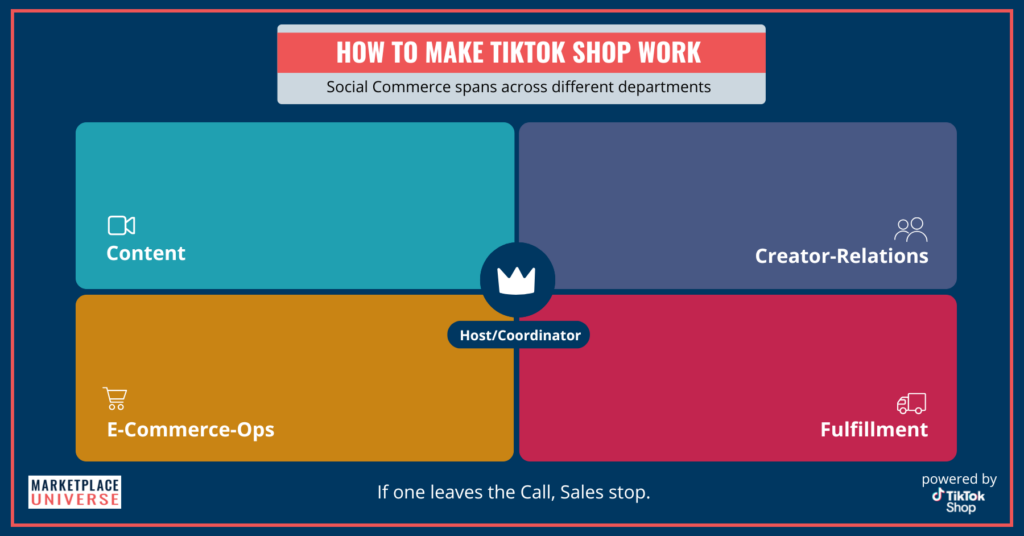
The question in almost every conversation with marketplace managers is organisational: is this e-commerce or marketing? Burianek’s answer is that the reporting line matters less than the profiles around the table. You need content people, creator-relationship people, capable e-commerce operators and fulfillment expertise — and, hardest of all, one person with the mandate to pull them together. Where that person sits is secondary.
The recurring mistakes are consistent: judging the channel after a few weeks rather than the six months it needs to find its footing, and underestimating how much content and the creator community drive everything downstream. It is also not a self-service channel yet. “It’s a new channel, a new playbook — and my team is here to help,” says Burianek.
For brands still on the sidelines, the starting points are unglamorous: study the case studies now available across categories and markets; make it a real priority with a named owner, not a side project; and treat the operational setup — assortment, listings, inventory, the Shop Tab — as a discipline in its own right. Few brands do all of this in-house, either — a growing ecosystem of agencies and TikTok Shop partners covers live hosting, creator management and cross-border localisation.
For whoever runs the day-to-day:
- don’t list your whole catalogue — pick a handful of “hero products” that are easy to demonstrate and scale the ones that perform.
- Treat stock as a growth lever, not admin: a single video can go viral overnight, and a stockout mid-spike costs the sale and the momentum.
- don’t confuse follower count with reach — because content is pushed on merit rather than audience size, creators with a few thousand followers can outsell far bigger names.
- For the actual how-to — listings, inventory, live setup — the TikTok Shop Academy goes deep.
Key Learnings
- TikTok Shop inverts marketplace logic: demand is created through content, not captured through search. Being findable is not enough — you have to be watchable.
- The front end is new, but the back end is a standard regulated EU marketplace. GPSR, EPR, VAT and an EU Responsible Person apply as they would anywhere.
- The creator affiliate model is a cost-efficiency lever — creators are paid on sales, not flat fees — but only if you manage the creator pool as deliberately as a CRM.
- Commission (9%, 7% for electronics) undercuts most classic marketplaces, yet the real investment sits in content and creator relationships, not platform fees.
- It is not a fire-and-forget channel. Brands need a six-month horizon and a clear owner before judging whether it works.
- Offerings, fees and feature availability differ by European market — the UK setup is not automatically the German, French or Spanish one.
- Where the team reports matters less than having one person who can coordinate content, creators, commerce and logistics.
TikTok Shop is the marketplace option of Social Media behemoth TikTok. It enables brands and sellers across Europe to reach customers through shoppable content, LIVE shopping and creator collaborations.