
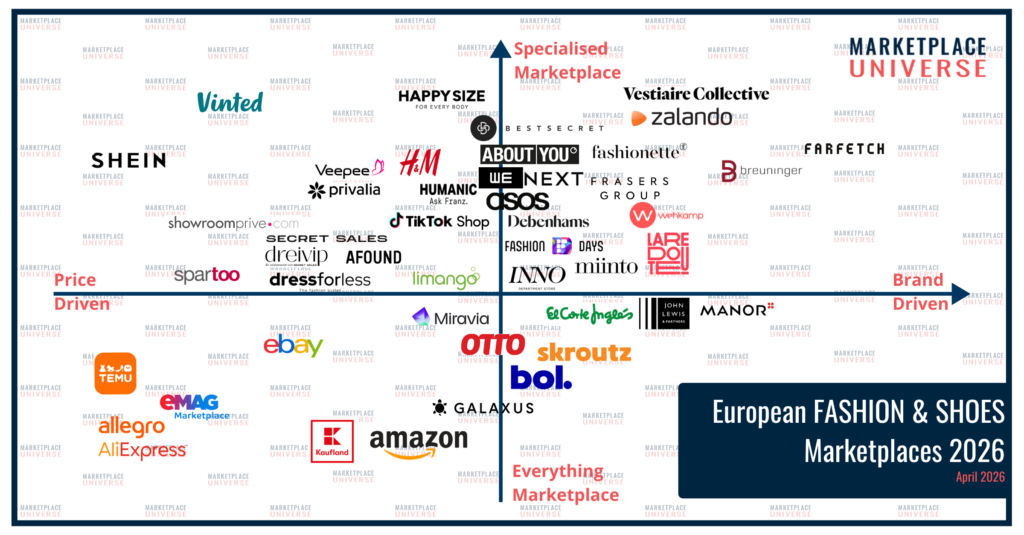
These are the 47 most relevant B2C marketplaces for Fashion & Shoes in Europe in 2026
Last update 17.04.2026
In a nutshell: The European fashion marketplace landscape hasn’t stopped growing — but it has become harder to navigate. Our updated Marketplace Quadrant Fashion & Shoes 2026 reflects that shift. We reduced the landscape from 66 to 47 platforms, applied stricter criteria, and combined data with real-world marketplace activity from our community. The result is not smaller for the sake of it — but sharper, while still reflecting how diverse and fragmented this category really is.
⏱ Time to Read: appr. 7 min
The state of the European fashion market
Fashion remains the largest e-commerce category in Europe — but the headline numbers only tell half the story. According to ECDB, the market reached €149.4bn in 2024, is expected to grow to €156.6bn in 2025, and will hit €165.7bn in 2026. Online penetration keeps climbing alongside it, moving from roughly 35% in 2024 to nearly 38% in 2026. On paper, that looks like stable, predictable growth. In reality, it isn’t.
A disproportionate share of that YoY growth sits with a handful of players — most notably Shein and Temu. Add Zalando and a few strong regional platforms like OTTO, bol, Skroutz or Allegro, and you already cover most of the momentum. Behind those platforms, the picture changes.
For much of the mid-market, the last two years have been difficult — squeezed between rising competition, high return rates and constant pressure on margins. The moderate growth expected for 2026 doesn’t suggest that this will ease anytime soon.
Growth is still there. But it’s no longer evenly distributed.
And that has consequences for how the marketplace landscape evolves. Fashion combines massive scale with extreme assortment complexity: sizes, colours, seasons, styles, men’s, women’s, kids. Add to that the fact that marketplace models have been embedded in fashion for years, and the result is a category that doesn’t collapse into a handful of dominant platforms. It spreads across global generalists, fashion-first marketplaces, off-price ecosystems, recommerce players and highly specialised niches — all operating at the same time.
A leaner quadrant — but not a small one
Compared to the 2025 edition, we have significantly reduced the number of platforms: from 66 marketplaces to 47 in 2026.
Not because the market shrank. But because we stopped pretending everything is equally relevant. We applied stricter criteria — focusing on real marketplace activity, clearer platform structures and actual commercial relevance. But at the same time, fashion doesn’t lend itself to a purely data-driven filter: Too many platforms operate in hybrid models. Too much activity happens in places that don’t fully show up in clean KPIs. And too many decisions are still driven by where brands actually sell — not where models say they should.
That’s why this update combines data with direct input from our Marketplace Universe Fashion Community. And integrated knowledge directly from the field.
And one more thing we changed: the X-axis. We moved away from “Budget Segment → Luxus/Premium” and now use Price Driven → Brand Driven — because it better reflects how brands and sellers actually navigate this landscape.
What’s changed?
The lower-priced end of the market has become impossible to ignore. Shein, Temu and AliExpress are no longer fringe cases or uncomfortable additions. They are structural forces in European fashion.
At the same time, off-price has become more visible as its own ecosystem. Best Secret, Veepee, Privalia, Showroomprivé, Secret Sales, DreiVIP, Afound and Dress-for-less are not just stock clearance channels. They are part of how fashion inventory is redistributed at scale.
Recommerce is getting bigger — but still finding its place. The business models like Vinted and Vestiare Collective are evolving fast, and a lot of players from outside the category are trying to get a piece of it too. Watch this space.
There are some marketplaces we deleted from our Fashion Quadrant from last year, because they are not really relevant – yet or anymore – for the Fashion Category in Europe. So whom did we delete from this overview? sarenza, Outletcity Metzingen, Yoox (not operating as a marketplace anymore), van Graaf, BrandAlley, Clubefashion, trendyol (mainly in Turkey), avocadostore, Ahlens, M&S, Galeries Lafayette, de Bijenkorf, Harvey Nichols, Harrods, Globus, Douglas, very, ellos, Modivo, Le BHV/Marais.
First time on the quadrant: Vestiaire Collective, Vinted, AliExpress, Frasers Group & TikTok Shop
And then there is the growing cluster of hybrid specialists and fashion-led marketplaces: Zalando, About You, breuninger, Next, La Redoute, Miinto, Fashionette, Fashion Days, WE Fashion, ASOS, and others. Different models, different strengths — but all relevant enough for some use cases to remain in the big picture.
The most important players
A few platforms still define the shape of the market.
Zalando remains the clearest reference point for fashion marketplaces in Europe. It combines scale, platform logic and a strong brand environment more convincingly than almost anyone else.
About You continues to build beyond its home region and has become one of the most important fashion-native marketplace players in Europe.
Amazon remains unavoidable. Not because it is the most fashion-specific platform, but because of its scale, traffic and role in basics, repeat purchases and price comparison.
A highly differentiated ecosystem
What makes the fashion marketplace landscape so difficult to compress is exactly what makes it so interesting: there is no single winning model.
At one end, you have price-driven generalists such as AliExpress, Temu, Allegro and eMAG. These platforms compete through scale, low prices and broad reach.
Then there are the large generalists with stronger local roots or more curated environments, including Amazon, eBay, Kaufland, Miravia, Galaxus, bol, OTTO, Skroutz, El Corte Inglés, John Lewis and Manor.
But fashion in Europe is not defined by generalists alone.
A large part of the category is carried by platforms that are much more fashion-specific – and price-driven. Shein has become the clearest example of a highly price-driven specialist. Showroomprivé, Vinted and Spartoo also play in that broader space, albeit with very different models.
The off-price segment follows its own rules. Best Secret, Veepee, Privalia, Secret Sales, DreiVIP, Afound and Dress-for-less are all built around deal logic, inventory pressure and brand offloading.
And then there is the broad group of more brand-led or segment-led fashion specialists: About You, Happy Size, H&M, Humanic, TikTok Shop, Limango, WE Fashion, Next, ASOS, Debenhams, Frasers Group, Fashionette, Fashion Days, INNO, Miinto, Wehkamp and La Redoute.
Finally, the right edge of the market remains reserved for the clearest fashion-first and brand-led environments: Zalando, Vestiaire Collective, Breuninger and Farfetch.
Conclusion
The 2026 update shows a more edited, curated view of the marketplace landscape for fashion & shoes. We cut the number of platforms from 66 to 47 — not to flatten the category, but to make the landscape more readable without losing what makes fashion different. Because fashion marketplaces in Europe stretch across price logic, brand logic, off-price, recommerce, niche positioning and local heritage. That makes the category messier, but also leaves plenty of room for growth opportunities and profitable niches aside from the big players.
Check out all our other Category and Country Quadrants here!