
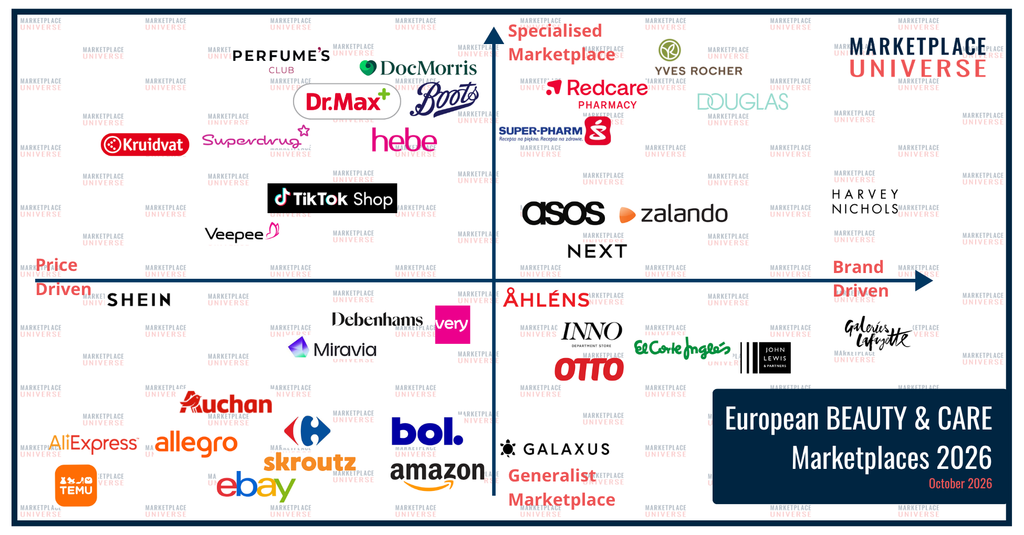
These are the 37 most relevant European B2C online marketplaces for Beauty & Care 2026
Last Update: October 10, 2026
In a nutshell: European Beauty & Care e-commerce is growing at around 10% per year – from €28.2bn in 2024 to a projected €33.9bn in 2026. But online penetration is still in the mid-teens. No other major category has this much room to run. The 37 platforms in this quadrant reflect a category in motion: specialist marketplaces launching, generalists pushing in, and TikTok Shop rewriting the rules faster than anyone else.
⏱ Time to Read: appr. 7 min
Market overview: Beauty & Care e-commerce in Europe
According to ECDB, online revenue in European Care Products reached €28.2bn in 2024, grew to €31.0bn in 2025, and is on track for €33.9bn in 2026. Year-over-year growth is running at roughly 10% – well above the cross-category average.
Online penetration is still in the mid-teens. For context: Consumer Electronics is close to 40%, Fashion approaching 38%. Beauty & Care is the category most major e-commerce players are actively trying to capture – and the one with the largest share of spending still happening offline.
That gap is the market opportunity. For platforms, for brands, and for sellers who get their positioning right before the category matures.
Why we rebuilt the quadrant
The 2025 edition had around 50 platforms. This year: 37.
We applied the same methodology we use across all Marketplace Universe Category Quadrants: platforms need a real marketplace structure with external third-party sellers, meaningful category volume, and actual relevance for brands operating in this segment. Curated dropshipping models don’t qualify. Platforms without a 3P component don’t qualify. Turkey and Ukraine are outside our European scope.
We also changed the X-axis – from Budget/Luxury to Price Driven vs. Brand Driven. The old framing was too blunt. The new axis reflects how brands actually evaluate platform fit: not just price level, but the overall environment a platform creates for sellers.
What’s new
Six platforms are new in this edition:
- Boots – Mirakl-powered marketplace, live since 2023, now large enough to matter for brands targeting the UK health and beauty channel
- Dr. Max – pharmacy marketplace operating in Czech Republic and Slovakia; first CEE pharmacy entry in this quadrant
- Yves Rocher – opened its platform to external sellers in September 2024, moving from a pure own-brand DTC model to a curated marketplace
- Hebe – Polish beauty specialist; already in our 2026 Country Quadrant Poland
- Super-Pharm – Polish pharmacy-beauty platform; also in the 2026 Country Quadrant Poland
- Auchan – included based on its expanding marketplace activity and presence in our 2026 Country Quadrant France
What’s out – and why
Twenty platforms were removed. The reasons fall into a few clear categories:
Out of scope: Trendyol, n11 – Turkish platforms, outside European scope
No real 3P model: Globus, Manor – curated dropshipping, not a marketplace structure
Category volume too low: Kaufland, Cdiscount – Beauty & Care GMV too small
Market or platform deterioration: Showroomprivé – Beauty revenue down ~40% in H1 2026, BHV Marais – significant brand exodus following the Shein ownership stake; sold June 2026, Farfetch – financial difficulties; no longer operationally stable enough to include
Fashion/off-price focus with marginal beauty relevance: BrandAlley, Secret Sales, limango, Place des Tendances, La Redoute, Ellos, wehkamp, CDON, Etsy
The most important players
International generalists
Amazon is the dominant platform across virtually every European market in this category. Scale, delivery infrastructure, and third-party seller depth make it the default channel for most brands.
Temu and AliExpress anchor the price-driven end. Both are growing fast in mass-market personal care and cosmetics. Neither is a natural environment for brand-positioned beauty products – but both are capturing significant volume in the value segment.
bol, OTTO, Allegro, Carrefour, and Galaxus are the Local Hero generalists – strong national market positions with growing beauty marketplace structures. Zalando sits in a distinct position: technically a generalist, but with a curated beauty environment and strong brand credentials that place it clearly towards the Brand Driven end of the axis. Veepee and El Corte Inglés round out the generalist tier with relevant positions in France and Spain respectively.
Beauty and health specialists
The pharmacy-adjacent cluster is this quadrant’s most distinctive group – and the one that has changed most significantly since 2025.
- Douglas – pan-European, genuinely category-deep, the clearest brand-driven beauty specialist in the quadrant
- Yves Rocher – new entry; curated external seller model with strong brand-environment positioning
- Redcare Pharmacy – structural leader in the pharmacy/health-beauty space; present in multiple European markets
- DocMorris – pharmacy marketplace with health-adjacent beauty relevance; includes PromoFarma
- Boots – UK pharmacy marketplace via Mirakl; relevant for brands targeting the health-beauty channel
- Dr. Max – CZ/SK pharmacy marketplace; first structured 3P pharmacy entry from CEE
- Hebe, Super-Pharm – Polish beauty and pharmacy specialists; strong local market positions
- Superdrug – UK; more accessible price point than Boots or Douglas, clear specialist credibility
- Kruidvat – Netherlands; pharmacy-adjacent beauty with strong local relevance
- Miravia – Spain; category ambition, growing positioning between generalist reach and specialist curation
- Perfume’s Club – niche fragrance and cosmetics specialist; limited geographic scale but genuine category depth
Generalists expanding into beauty
Several fashion-first or department-store generalists have been investing in beauty as a category:
- John Lewis – UK; curated beauty section with brand-positioned environment
- ASOS – UK; growing beauty marketplace alongside its fashion core
- Next – UK; marketplace expansion includes beauty as a meaningful category
- Debenhams – UK; operating as a marketplace-native model with active beauty development
- Galeries Lafayette – France; strong brand environment, early stage as a beauty marketplace
- INNO – Belgium; department store with beauty relevance
- Åhléns – Sweden; Nordic department store entry
- Harvey Nichols – UK; small in marketplace terms, relevant for premium beauty positioning
- Skroutz – Greece; pure 3P model, beauty as part of broader general marketplace
All Eyes on TikTok Shop
No platform has moved faster in this category over the past 12 months.
TikTok Shop combines social discovery, influencer content, live shopping, and in-app checkout in a format that maps almost exactly to how beauty products get discovered and purchased by younger buyers. Beauty is its strongest category – by some distance.
It’s already included in our 2026 Country Quadrants for the UK, Italy, and Spain. The growth in those markets is the reason we’ve positioned it significantly above the horizontal axis: TikTok Shop is not behaving like a generalist with a beauty section. It’s behaving like a beauty-native platform that also sells other things.
For brands, the operational implications are real. TikTok Shop requires a content-commerce integration that most existing marketplace playbooks don’t cover. That’s the challenge – and the opportunity.Conclusion
Conclusion
Thirty-seven platforms. Stricter criteria than 2025. A category that is structurally more open than 12 months ago – more specialist marketplaces with real 3P models, more generalists committing to beauty, and TikTok Shop accelerating everything.
Online penetration still in the mid-teens means this category has more growth ahead than almost any other in European e-commerce. For brands, that means platform prioritisation matters now – before the consolidation that tends to follow rapid category growth.
Have we missed a marketplace? Do you have any input to add to our quadrant? Let us know!
Check out all our other Marketplace Category and Country Quadrants here!