
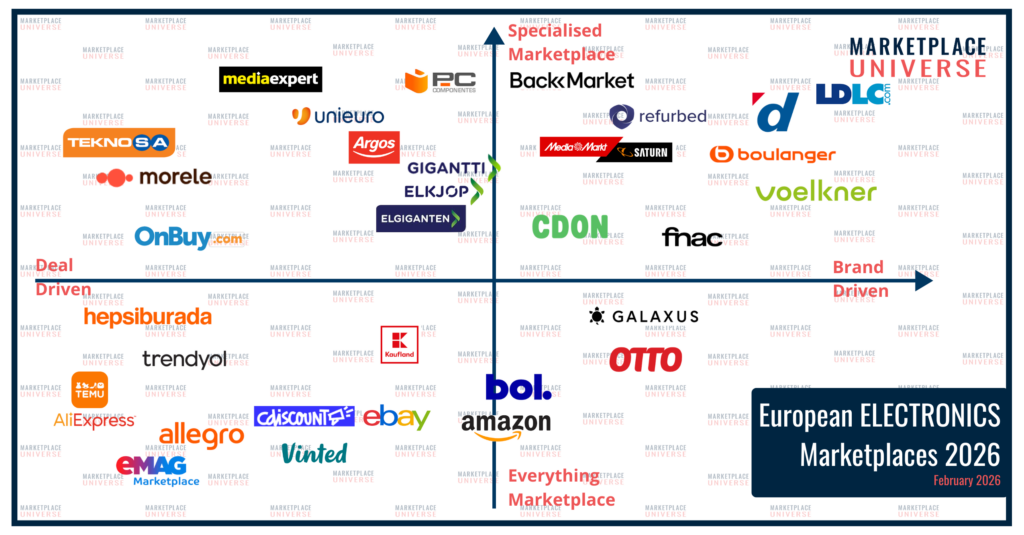
These are the 33 most relevant European B2C online marketplaces for Consumer Electronics in Europe
Last update: 26. February 2026
In a nutshell: Europe’s 33 CE Platforms That Really Matter
The European consumer electronics e-commerce market is back in growth mode. After pandemic peaks and a short correction phase, revenues are rising again – and marketplace competition is intensifying. Our updated Marketplace Quadrant Electronics no longer maps “everything that exists,” but the structurally relevant platforms in Europe. The result: around 30 marketplaces that truly matter – positioned between price-driven volume logic and brand-driven retail competence..
⏱ Time to Read: appr. 7 min
Market overview: Consumer Electronics E-Commerce in Europe
Consumer electronics is not just another retail category. It is the stress test of European e-commerce.
According to ECDB, online revenues in European consumer electronics reached €152.2bn in 2024, grew to €164.0bn in 2025 and are forecast to hit €175.4bn in 2026. After the pandemic spike and a brief stagnation phase, growth has normalized — but it has not disappeared. The category has returned to structurally stable growth, not temporary hype.
What matters more than growth, however, is penetration. Close to 40% of electronics retail in Europe now happens online. Electronics is one of the most digitalized product segments in European retail.
And electronics behaves differently.
Price transparency is extreme. Specifications are standardized. Comparison logic dominates. In such an environment, marketplaces naturally capture a significant share of transactions — especially through 3P models. A large portion of online electronics volume flows through platforms where algorithmic ranking and Buybox dynamics define visibility.This is not a cozy market. It is structurally competitive. And that is precisely why a curated Marketplace Quadrant Electronics is more relevant than ever.
The new quadrant: Why we rebuilt it
We rebuilt the Marketplace Quadrant Electronics because both the data and the market matured.
Two years ago, category-level marketplace data was limited. Today, with ECDB, we have filtered GMV by category, visible 3P shares and cross-country comparability. That allows us to set hard thresholds — including ≥ 80m USD filtered GMV in Electronics and a meaningful 3P structure.
Instead of mapping “everything that exists,” we now filter first, then interpret.
The result: roughly 30 structurally relevant platforms — not 60 logos without hierarchy.
The axes remain intuitive (Price-Driven vs. Brand-Driven; Generalist vs. Specialist), but the underlying selection is far stricter and data-based. In Electronics, “Brand-Driven” also implies service depth, repair capability and retail competence — not luxury positioning.
If you want to understand the exact KPI logic and selection process behind the Marketplace Quadrant Electronics in more detail, you can read our full methodology here:
👉 [Read our detailed Quadrant Methodology]
The most important players
International generalists
As in previous years, generalist marketplaces dominate the electronics category, thanks to their wide reach, high traffic volumes, and aggressive pricing strategies.
- Amazon remains the structurally dominant marketplace in European electronics. Its scale, Prime ecosystem and seller infrastructure make it unavoidable in nearly every country.
- eBay combines price competition with a strong refurbished and recommerce presence. It remains structurally relevant for secondary markets and cross-border volume.
- AliExpress operates on a clearly price-driven logic, focusing on aggressive value positioning. It is structurally important in entry-level and cross-border electronics trade.
- Temu represents the extreme of price-driven marketplace logic. Its expansion into electronics reinforces price pressure across Europe.
Local Heroes
- Allegro (Poland) is the structural backbone of Polish e-commerce and highly price-driven in electronics. For brands active in CEE, it is often more relevant than international platforms.
- bol (Netherlands & Belgium) is deeply embedded in the Dutch and Belgian markets. Its marketplace structure makes it central for electronics distribution in the Benelux region.
- OTTO (Germany) has expanded its marketplace significantly and positions itself slightly more brand-driven than pure price platforms. Its curated seller structure differentiates it from hyper-competitive marketplaces.
- Kaufland (DACH & CEE) is quite price-driven and cross-border oriented. It has become a relevant challenger in Central and Eastern Europe, but is now also reaching out to France and Italy.
- Galaxus (Switzerland & Germany) is traditionally strong in Switzerland and has grown significantly in Germany through Galaxus.de. It differentiates through structured data and curated presentation.
- Cdiscount (France) remains a price-competitive French marketplace with significant electronics volume. It plays a strong role in mid-market and promotional segments.
- Fnac (France, Iberia) combines marketplace logic with strong retail and advisory DNA. It sits more on the brand-driven side due to service orientation and category competence.
- Trendyol (Turkey) has expanded its electronics marketplace significantly and operates largely on a price-driven logic. It is structurally central for the Turkish market.
- Hepsiburada (Turkey) integrates marketplace and retail elements and remains a central Turkish platform for electronics.
- eMAG (Romania & CEE) is a structural leader in Romania and surrounding markets. It is a key marketplace backbone in CEE.
- CDON (Nordics) operates as a Nordic marketplace with cross-border focus. Electronics is one of its most visible and competitive categories.
- OnBuy (UK) is strongly price-driven and focused on marketplace volume in the UK. Electronics is one of its most prominent traffic drivers.
Electronics Specialists
- MediaMarktSaturn (DACH & Europe) combines marketplace expansion with retail infrastructure, installation services and after-sales capabilities. Service depth and retail competence position it slightly on the brand-driven side.
- Boulanger (France) positions itself as a service-oriented electronics specialist with advisory focus. Its differentiation lies in retail competence, not just price.
- MediaExpert (Poland) launched its marketplace in autumn 2025, adding a new structural player to the Polish market. It remains price-competitive but category-focused.
- Unieuro (Italy) is an Italian electronics specialist with marketplace development underway. It balances price competitiveness with growing service orientation.
- Teknosa (Turkey) is a Turkish electronics-focused retailer with marketplace expansion. Its positioning remains largely price-driven.
- PC Componentes (Spain) is deeply rooted in electronics and IT. Technical assortment depth is its core strength.
- LDLC (France) represents one of the strongest technical specialists in Europe. Its positioning is clearly brand- and competence-driven, especially in IT and gaming hardware.
- Morele (Poland) is a price-driven electronics specialist in Poland, particularly strong in IT components.
- Argos (UK) is a major UK retail player with a comparatively young marketplace structure. Its marketplace model is still evolving.
- Elkjøp Group (Nordics) operates with its three retail brands ElGiganten, Gigantii and Elkjop across the Nordic region as a strong electronics specialist. Retail remains central, with marketplace elements complementing the model.
- Digitec (Switzerland) is an electronics-focused specialist with strong structured assortment. It sits slightly more on the brand-driven side due to technical depth.
Recommerce Specialists
While many CE retailers are also offering second hand and refurbished products (MediaMarktSaturn stands out in particular), there are specialist platforms that solely focus on recommerce.
- Back Market emphasizes quality control and trust in refurbished electronics. Its differentiation lies in structured trust architecture.
- Refurbed combines refurbished electronics with visible quality assurance. It competes on credibility as much as on price.
- Vinted remains a generalist platform but has growing relevance in electronics resale. Trust and community logic define its positioning more than service depth.
Outlook 2026: Price transparency meets Agentic pressure
Electronics is the category where Agentic Commerce will hit first — and hardest. Because products are comparable and specifications are standardized, AI agents can optimize selection almost instantly. They filter, rank and decide based on structured data and price-performance logic. In such an environment, hyper-fragmented marketplace landscapes lose relevance. Volume concentrates. Visibility concentrates. Structural strength wins.
That does not mean only the biggest survive. It means the clearest models survive:
- Platforms with scale and data density.
- Specialists with real service or technical competence.
- Recommerce players with credible trust architecture.
What will struggle are the half-hearted marketplace add-ons — the platforms that exist, but lack structural depth.
Europe does not need 200 electronics marketplaces. It likely does not even need 30 in the long run.
The Marketplace Quadrant Electronics 2026 does not predict who will survive. But it makes one thing clear: consolidation is not a theory — it is a structural consequence.
Key Takeaways: Marketplace Quadrant Electronics 2026
- European consumer electronics e-commerce is approaching €175bn in 2026 and remains one of the most digital retail categories.
- A significant share of volume flows through 3P marketplace models, reinforcing platform dominance.
- Roughly 30 marketplaces meet our structural relevance criteria for the Marketplace Quadrant Electronics 2026.
- The market is dominated by powerful international and local generalists — yet strong electronics specialists retain defensible positions.
- Electronics remains highly price-driven, but service depth and retail competence create meaningful differentiation.
- Recommerce platforms are structurally embedded in the ecosystem.
- Agentic Commerce is likely to accelerate consolidation and reward structural clarity over marketplace inflation.
Have we missed a marketplace? Do you have any input to add to our quadrant? Let us know!
Check out all our other Marketplace Category and Country Quadrants here!