
IN A NUTSHELL
The Netherlands is not a market for logistical experimentation. Anyone selling here must master Next Day Delivery, late cut-off times, and reliable delivery promises as basic requirements. Anything less costs visibility and trust. In an environment where products and prices are often interchangeable, delivery performance becomes the decisive competitive factor. Marketplaces like bol make this reality measurable through very concrete requirements. And consistently exclude those who fail to meet the standard over time.
⏱ Time to Read: appr. 6 min
Logistics as an entry test
The Netherlands ranks among the most logistically mature e-commerce markets in Europe. High customer expectations and a strong platform ecosystem have made delivery performance a basic requirement rather than a differentiating factor. Sellers who underestimate the market almost always fail on logistics.
A central role is played by the marketplace bol. As the largest marketplace in the country, bol brings extensive operational experience to the table and effectively sets the pace for service and delivery standards in the market. For international sellers, bol therefore serves as a strong reference point for understanding the realities of the Dutch market.
“Many international sellers enter the market with very strong products – and are surprised by how quickly logistics becomes the decisive factor,” explains Julia Buijs, International Strategy & Proposition Developer at bol.
Delivery standards in the Netherlands: clearly defined, hardly negotiable
Dutch consumers are demanding, and their expectations can be summarized quite clearly: Next Day Delivery (“order today, receive tomorrow”) is the standard, often combined with late cut-off times of up to 11:59 p.m. What matters is that there is very little tolerance for deviation. Reliability takes priority over speed – failing to meet a delivery promise is considered an absolute no-go. Delivery is still primarily made to the customer’s doorstep. In addition, there are initial signs of increasing demand for flexibility (pick-up locations, convenience).
In short: fast delivery is not a bonus – it is the entry ticket.
Delivery performance is not a single metric, but a system
In the Dutch logistics reality, speed, reliability, and transparency form a single promise. A weakness in one area cannot be compensated by strength in another, as trust is essential.
Successful delivery performance is therefore based on the interaction of:
- Speed: sellers must meet the established market standard.
- Reliability: delivery promises must be fulfilled without exception.
- Transparency: sellers must ensure reliable tracking and clear delivery communication.
Typical mistakes made by international sellers
Experienced international sellers often fail due to operational details, as they transfer standards from other markets to the Netherlands without local adaptation. Common mistakes include warehouses located too far from customers, non-competitive cut-off times, and underestimated returns processes that are optimized for cost rather than customer experience. A lack of familiarity with platform-specific requirements is also frequent. The consequences quickly become visible: declining conversion rates, poorer reviews, and reduced visibility.
When logistics determines visibility
Delivery performance has a direct impact on offer performance in the Dutch marketplace environment. When price and assortment are comparable, delivery performance often determines which offer is prioritized.
Key KPIs include:
- Delivery speed
- On-time delivery
- Track & Trace rate
- Lost-in-mail rate
These metrics influence customer satisfaction, reviews, and the preferred display of offers.
“Reliable delivery is not a nice-to-have, but a central lever for visibility and sustainable growth,” says Julia Buijs, referring to the performance logic of the Dutch market.
Bol’s delivery and service standards at a glance
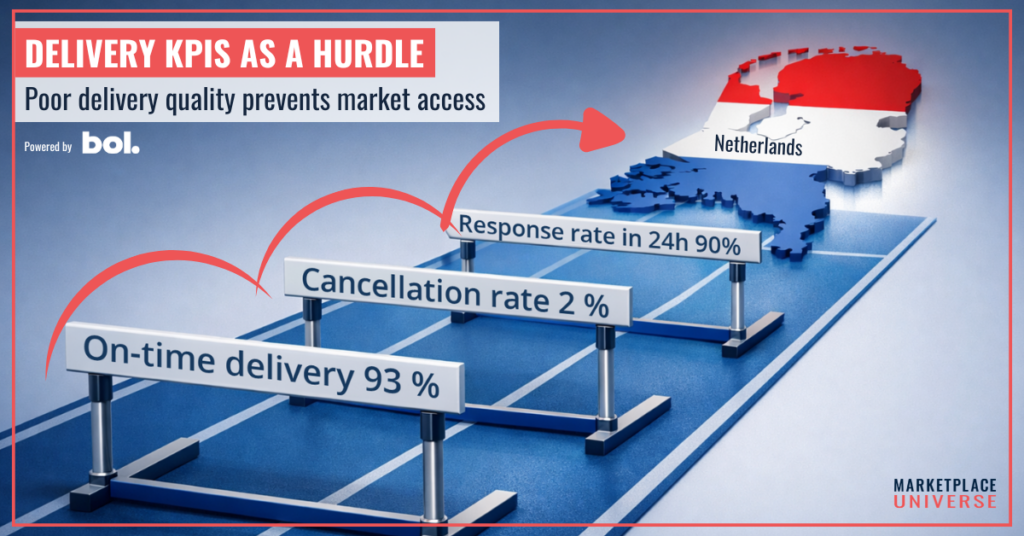
Bol enforces reliability through clear, measurable service standards. Sellers are evaluated against the following criteria:
| Service criterion | Target value |
| On-time delivery | 93% |
| Cancellation rate | 2% |
| Track & Trace | 98% |
These standards form the basis of bol’s warning and sanction mechanisms for sellers. Sellers who repeatedly fail to meet them risk penalties up to and including termination. Bol’s objective is to ensure a consistent and reliable customer experience.
Fulfillment, returns, sustainability: the strategic levers
To secure delivery standards and returns quality, sellers must make an early decision on fulfillment. Fulfillment solutions such as Logistics via bol can help, but are not suitable for every assortment. Returns handling remains a mandatory part of the service level.
The key levers are:
- Choosing a fulfillment setup that realistically enables Next Day Delivery
- Establishing a clear, simple, and transparent returns process
- Reducing returns through accurate expectation management and appropriate packaging
Conclusion & key learnings
The Dutch market requires sellers to treat delivery performance as a strategic core capability.
- Next Day Delivery is a basic requirement
- Reliability outweighs speed
- Delivery performance directly affects visibility
- Platform standards are clearly defined and consistently enforced
- Returns are a performance driver, not a side issue
In short: in the Netherlands, logistics does not determine efficiency. It determines market access.
Interview
Julia Buijs, International Strategy & Proposition Developer at bol, describes the special features of logistics at bol in an interview.

What role does “Logistics as a Service” play within the bol ecosystem?
Julia: Logistics via bol is a key proposition that supports our partners with storage, picking and packing, shipping, returns, and customer service. Essentially, it takes the logistics process off the hands of partners while providing customers with next-day delivery and a seamless experience.
Which assortments is it particularly well suited for, and which are not?
Julia: Logistics via bol is a great fit for brand owners and sellers who want to create a high-quality delivery experience in the Netherlands and Belgium. At the same time, other sellers benefit from Logistics via bol as a multi-warehouse solution for product lines that sell quickly and therefore have a high turnover. It is less suitable for certain product ranges, such as second-hand items, specific dangerous goods, and fresh food.
How does bol handle delivery issues when they occur?
Julia: Bol aims to be extremely transparent towards both its partners and its customers. When something goes wrong – which happens surprisingly infrequently for a company of this size – we inform all parties immediately. We expect the same level of transparency from our (ecosystem) partners and sellers. Accounts of sales partners who continuously fall below our service standards are terminated. It therefore pays off for sellers to communicate quickly and transparently and to always offer a clear solution.
How is sustainability changing the logic of delivery and returns?
Julia: One of the most prevalent customer complaints is that small items are delivered in oversized boxes. In addition, we see some last-mile carriers offering more sustainable options, such as picking up returns along their delivery routes. Ultimately, lowering return rates is the holy grail of e-commerce. As a result, both offering high-quality products (to reduce returns) and developing additional solutions to handle returns are a strong focus for logistics players.