
IN A NUTSHELL
CEE is not a low-cost extension of Western Europe but a marketplace-first region dominated by strong national ecosystem players such as Allegro, eMAG and Alza. Success depends less on brand power and more on operational excellence – competitive total pricing, local logistics (including parcel lockers), strict service KPIs and full catalogue localisation. Poland remains the structural heavyweight, but across CEE, sellers must adapt to local platform logic rather than copy-paste Amazon strategies.
⏱ Time to Read: appr. 5 min
CEE is not Western Europe light
Central and Eastern Europe (CEE) is not “Western Europe light.” Our partner, the integrator base, supports many sellers on their marketplace journey into these markets and therefore has in-depth insights. Together, we have summarized the most important findings. This is because the region follows its own structural, operational, and cultural logic. Anyone who sees CEE merely as a low-cost extension of existing Amazon strategies underestimates the dynamics of these markets.
Marketplaces often play an even more dominant role here than in Western Europe. Consumers rely on them as primary commerce infrastructure – for payments, delivery and buyer protection. At the same time, the region is not dominated by one pan-European player but by strong national market leaders with deeply rooted ecosystems. Add to this higher price sensitivity, an aggressive comparison culture, the strong relevance of parcel lockers, and an operational pace that leaves little room for slow learning curves.
The 5 Most Important Marketplaces in CEE
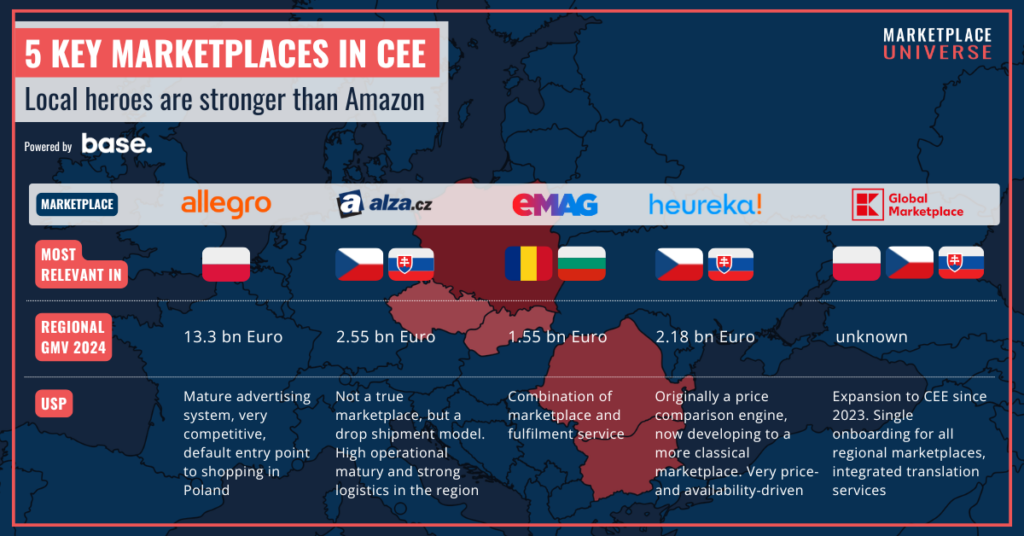
In many CEE countries, local heroes play a strong and often market-leading role. Many of these platforms are evolving beyond pure marketplaces into full ecosystems. Based on ECDB data, the following players rank among the most relevant in the region by total GMV 2024:
1. Allegro (Poland) – GMV €13.3bn
Poland is the largest e-commerce market in the region – and Allegro is its clear leader. With €13.3 billion in GMV, Allegro is far ahead of international competitors. For many Polish consumers, Allegro is the default entry point into online shopping.
A mature advertising system and a highly catalogue-driven structure make the platform extremely competitive. Poland therefore often functions as a “gateway to CEE.”
2. Alza.cz (Czech Republic & Slovakia) – €2.55bn
Alza is the market leader in the Czech Republic with €2.05 billion in GMV and ranks second in Slovakia with €503 million. High operational maturity, strong logistics capabilities and strong brand recognition define the platform.
Originally built as an electronics retailer, Alza continues to expand its assortment. It operates a partner/marketplace structure that allows third-party sellers to distribute products via the platform. However, this is not a pure 3P marketplace model: in many cases Alza acts as the contractual partner and manages central processes such as payments and customer service. Due to this hybrid structure, its classification as a marketplace is not always clear-cut.
3. Heureka Group (Czech Republic & Slovakia) – €2.18bn
Heureka is the central and leading platform in both the Czech Republic (€1.6 billion GMV) and Slovakia (€579 million GMV). Initially launched as a price comparison engine, it has increasingly developed into a transactional infrastructure. The platform is highly search- and performance-driven; price and availability are particularly decisive here.
4. eMAG (Romania & Bulgaria) – €1.55bn
In Romania, eMAG clearly dominates the market with €1.3 billion in GMV and is also the leading player in neighbouring Bulgaria (€249 million GMV). The model combines marketplace and retail infrastructure. eMAG invests heavily in fulfillment, logistics and regional expansion and has positioned itself as a platform ecosystem.
5. Kaufland Global Marketplace – €183m GMV (excluding Poland)
Kaufland Global Marketplace plays a special role. Originating from Germany, it has built a strong cross-border scaling model. Since 2023, the online marketplace has gradually launched in the Czech Republic, Slovakia and Poland.
Although GMV remains relatively moderate due to its still young marketplace presence, Kaufland Global Marketplace is experiencing rapid growth. It can therefore be seen as a bridge between Central and Eastern Europe and the DACH region – making it attractive for Western brands, also due to Kaufland’s strong brick-and-mortar retail presence in CEE.
Success Factors and Typical Pitfalls in CEE
Operational performance matters more than brand awareness. Markets react sensitively to price and service deviations.
1. Price as a lever: Lower purchasing power and high price transparency require competitive, dynamically managed pricing. Transferring Western European price levels 1:1 leads to margin erosion or loss of visibility.
2. Logistics as a ranking factor: Parcel lockers and local carrier models are standard. Marketplace fulfilment programmes directly influence filterability and ranking.
3. Service KPIs as a multiplier: Response times, cancellation rates and delivery reliability feed directly into seller ratings and placement. Operational strictness is often underestimated.
4. Localisation: Visibility depends on structured parameters, full catalogue integration and market-specific requirements. Simply translated listings without technical adaptation cost ranking
5. Retail media: Programmes such as Allegro Ads act as accelerators but do not compensate for structural weaknesses in pricing, logistics and service levels.
6. Platform logic: CEE marketplaces follow their own mechanics (e.g. the “Top Offer” on Allegro). Generic Amazon strategies often fail.
Deep Dive: Allegro
Allegro is not just the market leader in Poland – it is market infrastructure. Since 1999, the platform has shaped payment habits, delivery expectations and the overall understanding of online commerce in the country. A large share of product searches starts directly on Allegro, not on Google.
The “Top Offer” – the central lever
Unlike many Western marketplaces, Allegro does not distribute visibility evenly across multiple sellers. For each product, a so-called Top Offer is highlighted – a single offer prominently displayed that captures the majority of clicks.
The Top Offer frequently appears with increased visibility in search results and is displayed as the primary purchase option on the product detail page, with price, delivery time and Smart! participation clearly highlighted.
Selection is algorithmic and based on multiple factors:
- Total price (including shipping)
- Delivery speed
- Participation in Allegro Smart!
- Conversion history
- Seller KPIs
- Offer quality and catalogue compliance
- Performance in Allegro Ads
👉 The objective is therefore not a “Top 5 ranking” but winning this position. Whoever controls the Top Offer often controls the majority of volume within a product cluster.
Allegro Programmes in Detail
Allegro Smart!
Allegro Smart! is a subscription-based shipping and loyalty programme comparable to Prime. Customers pay a monthly or annual fee and receive free shipping above a certain order value, along with additional benefits.
For sellers, Smart! means better filterability in search results, higher conversion rates, and increased competitiveness in price-sensitive categories. Participation is also a relevant factor in winning the Top Offer. In many categories, Smart! participation is effectively a prerequisite for scaling.
Fulfilment by Allegro
Fulfilment programmes allow sellers to store inventory in local warehouses. International sellers in particular benefit from local storage, as delivery performance is a key ranking factor.
The advantages include faster delivery times, higher service levels, a positive impact on ranking, and reduced operational complexity.
Allegro Ads
Allegro Ads acts as a visibility accelerator. Ads improve placement in search results and support the fight for the Top Offer. However, ads primarily amplify existing competitiveness – without a competitive price and strong service levels, the effect is limited.
Brand Zone
The Brand Zone enables stronger differentiation within a highly performance-driven environment. It offers additional brand space, content opportunities and greater control over presentation – particularly relevant for established brands that do not want to compete solely on price.
Why Classic Amazon Strategies Often Fail on Allegro
Allegro is more catalogue-driven, more price-sensitive and more operationally strict than many Western platforms. Competition concentrates on a single winning position – the Top Offer.
👉 Successful sellers strategically integrate pricing, shipping and Smart!, closely monitor service KPIs and rely on automation. Allegro is not an Amazon clone but an independent, performance-driven ecosystem.
Key Learnings from the Top 5 Marketplaces in CEE
CEE is not a side market. The region is driven by strong national platforms deeply embedded in local consumer habits. International strategies only work when adapted.
Poland – with Allegro – remains the structural heavyweight and often the strategic starting point. However, Romania, the Czech Republic and Slovakia also offer relevant volumes and scaling potential.
Key Learnings:
- CEE is fragmented, not homogeneous.
- Local market leaders are structurally well protected.
- Price and delivery logic determine visibility.
- Operational excellence outweighs brand awareness.
- Allegro is not an “Amazon clone” but its own performance-driven ecosystem.
Anyone serious about CEE needs more than a copy of Western strategies – they need a dedicated marketplace logic.