
In a nutshell
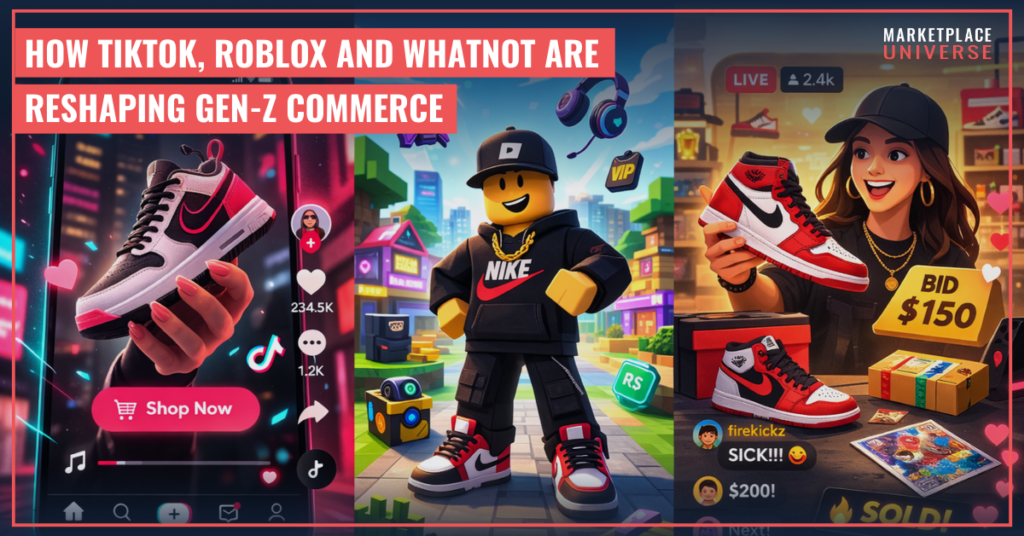
Gen-Z commerce is increasingly happening outside traditional marketplaces. Platforms such as TikTok, Roblox and Whatnot combine entertainment, community and product discovery with new forms of selling. While all three attract younger audiences, they rely on very different commercial mechanics: social commerce, virtual economies and livestream marketplaces. For brands and retailers, understanding these models is becoming essential as product discovery and purchasing shift toward new platform ecosystems..
⏱ Time to Read: appr. 10 min
The Gen-Z platform landscape
Where does Gen-Z actually shop today?
Increasingly, not on traditional marketplaces. Instead, commerce is increasingly emerging across platforms where entertainment, social interaction and shopping blend together.
From a brand perspective, Gen-Z platforms can roughly be grouped into three categories.
Audience platforms
These platforms reach massive audiences and play a central role in content consumption, creator ecosystems and product discovery.
Examples include:
- YouTube
- Snapchat
These platforms are highly relevant for Gen-Z commerce overall, but they are first and foremost broad audience platforms.
Marketplace Universe Insight
Platforms like YouTube and Instagram play an enormous role in product discovery. At the same time, their scale and breadth make them difficult to analyse through a single commerce lens. They function as general-purpose attention platforms, where commerce is just one layer among many others such as entertainment, media and creator ecosystems.
Community platforms
Some platforms influence purchasing decisions primarily through discussion and peer interaction.
Examples include:
- Discord
Here, commerce tends to be more indirect. Products gain traction through reviews, niche communities and social validation rather than through built-in selling infrastructure.
At the same time, platforms in this category are beginning to experiment more actively with commerce. Reddit, for example, is currently testing AI-driven shopping functionality in the US, signalling that even community platforms may increasingly integrate product discovery and purchasing features in the future.
Commerce-native platforms
A smaller group of platforms places commerce much closer to the core user experience.
This article focuses on three of them:
- TikTok
- Roblox
- Whatnot
All three reach younger audiences. But unlike the audience platforms above, commerce is embedded directly in how these platforms work.That doesn’t mean they follow the same logic.
Quite the opposite.
Three very different models of Gen-Z commerce
Although TikTok, Roblox and Whatnot can all be described as commerce-native platforms, they represent three very different ways commerce can happen online.
| Platform | Commerce model | Key driver |
| TikTok | Social commerce marketplace | algorithmic discovery |
| Roblox | Virtual experience economy | immersive interaction |
| Whatnot | Livestream auction marketplace | community engagement |
Looking at these platforms side by side reveals a clear pattern: Gen-Z commerce is not converging around a single dominant platform. Instead, it is spreading across several ecosystems built around different user behaviours.
Marketplace Universe Insight
Platforms like YouTube and Instagram play an enormous role in product discovery. At the same time, their scale and breadth make them difficult to analyse through a single commerce lens. They function as general-purpose attention platforms, where commerce is just one layer among many others such as entertainment, media and creator ecosystems.
TikTok, launched in 2016 by the Chinese technology company ByteDance, has evolved from a short-video entertainment platform into one of the most powerful product discovery engines for younger audiences.
The platform now reaches more than 1.5 billion monthly users worldwide, with particularly strong adoption among Gen-Z consumers. Short-form video combined with algorithmic recommendation allows products to spread at remarkable speed. Viral clips can generate massive demand within hours.
According to ECDB estimates, TikTok Shop generated more than $30 billion in global GMV in 2024, making it one of the fastest-growing social commerce ecosystems.
For a deeper analysis of TikTok’s marketplace infrastructure, see our previous Marketplace Universe article: TikTok Shop: Is it Worth it?
Core audience
TikTok’s user base is broad, but the platform remains one of the most important digital environments for Gen-Z consumers aged roughly 16–24. A large share of users under 30 actively use TikTok for product discovery, often encountering brands through creators rather than through traditional advertising.
Content format
TikTok’s commerce engine is fundamentally content-driven.
Products gain traction through:
- short-form videos
- creator reviews
- livestream shopping
- viral recommendation loops
The recommendation algorithm continuously surfaces engaging content, making discovery largely algorithmic rather than search-based.
Commerce infrastructure
TikTok’s commerce ecosystem is built around TikTok Shop, which integrates marketplace functionality directly into the platform.
Key elements include:
- in-app checkout
- seller product catalogues
- creator affiliate programs
- livestream shopping
- integrated fulfilment solutions in selected markets
Together, these features form a tightly integrated ecosystem connecting brands, creators and consumers.
Who sells here?
TikTok Shop mainly hosts professional sellers and brands, while creators act as distribution partners through affiliate programmes.
Examples of brands successfully using TikTok commerce include:
- e.l.f. Cosmetics
- Made by Mitchell
- Gymshark
These brands rely heavily on creator partnerships and viral product discovery.
Roblox: experience-driven commerce and virtual economies
Roblox, founded in 2006 in the United States by David Baszucki and Erik Cassel, is primarily known as a user-generated gaming platform where developers build interactive worlds and experiences that players explore together.
Over time, the platform has built one of the largest digital economies on the internet.
Roblox reports more than 85 million daily active users, with particularly strong engagement among younger audiences. Its creator ecosystem has also grown significantly, paying out more than $1 billion to developers through the DevEx programme.
A recent ChannelX analysis highlighted Roblox’s growing relevance for Gen-Z commerce, noting that the platform is increasingly evolving into a sales environment for both digital and physical products.
Core audience
Roblox’s audience is significantly younger than most social platforms.
Approximately:
- around 60 % of users are under 16
- the fastest-growing segment is 17–24
This places Roblox at the intersection of Gen-Z and Gen-Alpha audiences, making it one of the earliest digital environments where younger consumers interact with brands.
At the same time, the platform’s young user base has attracted increasing scrutiny. Critics and regulators have raised concerns about content moderation and the presence of experiences that may not always be age-appropriate, prompting ongoing debate about stronger moderation.
Despite these discussions, Roblox remains one of the largest digital environments for younger audiences.
Content format
Unlike TikTok, Roblox is built around interactive experiences rather than media content.
Developers create:
- games
- social environments
- branded worlds
- virtual events
Users participate through avatars and interact with both the environment and other players.
Commerce therefore happens inside experiences rather than through content feeds.
Commerce infrastructure
Roblox’s internal commerce system is built primarily around digital goods.
Users purchase items such as:
- avatar clothing
- accessories
- digital collectibles
- in-game upgrades
All transactions are made using the platform’s virtual currency Robux.
Developers can monetize their experiences by selling these items inside their games and convert earnings into real money through Roblox’s Developer Exchange (DevEx) programme.
Physical products can also play a role in Roblox commerce, but not through a native marketplace infrastructure comparable to TikTok Shop or Amazon.
Instead, physical commerce typically happens through:
- phygital products, where buying a real-world item unlocks digital items inside Roblox
- external store links embedded in brand experiences
In practice, Roblox still operates primarily as a digital goods economy.
Marketplace Universe Insight
Roblox functions less like a marketplace and more like a digital brand experience environmentthat can drive engagement and indirect product demand.
Who sells here?
Roblox sellers are typically developers, creators and brands that build experiences inside the platform.
Examples include:
- Nike (Nikeland)
- Vans (Vans World)
- Tommy Hilfiger
These brands typically create interactive branded environments rather than traditional product listings.
Whatnot: livestream marketplaces for collector communities
Whatnot, founded in 2019 in the United States, is a livestream commerce platform where sellers present products live while viewers bid in real time.
Originally launched as a marketplace for collectibles such as Funko Pop figures and trading cards, the platform has since expanded into categories including sneakers, comics and vintage fashion.
Industry estimates suggest Whatnot reached around $8 billion in GMV in 2025, highlighting the rapid growth of livestream commerce.
As Daniel Fisher, General Manager at Whatnot, explained in a Forbes interview, live shopping recreates elements of physical retail in a digital environment:
“It’s really about bringing the best of an in-store experience directly to your phone.”
Core audience
Whatnot’s audience differs significantly from TikTok and Roblox.
The platform is particularly popular among young adult collectors aged roughly 18–35.
Many users participate not only as buyers but also as active members of niche collector communities.
Content format
The platform’s central format is the livestream auction.
Sellers host live sessions where they:
- present products
- interact with viewers
- launch timed auctions
The format blends entertainment, community interaction and competitive bidding.
Commerce infrastructure
Whatnot operates structurally as a marketplace platform.
The platform provides:
- seller accounts
- integrated payments
- shipping tools
- livestream auction infrastructure
Who sells here?
Whatnot supports both professional sellers and individual collectors, making it a hybrid B2C and C2C marketplace.
Typical sellers include:
- trading card retailers
- sneaker resale shops
- vintage fashion sellers
- individual collectors
The platform is still largely dominated by specialist sellers rather than major consumer brands.

Key learnings for brands and retailers
Several patterns emerge when comparing TikTok, Roblox and Whatnot.
- Gen-Z commerce is fragmenting across different platform logics. Discovery, engagement and purchasing now happen across multiple environments.
- Content drives commerce on TikTok. Success depends heavily on creators, storytelling and viral product discovery.
- Experiences drive engagement on Roblox. Brands do not simply sell products but build interactive environments around them.
- Communities drive conversion on Whatnot. Trust, expertise and scarcity play a central role in these marketplaces.
For brands and retailers, the challenge is not simply joining another platform. The real question is which commerce model actually fits their products and audiences.
Enjoyed this article? The Marketplace Universe Weekly is our free newsletter — every Monday, the latest marketplace news, platform updates, our newest posts, and the insights that matter, delivered straight to your inbox. So you never miss a thing.
👉 Subscribe here: https://marketplace-universe.com/newsletter/
10.03.2026 – Written by Ricarda Eichler, Journalist and Author for OHN