
In a nutshell
AI is not just changing how fashion content is produced — it is changing the economics of marketplace competition itself. The marginal cost of a product image or video is collapsing. Early adopters like Zalando and Etro are already reporting significant gains in both revenue and efficiency. For brands still running the same PDP workflow they used five years ago, the cost is not a future risk. It is a present one.
⏱ Time to Read: appr. 7 min
The Old Logic Is Breaking Down
For years, product content in fashion e-commerce was treated as a cost to be managed. Every SKU needed photography. Every market needed assets. Every new channel demanded more material. The cost scaled linearly with volume — and that meant brands constantly made trade-offs: fewer images, slower time-to-market, underfunded product pages.
That logic is now being dismantled.
AI has made it possible — for the first time — to scale content without scaling cost. The result is not just operational efficiency. It is a structural shift in how competition on fashion marketplaces works. And the brands and platforms that recognised this earliest are already pulling ahead.
Zalando: The Signal Everyone Should Be Reading
When Zalando reported its full-year outlook in March 2026, the headline numbers were strong: a forecast jump of 12–25 % in adjusted operating profit, a share buyback of up to 300 million euros, and shares leaping 12% on the day — their best performance since March 2024.
But the more significant signal was in how Zalando explained the growth. Co-CEO David Schröder attributed it directly to AI:
“We have 70 % more content now, basically at the same kind of cost.”
Seventy percent more content. Same cost. That is not incremental improvement — that is the unit economics of content production fundamentally resetting.
Zalando also pointed to AI-generated product images as a driver of efficiency in ad creation, and flagged AI virtual try-on as a tool for reducing returns — historically one of the most expensive structural problems in online fashion.
The takeaway is not that Zalando is doing something clever with technology. It is that content — long a fixed operational cost — is beginning to behave like a variable one.
Marketplace Universe Insight
When the marginal cost of an additional product image approaches zero, the competitive logic of a marketplace changes entirely. Content stops being a constraint and starts being a weapon.
Luxury Is Not Sitting This Out
One persistent assumption in the AI-and-fashion conversation is that the premium segment will resist. Brand DNA, heritage, creative control — these are real concerns. But the data from early adopters tells a different story.
Fabrizio Cardinali, CEO of Etro and former General Manager of Dolce & Gabbana, spoke at BoF VOICES 2025 about the brand’s results after partnering with AI content provider PIXELMODA:
“With PIXELMODA we have been growing e-comm sales close to 50% per year for 2 years — and we are spending less than what we did 3 years ago.”
50 % annual e-commerce growth. Lower cost than before. That is the kind of P&L impact that tends to end the philosophical debate about AI fairly quickly.
Cardinali was also candid about how the shift happened internally. Etro began by using AI to improve precision and consistency in product imagery, then expanded into campaign content — including the SS24 “Nowhere” campaign, which used AI to build imaginative visual worlds around products. The concern that AI would dilute brand DNA has not materialised. According to Cardinali:
“It’s very difficult, almost impossible, to see the difference between a non-AI image and an AI-assisted one.”
The human element — real photographers, real models, real stylists — remained central. What changed is how efficiently that human team works, and how many additional assets can be generated from each shoot. The freed-up budget and creative capacity then went into the work where human judgement genuinely cannot be replicated: editorial, campaign, storytelling.
How the Production Model Actually Works
To understand why this matters at scale, it helps to understand what modern AI content production actually looks like. The industry has largely converged on two complementary modes — and the combination of both is where the real economics shift happens.
Mode 1: AI-Assisted Production A human team — model, photographer, stylist — shoots on set, but guided in real time by AI that checks every frame against the brand’s specific visual guidelines. Nothing is generated or synthetic. The output is traditional photography, produced faster and with significantly less rework and waste. The AI acts as a quality layer, not a replacement for the shoot itself.
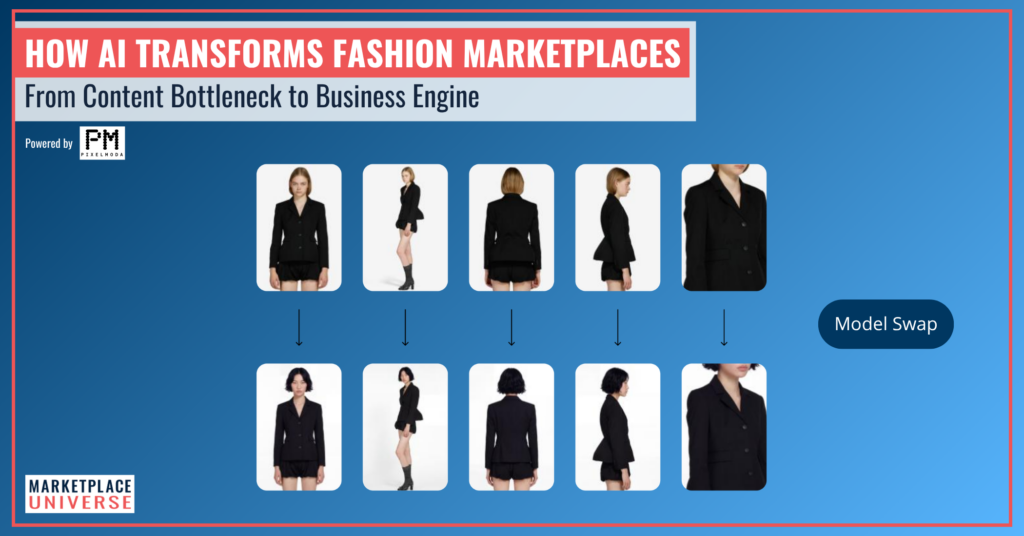
Mode 2: Generative AI Using AI-assisted images as inputs, generative AI then produces additional assets per SKU: body swaps, alternative backgrounds, different poses, video clips, editorial shots. Content that previously required separate shoots, separate locations, and separate budgets can now be generated in hours.
Providers like PIXELMODA have built their entire service model around this two-layer approach — using the assisted shoot as the foundation and the generative layer as a multiplier. The results, across a client base of over 900 brands, make the case for the model plainly.
The cost impact is significant:
- Photography costs reduced by up to 70 %
- Video production costs reduced by up to 90 %
- Time-to-online cut by up to 50 %
And the revenue impact is equally measurable. According to PIXELMODA’s data:
- Moving from 4 images to 7+ per SKU reduces returns by 22 % (Shopify data)
- Adding video drives sales up by +10–20 %
- Aligning model ethnicity with target consumer demographics adds a further +10–25 % in conversion
The Missed Opportunity Most Brands Don’t See
Gianni Serazzi, who leads PIXELMODA, put the business case bluntly at BoF VOICES 2025:
“If you look at your business and you’re creating content for online the same way you were creating it 5 years ago, you’re probably missing anything between 10 % and 30–40 % of sales — now, this month.”
The uncomfortable truth is that this gap does not show up on a P&L as a line item. It is invisible — the sales that never happened, the conversions that never came, because the product page wasn’t good enough to close the deal.
Marketplace Universe Insight
Content gaps don’t announce themselves. You don’t see the sales you’re missing — you only see the ones you make. That’s what makes AI-driven content so structurally important: it makes previously invisible losses recoverable.
What This Means for Marketplace Competition
Here is where the argument gets structural.
Content volume and quality are already major inputs into marketplace ranking algorithms, conversion rates, and retail media performance. As AI makes richer content dramatically cheaper to produce, the baseline expectation on platforms will rise. What is a differentiator today — more images, video, diverse model representation — becomes table stakes in a short window.
That changes the nature of competitive advantage. Once AI content tools are widely available and the cost advantages compound for everyone who adopts them, content quality alone ceases to be a moat.
The brands that pull ahead will be those that use the newly freed-up capacity — budget, time, creative talent — more intelligently. That might mean:
- Faster creative testing across markets
- Deeper localisation (language, model ethnicity, cultural context)
- Higher investment in the data capabilities needed to understand which content actually converts, and where
The Uncomfortable Conclusion
The structural argument cuts both ways. If AI makes content production dramatically cheaper and faster for everyone, then the brands and marketplaces that benefit most will not be those who simply adopt the technology. They will be those who move earliest and build operational and strategic capabilities around it before the window closes.
Zalando’s framing — AI as a catalyst for both efficiency and growth simultaneously — is the version of this story that should be landing in boardrooms. Not AI as cost-cutting. Not AI as a creative experiment. AI as the mechanism by which the economics of marketplace competition fundamentally reset.
For fashion brands still treating content as a linear cost to be managed, that reset is already underway.
Key Learnings
- AI has broken the linear relationship between content volume and content cost. 70 % more content at the same cost (Zalando) is not an edge case — it is the new direction of travel.
- Premium and luxury brands are adopting AI, not resisting it. The Etro example shows that AI-assisted content can preserve brand DNA while delivering significant commercial results.
- The production model has structurally changed. AI-assisted shooting + generative AI output means 30+ assets per SKU, at a fraction of traditional cost.
- The revenue impact of richer content is measurable and significant. More images reduce returns. Adding video lifts conversion. Localised models drive further uplift.
- The gap is invisible until it’s gone. Brands not optimising their PDP content are losing sales they cannot see — and won’t recover until they change the workflow.
- Content quality will become table stakes, not a differentiator. Competitive advantage will shift toward execution, data, and how freed-up resources are reinvested.
PIXELMODA is a global provider of AI-assisted and AI-generated content for fashion and luxury e-commerce, working with over 900 brands across Europe, the US and Asia. For more information see pixelmoda.net
04.05.2026 – Written by Ricarda Eichler, Journalist and Author for OHN