
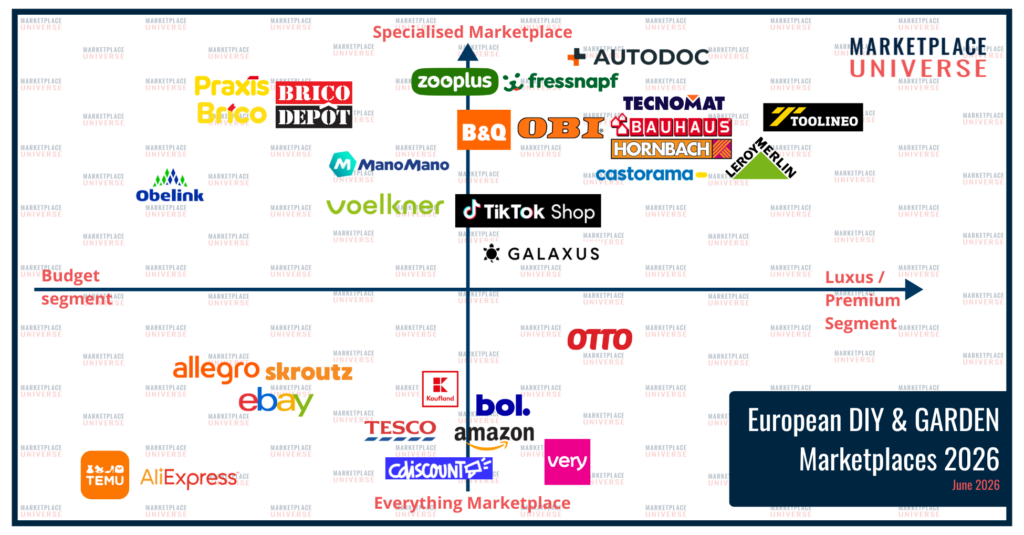
These are the 31 most relevant B2C marketplaces for DIY & Garden in Europe in 2026
Last update: 06. July 2026
DIY & Garden e-commerce in Europe has stopped sprinting and started walking with purpose. Growth is steady rather than spectacular, and the marketplaces that matter are the ones actually generating third-party sales — not the ones merely announcing them. Our updated Marketplace Quadrant DIY & Garden 2026 reflects that: from 49 platforms down to 31, filtered against real third-party GMV data and sharper category boundaries. Smaller, but far more telling.
⏱ Time to Read: appr. 6 min
The state of the European DIY & Garden market
DIY & Garden e-commerce in Europe keeps getting bigger: €58.1 billion in 2025, according to ECDB, up from €24.8 billion in 2017, with €82.6 billion forecast by 2030. Online penetration has nearly doubled over the same stretch to 10.0%, and is expected to climb to 13.3% by the end of the decade.
But look at the shape of that growth, not just its size, and the real story shows up. 2020 delivered a pandemic-fuelled spike of 43.6% year-on-year — the kind of number every category dreams about. Then came the hangover: growth actually went negative in 2023. Since then, the market has settled into something far less dramatic: a steady ~7% a year.
That is less a sign for slowing momentum but of a category growing up. And a market that grows up demands a different kind of marketplace map: one built on who’s actually selling, not who’s merely present.
A leaner quadrant — but not a small one
Compared to the 2025 edition, we’ve cut the number of platforms almost in half: from 49 down to 31.
Not because the category shrank — quite the opposite, as the numbers above show. We cut the list because we stopped taking marketplace claims at face value. This year, we cross-checked every candidate against ECDB’s Total 3P GMV data: does a platform actually generate third-party sales, or does it just have a storefront that looks the part? Several long-standing names didn’t survive that test.
We also sharpened the category itself. Platforms with genuine marketplace models but a center of gravity firmly in furniture and home décor have moved out to make room for a cleaner DIY & Garden view. This leaves out a few platforms which are interesting to gardening supplies; if you’re interested in those, make sure to check out our Marketplace Quadrant Home & Living as well.
The result: a smaller quadrant that says more with less.
A fragmented market
The DIY & Garden story looks very different depending on which European market you’re standing in. While the marketplace story in some countries is gaining traction (or is being pushed by very active local players), the market in other countries remains firmly brick-and-mortar-oriented.
Germany is the category’s biggest paradox: home to some of the continent’s most aggressive marketplace builders (Bauhaus, OBI, Hornbach all launched or expanded third-party platforms), yet its overall online DIY penetration sits at just 5.7% — nearly half the European average. France is the most mature but also the toughest market: Adeo (Leroy Merlin, Tecnomat) now pulls over 80% of its e-commerce growth from marketplace sales and grew 1.4% in a market that shrank 3.2%, while Kingfisher’s French banners (Castorama, Brico Dépôt) fell 2.5% in the same period. The UK is offline consolidation AND online growth: Homebase collapsed in late 2024, B&Q simply absorbed eight of its stores, and Kingfisher’s group marketplace GMV jumped 58% to £518m. Spain posted the single most dynamic number in our whole research — Leroy Merlin’s marketplace revenue up 53% to €150m. Meanwhile Poland has an accelerating, construction-driven market and a genuinely open marketplace race between Kingfisher’s Castorama and Adeo’s Leroy Merlin (56% combined market share).
What’s changed?
Normally, each quadrant update sees new entries. In this category, though, we have not seen notable new entries into the market. Instead, the existing players are expanding their business into more and more countries. The fight for market share has already begun – even though the category is still growing.
This fight has led to a harsher competition for relevance – and to a number of exits from the quadrant.
Out this year: Praktiker, Wayfair, Rakuten, MediaMarkt, Digitec, Auchan, Fruugo, La Redoute, OnBuy, Worten, wehkamp, hood.de, Empik, Vente-Unique, Black Red White, Leen Bakker, Maisons du Monde, and BUT.
The most important players
A handful of platforms define where this category is heading.
Amazon is, by a wide margin, the single most important DIY marketplace in Europe. Nobody else comes close.
eBay comes next; in DIY & Garden specifically, it sits closer to Amazon than it does in almost any other category.
After that there’s the giant retailers to consider: the marketplaces built by the big three retail groups — Kingfisher (B&Q, Castorama, Brico Dépôt), Adeo (Leroy Merlin, Tecnomat) and Maxeda (Praxis, Brico Belgium). Different countries, different momentum, different challenges — but together, they’re the group actually shaping how the category evolves.
ManoMano is the oldest pure-play DIY online specialist in Europe — but its relevance has faded sharply outside its home market. Today, it’s genuinely significant in one country only: France.
A highly differentiated ecosystem
Thirty-one platforms, four very different playbooks.
Online generalists
Amazon, eBay, AliExpress, Temu, Allegro, Skroutz, Cdiscount, bol.com, Kaufland, TikTok Shop, Tesco, OTTO, Galaxus, Very don’t specialise in DIY at all. It’s just one assortment among many, but their sheer scale still makes them unavoidable for anyone selling into the category.
Brick & mortar retail giants with a marketplace
B&Q, Castorama, Brico Dépôt (Kingfisher), Leroy Merlin, Tecnomat (Adeo), Praxis, Brico Belgium (Maxeda), and the German retail giants Hornbach, OBI, Bauhaus are the traditional DIY trade’s answer: take decades of category expertise and store networks, then widen the assortment with third-party sellers. This is the most active, fastest-moving group in the whole quadrant right now.
Online DIY specialists
ManoMano, Voelkner, Toolineo were born as marketplaces, with no legacy stores to integrate and no first-party baggage to manage.
Niche champions
Zooplus, Fressnapf, Autodoc, Obelink sit just outside the core category but earn their place through meaningful overlap: pet-related outdoor and garden equipment, camping and outdoor living, and vehicle maintenance as its own form of DIY.
Conclusion
Forty-nine platforms down to 31 — not a smaller category, but a more honest one. European DIY & Garden e-commerce has left its boom-and-bust years behind and settled into steady, structural growth. That maturity shows up everywhere: in the countries pulling ahead through real marketplace commitment (France, Spain), in the ones consolidating hard around the strongest players (UK), and in the ones still punching below their digital weight despite building the most marketplace infrastructure (Germany). The market grew up. Our quadrant just caught up with it.
Check out all our other Category and Country Quadrants here!
Have we missed a marketplace? Do you have any input to add to our quadrant? Let us know!