
In a nutshell
Within a single year, France has fined Shein more than €210 million and pushed through a world-first anti-ultra-fast-fashion law – not through sheer toughness, but by deliberately exploiting gaps in EU law. Where those gaps didn’t exist and France went it alone nationally, the measure visibly failed – but that very failure became the lever for an EU-wide solution.
⏱ Time to Read: appr. 6 min
One Store Opens, Another Gets Shut Down
On November 5, 2025, Shein opened its first permanent store worldwide inside the Parisian department store BHV – accompanied by protesters outside the door. The same day, France’s Ministry of Economy blocked access to the Shein platform. The trigger: childlike sex dolls, along with banned weapons and medication, found on the third-party marketplace. This juxtaposition – expansion on one side, regulation on the other – runs through the entire year. A good moment, then, to pin down where France was genuinely ahead of the curve – and where its go-it-alone approach hit its limits.
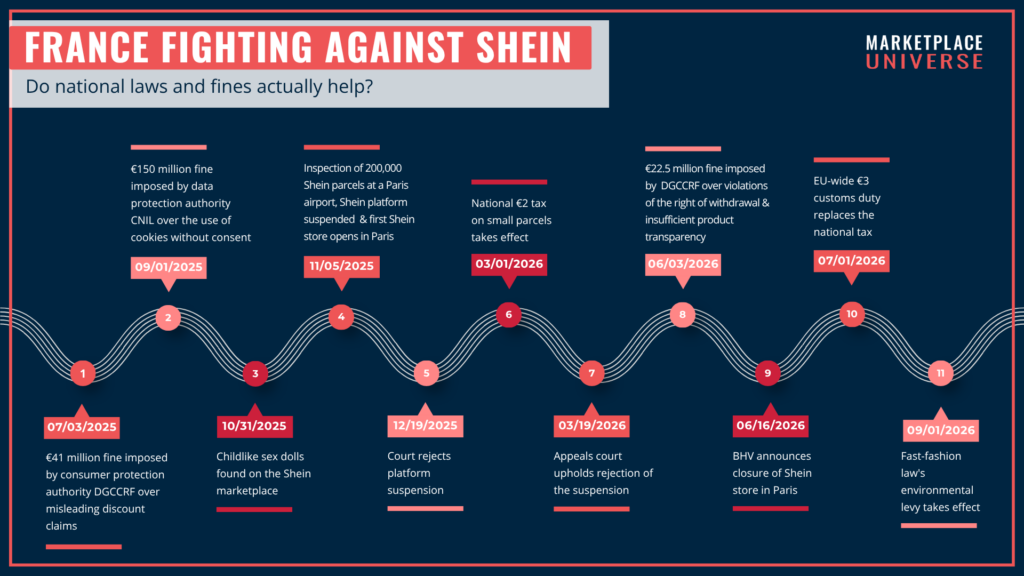
Fourteen Months, Three Waves of Fines, One Court Case in Two Acts
That’s how France’s campaign against Shein has unfolded between July 2025 and September 2026 (see timeline graphic). The rhythm stands out: each wave of fines is followed by a new level of escalation – from consumer protection to data protection to criminal law, triggered by the discovery of the sex dolls in October 2025. The attempt to suspend the platform over this dragged on through two court instances and four months – and ended in defeat for the state both times.
In total, French fines against Shein now add up to more than €210 million – a scale with no real European counterpart: Italy’s competition authority AGCM imposed a greenwashing fine of just one million euros in August 2025, explicitly citing the French precedent.
Where France Deliberately Exploits Gaps in EU Law
What stands out about France isn’t just toughness. It’s how the country operates: in two instances, the state deliberately exploits gaps in EU law – something other member states rarely do.
The first case concerns the €150 million fine from France’s data protection authority, the CNIL. Under the EU’s GDPR, the one-stop-shop principle applies: only the data protection authority of a company’s EU home country may impose cross-border sanctions. In Shein’s case, that’s Ireland. Yet the CNIL based its decision on Article 82 of French data protection law, which implements the EU’s ePrivacy Directive. That directive has no one-stop-shop mechanism – any national authority can act independently. The CNIL had already successfully defended this approach against Google and Amazon in 2020 before France’s highest administrative court, the Conseil d’État. The Shein case follows a well-established playbook.
The second case concerns the suspension order. Shein has been designated a “Very Large Online Platform” under the Digital Services Act by the EU Commission since April 2024 – meaning oversight of systemic risks is supposed to lie exclusively with the Commission. France, however, based its lawsuit on Article 6-3 of the national digital law LCEN, which allows for swift injunctions to prevent harm. The state’s legal representative accordingly framed the claim in court with deliberate restraint. The goal wasn’t to replace the European Commission, only to prevent harm.
👉 Marketplace Universe Insight: Legal experts classify this balancing act as a borderline case, seeing it as evidence that national law reaches its limits once systemic platform risks are at stake. Notably, the government itself admitted after its defeat before the Cour d’appel in March 2026 that the legal framework needs to evolve at both the national and European level – an unusually open acknowledgment of its own limits.
The Small-Parcel Tax: From Failed Go-It-Alone Effort to EU-Wide Blueprint
Not every measure relied on such legal gaps: on March 1, 2026, France introduced a national tax of two euros per item on parcels under €150 in value, expecting annual revenue of around €400 million. The problem: Shein and comparable platforms simply cleared their shipments through customs in other EU countries and trucked them into France afterward. According to the director general of the French customs authority, this evasion affected around 90 percent of shipments that were technically liable for the tax. In the end, only about €2.3 million came in per month, less than seven percent of the expected sum.
Since July 1, 2026, a uniform EU-wide customs duty of three euros per product category has applied, binding across all 27 member states – France’s national tax was suspended at the same time. France’s tax mainly added momentum to the implementation of the EU’s existing plans – alongside Italy and Romania, which had also introduced national fees ahead of the EU rule.
👉 Marketplace Universe Insight: In fact, it wasn’t the success of the French tax that brought about the EU solution, but its visible failure: it supplied the argument for why EU-wide solutions are needed in such cases.
What Comes Next – And Where the EU Is Unlikely to Follow
On June 29, 2026, the French parliament passed the law to reduce the environmental impact of the textile industry. It specifically targets “ultra-fast-fashion” providers like Shein, Temu, and AliExpress, while exempting established chains like Zara or H&M. Since September 1, 2026, a tiered levy has applied. From €0.50 for underwear to €12 for coats this year, rising to €19.50 by 2030, capped at 50 percent of the net price. A separate, not yet finalized EU-wide handling fee is additionally slated for November 2026.
While the customs reform was an EU project all along, one where France mainly pushed for speed, the fast-fashion law tells a different story. International media have called it a first among major European states, but there’s no EU-wide equivalent so far. Quite the opposite – the Commission scrutinized the proposal critically for compatibility with EU law. Here, France remains on its own for now, with no sign of the EU following suit.
Does Any of This Actually Work?
An analysis by the French cashback app Joko, based on bank transaction data from 1.5 million users in France, shows a 50 percent drop in purchase volume at Temu between June and July 2026 – but only 15 percent at Shein. Joko attributes this to a warehouse Shein had already opened in Poland by late 2025, which may have reduced its tax exposure. Even though these figures should be treated with caution, France’s Ministry of Economy reported, based on its own customs data, a 30 to 40 percent drop in Chinese small parcels overall – confirming the broad trend.
Conclusion
What can be cautiously concluded from this: regulation and legal action can change things – but operators like Shein are good at finding loopholes and evading restrictions. It’s therefore still unclear whether this will lead to genuine structural shifts, and ultimately to a change in consumer behavior.
That political and public pushback can have an effect showed itself in France beyond regulation proper, too. After months of criticism over its environmental footprint and labor practices, the department store BHV announced in June 2026 that it was ending its partnership with Shein – the new management called the collaboration a “strategic mistake.” The store is expected to close by Christmas 2026.
Key Learnings
- France’s sharpest weapon is legal precision, not toughness. Both the CNIL fine (ePrivacy instead of GDPR) and the suspension order (LCEN instead of DSA) exploit structural loopholes that other member states don’t tap into in the same way.
- With more than €210 million in fines, France stands without a real European counterpart. Italy’s only comparable fine explicitly followed the French example.
- A purely national go-it-alone effort can structurally fail within the single market. The small-parcel tax was evaded 90 percent of the time before it could take effect.
- That very failure supplied the argument for an EU-wide solution that can’t be evaded. France claims to have played a driving role, but wasn’t the only one pushing for it.
- Not every instance of France being a pioneer finds an EU successor: on the fast-fashion law, France remains alone for now.
Enjoyed this article? The Marketplace Universe Weekly is our free newsletter – every Monday, the latest marketplace news, platform updates, our newest posts, and the insights that matter, delivered straight to your inbox. So you never miss a thing. 👉 Subscribe here: https://marketplace-universe.com/newsletter/