
In a nutshell
Wolt has long since stopped delivering just meals. Customers can now also order electronics from MediaMarktSaturn, home & living products from Mömax and groceries from REWE via the platform – straight from the store and within an hour. This makes instant retail relevant for brick-and-mortar retailers across many sectors. Our analysis shows how the model differs from quick commerce, where it has already led in China and why it is likely to play out differently in Europe.
⏱ Time to Read: appr. 6 min
REWE now delivers via Wolt
Since 15 September, shoppers in Cologne have been able to order their REWE groceries via Wolt and have them delivered within an hour at most. Five stores are taking part at launch, with more locations and cities to follow. The orders are picked in the store itself, and a Wolt courier takes it from there.
That is a different thing from the quick commerce made famous by Flink and Gorillas. The partnership follows a model known as instant retail – and in China, it has become a key growth driver of online retail.
Quick commerce and instant retail
The two terms are often used interchangeably, as both promise delivery within minutes rather than days. Strictly speaking, though, quick commerce describes a logistics model: a provider supplies customers from its own dark stores, usually with groceries and everyday essentials. Instant retail casts a wider net and includes deliveries from existing shops.
What sets quick commerce apart from instant retail
| Quick Commerce | Emphasises logistics and delivery speed. Goods usually come from decentralised, delivery-only warehouses (dark stores). | Groceries, drugstore items or snacks delivered to the door by e-bike within 15 minutes. |
| Instant Retail | Emphasises the customer experience of immediate availability. It often links the digital order more closely with traditional brick-and-mortar retail. | A local fashion store or electronics retailer sends a product to the customer by courier immediately after the click in the online shop. |
In China, where the model is most advanced, people hardly talk about quick commerce at all, says China retail expert Ed Sander. The term there is instant retail: ordering via an app, with delivery within an hour and often within 30 minutes – from a dark store or a shop alike.
Wolt runs both models
The company is building out both models at the same time. Its own online supermarket, Wolt Market, operates from dark stores. In August, Wolt added the Wolt Bio Market: 15 locations in eight German cities offering up to 1,800 organic products depending on the city, with Alnatura as its key assortment partner.
On the other side are brick-and-mortar retailers that fulfil orders from their own stores, with Wolt supplying the app, the reach and the couriers. Recent additions in Germany include:
- MediaMarktSaturn (July 2026): around 2,000 electronics products depending on location, delivered in about 35 minutes
- Mömax (August 2026): home & living products, initially from eight stores
- SuperBioMarkt (September 2026): organic range, pilot project in Düsseldorf
- REWE (September 2026): groceries, initially from five stores in Cologne
And this is no sideline: according to Wolt, retail now accounts for more than a quarter of its global sales (as of Q4 2025), with more than two million people worldwide ordering retail products through the app every month.
The Chinese model
In China, instant retail is already part of everyday life. Ed Sander estimates its share of Chinese e-commerce at around 10 percent – and rising fast, while traditional e-commerce and live commerce are stagnating. In episode 162 of our podcast “Let’s Talk Marketplace”, he breaks it down into three models:
- Store plus warehouse: a supermarket with an attached warehouse and its own courier fleet, such as Alibaba’s Freshippo.
- Front-end warehouse: dark stores in residential areas, mainly for fresh food, such as Dingdong Maicai.
- Marketplace: retailers connect their inventory management system to a platform, pick orders themselves and hand them over to the platform’s couriers. Walmart and Decathlon, for example, work this way.
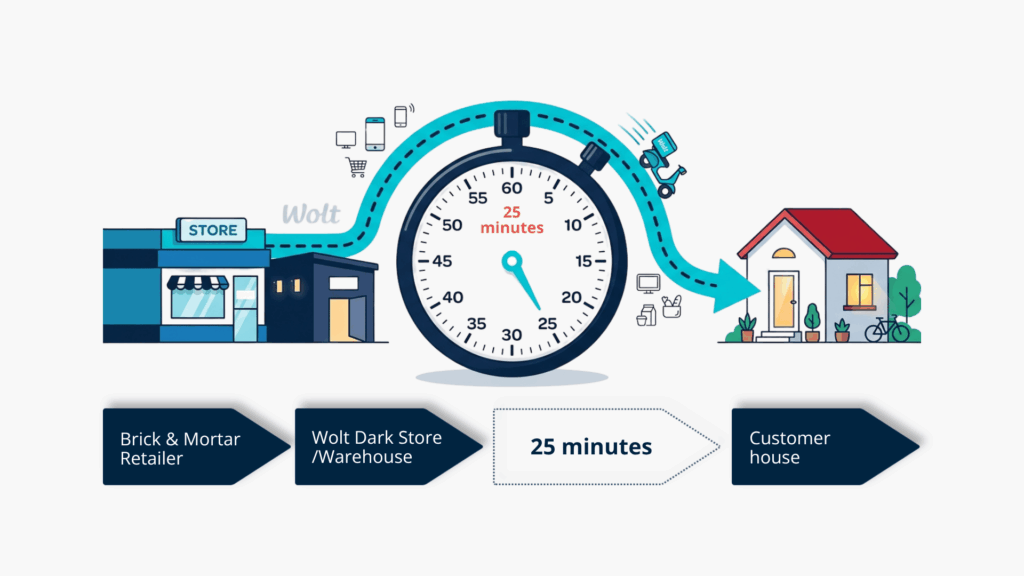
Wolt Market fits the second model; the partnerships with REWE, Mömax and MediaMarktSaturn fit the third. The product range is following a similar path, too. In China, instant retail started with groceries and urgent needs such as medicine.
Today, Chinese consumers can get almost anything delivered within the hour. Wolt is heading the same way, step by step, adding electronics, toys and home & living products.
👉 Marketplace Universe Insight: With instant retail, the store becomes a fulfilment location. Retailers don’t need their own delivery network for this, but they do need an inventory management system that reliably reports available stock to the platform. Those who, like REWE, connect to several platforms in parallel also reduce their dependence on any single provider.
Why Europe won’t become China
Even so, Ed Sander doesn’t expect instant retail to take off on the same scale in Europe. Labour costs aren’t the issue, he argues – relative to average incomes, they are comparable. The real difference is population density. “In China they live vertically, we live horizontally,” says Sander.
On top of that, China has three internet giants pushing the model: Alibaba, JD.com and Meituan. According to Sander, they spent a combined total of more than 150 billion renminbi on consumer discounts last year to win customers. Europe has seen nothing like this subsidy race.
Against this backdrop, Wolt is treading carefully. New partnerships start out in selected major cities, and Wolt has not said how many more locations and cities will follow. It is also targeting categories that Sander sees as viable in Europe – those where order values and margins are high enough, such as consumer electronics. And many grocery orders are large: according to Wolt, 48 percent of grocery baskets contain ten or more items. That matters, because larger baskets are what pays for the costly last mile.
Conclusion
Wolt is building an instant retail model along Chinese lines, with its own dark stores and a growing marketplace for brick-and-mortar retailers. Unlike in China, this is happening step by step, with a focus on major cities and on categories that can bear the delivery costs. Structurally, Wolt looks most like Meituan, whose core business is also food delivery and which uses its courier network for retail.
The open question is how much leverage Wolt will gain over retailers. REWE, for one, is rolling out its express delivery via other platforms in other German cities at the same time, treating Wolt as one channel among several.
Key learnings
- Quick commerce describes delivery from a provider’s own dark stores; instant retail also includes delivery from existing stores.
- Wolt runs both models: Wolt Market and Wolt Bio Market as dark stores, plus connected retailers such as REWE, MediaMarktSaturn, Mömax and SuperBioMarkt.
- According to Ed Sander, instant retail is the most important growth area of e-commerce in China.
- In Europe, lower population density limits the model to major cities and to categories with high order values or large baskets.
- For retailers, the platform is an additional sales channel, not an exclusive partner.
Want to learn more about instant retail in China? Then check out our podcast episode with Ed Sander.
Enjoyed this article? The Marketplace Universe Weekly is our free newsletter – every Monday, the latest marketplace news, platform updates, our newest posts, and the insights that matter, delivered straight to your inbox. So you never miss a thing. 👉 Subscribe here: https://marketplace-universe.com/newsletter/