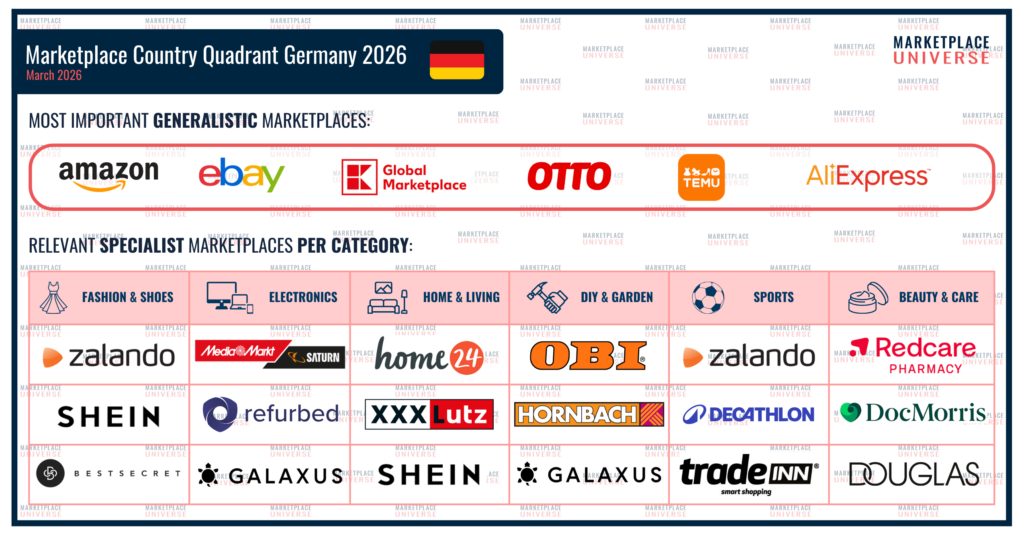
These are the 23 most important marketplaces for selling to Germany!
Last update: 16.03.2026
Germany remains the largest e-commerce market in Europe. With a population of roughly 84 million people and one of the continent’s strongest consumer economies, the country continues to be a central battleground for global marketplace competition.
According to the latest ECDB data, German e-commerce revenue reached €110.2 billion in 2025, growing +6.9% year-over-year. After two years of stagnation following the pandemic boom, the market has returned to moderate growth.
Online retail still represents a relatively modest share of total retail spending. According to the HDE Online Monitor, the online share of retail reached around 13.6% in 2025. Marketplaces dominate this digital economy: 57% of all online sales are generated through marketplace models, a share that has continued to grow over the past years.
This structural dominance is clearly reflected in consumer behaviour. Platforms such as Amazon, eBay or Zalando are no longer just sales channels — they have become the starting point for product discovery.
The Marketplace Country Quadrant Germany therefore focuses on the platforms that matter most for brands and sellers navigating this complex ecosystem.
What’s changed in the 2026 update?
Compared to last year’s version, the Marketplace Country Quadrant Germany has undergone several notable adjustments.
The most visible change is the growing relevance of international platforms.
AliExpress now appears among the generalist marketplaces. While the platform has been active in Germany for years, it has recently gained traction across a wider range of categories and has established itself as a recognizable cross-border shopping destination.
Shein has also expanded its footprint. Still primarily known for fast fashion, the platform is increasingly moving into adjacent categories — particularly Home & Living, where it is already attracting significant consumer demand.
In Electronics, Refurbed replaces Back Market in this year’s quadrant. Both companies are competing for leadership in Europe’s rapidly growing refurbished electronics market, but in Germany Refurbed currently holds a slight edge in visibility and marketplace activity.
The DIY & Garden category also sees a shift. Galaxus.de enters the quadrant here, reflecting the platform’s steady growth in technical DIY products and tools. At the same time, ManoMano has lost considerable relevance in Germany and has therefore been removed from the list.
Finally, TradeInn joins the Sports category. The Spanish marketplace group has gained a growing German customer base through its extensive assortment of specialized sports equipment and competitive cross-border pricing.
Taken together, these changes highlight an important development: while the largest marketplaces remain firmly established, the second tier of platforms is becoming much more dynamic.
🛒 The Generalists
Germany’s marketplace ecosystem continues to be dominated by a handful of large generalist platforms that span almost every product category.
Amazon remains the undisputed market leader and the default destination for many online purchases. Even though its penetration among German online shoppers has recently declined somewhat, the platform still dominates both traffic and transaction volume.
eBay continues to play an important role as a secondary marketplace. The platform remains particularly relevant in categories such as electronics, refurbished goods and home improvement products.
Otto operates one of Europe’s most sophisticated curated marketplace models. The Hamburg-based retailer combines a strong brand heritage with a carefully controlled seller ecosystem and remains the most important domestic alternative to Amazon.
Kaufland Global Marketplace has steadily expanded its presence in Germany and across Europe. The platform’s international expansion strategy has made it increasingly relevant for cross-border sellers looking to scale their marketplace business.
Meanwhile, international challengers are gaining visibility. Temu has rapidly built consumer awareness in Germany through aggressive pricing and marketing, even though its growth trajectory has been slower than in markets such as Spain or France.AliExpress has also strengthened its position and now appears across multiple product categories — particularly electronics accessories, gadgets and low-cost consumer goods.
🧩 The Specialists by Category
👗 Fashion
Zalando continues to dominate the fashion marketplace landscape with its strong brand relationships, logistics network and growing partner ecosystem. Shein has become a major force in fast fashion, particularly among younger consumers. While its market penetration in Germany is somewhat lower than in Southern Europe, the platform continues to expand its product range and audience. Best Secret remains one of Germany’s most important premium off-price platforms, offering discounted luxury and designer brands to a loyal customer base.
💻 Electronics
MediaMarktSaturn remains the category leader. The Ceconomy group has significantly expanded its marketplace strategy and continues to strengthen its omnichannel ecosystem. Refurbed represents the fast-growing recommerce segment. Together with competitors like Back Market, it benefits from the rising consumer acceptance of refurbished electronics — a trend that is particularly strong in Germany. Galaxus.de, originally launched by the Swiss retailer Digitec Galaxus, is slowly gaining ground in the German electronics market. Despite operating with a comparatively small local team, the platform’s strong product content and advisory approach are beginning to translate into measurable growth.
🛋️ Home & Living
Home24 continues to be one of Germany’s most established online furniture platforms and has expanded its marketplace model in recent years. XXXLutz, the Austrian furniture giant, has significantly increased its digital presence and continues to strengthen its marketplace offering. Shein has also entered this category with a rapidly growing assortment of home accessories, decoration items and lifestyle products.
🧰 DIY & Garden
Germany’s DIY sector is still developing its marketplace maturity. Obi continues to expand its digital ecosystem and marketplace capabilities. Hornbach remains a major player in the professional DIY segment with a strong assortment and loyal customer base. Galaxus.de has gained relevance here as well, particularly in tools, smart home technology and technical DIY equipment.
🏃 Sports
Zalando plays a major role in sports fashion and lifestyle segments. Decathlon remains highly relevant for sports equipment and outdoor products, even though its marketplace activity varies across European markets. TradeInn has become increasingly visible in Germany through its portfolio of specialized sports marketplaces and its strong cross-border logistics model.
💄 Beauty & Care
Redcare Pharmacy (formerly Shop Apotheke) is the leading digital pharmacy marketplace and one of Europe’s most important online health retailers. DocMorris continues to compete closely with Redcare in pharmacy and wellness products. Douglas remains the most important beauty marketplace for premium brands and fragrances.
🔍 A mature market — but far more dynamic than it seems
Germany’s marketplace landscape is often perceived as slow-moving — and in some ways, that perception is justified. Amazon remains firmly in the lead. Platforms like Otto, Zalando, MediaMarktSaturn and Redcare Pharmacy are deeply entrenched in their respective categories.
But beneath this stable surface, the market is evolving faster than many observers realize.
Chinese platforms such as Temu, Shein and AliExpress continue to expand their reach. Even if their growth in Germany is more gradual than in Southern Europe, they are steadily gaining consumer attention and category relevance. At the same time, newer European challengers are building momentum. Galaxus.de is slowly establishing itself in electronics and DIY, while the recommerce segment — driven by platforms such as Refurbed — is growing rapidly as consumers become more comfortable buying refurbished products.
In short: Amazon still dominates the German marketplace economy. But below that dominant first layer, competition is intensifying — and the next generation of marketplace winners is beginning to take shape.
📣 Want to add your voice?
This is the latest version of our Marketplace Country Quadrant Germany, and like all of our quadrants, it’s informed not just by data — but by community input. Have we missed something? Are you seeing different trends? Let us know! We’re always happy to hear from marketplace professionals, sellers, and partners in the field.
Looking for the most important marketplaces in another country or a specific category? Check out all our Marketplace Quadrants here!