
IN A NUTSHELL
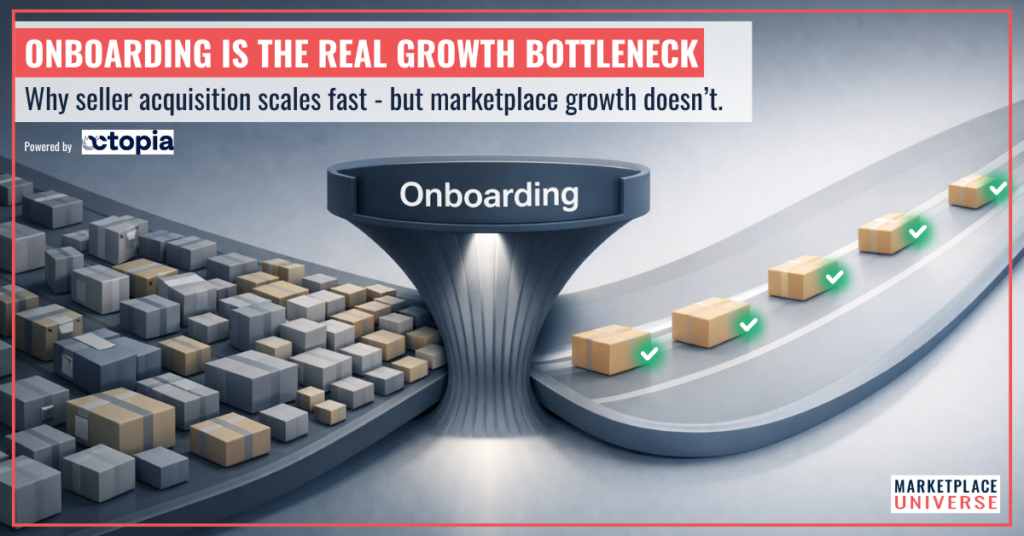
Fast seller marketplace onboarding has become a central growth lever. For sellers, a short time-to-go-live determines whether capital turns into revenue quickly or remains tied up; for marketplaces, it determines how fast GMV can be built with limited operational effort. While many marketplaces invest heavily in seller acquisition and then lose weeks in onboarding, solutions like Octopia show that a go-live within 3–5 days is possible. The key lies in which process steps are automated – and where human governance remains essential.
⏱ Time to Read: appr. 5 min
Why onboarding has become a bottleneck
Lengthy onboarding is costly for marketplaces and frustrating for sellers, as no GMV is generated during this phase. For brands expanding internationally, long time-to-go-live represents a real barrier to growth. The biggest time sinks rarely lie in the technical integration of a feed, but rather in upstream processes that are often manual and fragmented. This is where a marketplace’s ability to scale is ultimately decided. Against this backdrop, providers like Octopia focus precisely on these structural onboarding bottlenecks.
Octopia, a full-service provider originating from the ecosystem of the French marketplace Cdiscount, promises onboarding within 3–5 days. For example, Rakuten went live with 150 sellers within a month using this method. We took a closer look at how Octopia aims to deliver on this promise.
The biggest time sinks in seller onboarding
According to Octopia’s experience, two manual processes drive around 80% of the onboarding effort:
- KYC & compliance (identity, company, and tax verification)
- Taxonomy mapping & catalogue structure
These steps are particularly critical for sellers, as they often have to repeat them multiple times – sometimes with slightly different requirements – when connecting to several marketplaces in parallel.
Octopia eliminates much of this manual work:
- Automated KYC: Sellers upload their documents centrally. The platform automates identity and company checks and handles only exceptions manually. Because sellers are verified once when joining the Octopia seller community, the KYC effort for each additional marketplace is significantly reduced.
- Central seller catalogue & taxonomy: Octopia operates a central seller catalogue where all sellers are aligned to the same taxonomy. Sellers submit their catalogue, the system proposes taxonomy and localisation, and Customer Success Managers (CSMs) validate complex cases. Marketplaces need to map their taxonomy only once. Sellers benefit from reusing a cleanly structured catalogue across multiple markets, reducing error rates and accelerating international rollouts.
Why automation alone is not enough: the role of the CSM
Automation enables sellers to go live quickly, but sustainable success emerges only in combination with active support. This is why Octopia assign each seller a Customer Success Manager (CSM). During onboarding, the CSM acts as a central point of contact, ensuring compliance and catalogue quality while helping sellers navigate different marketplace logics. After go-live, the CSM supports performance monitoring and commercial initiatives. CSMs actively negotiate deals that generate around 25% of Octopia’s GMV.
Speed without sacrificing quality
Fast onboarding only leads to growth if offer quality remains high. Octopia therefore relies on strong selection and continuous monitoring and accepts only around 2,000 sellers out of more than 100,000 applications per year. After launch, CSMs and account managers monitor catalogue quality, pricing logic, and service levels on a daily basis. The results show a churn rate of under 1% among top sellers and an NPS that is 15% higher than other sales channels.
What fast onboarding enables strategically
From a marketplace perspective, speed is a direct growth lever – shortening time-to-GMV and enabling scalable international expansion. For sellers, internationalisation becomes more predictable: they can test new markets quickly and reduce market entry risk. Around 80% of GMV on Octopia comes from sellers operating outside their home market, enabled by seamless multi-marketplace connectivity.
Onboarding does not end at go-live
The first weeks after launch determine success. At Octopia, onboarding deliberately continues beyond go-live, including performance tracking and support in optimising pricing and assortment, to ensure that a new marketplace actually generates revenue.
Conclusion & key learnings
Fast onboarding determines whether marketplaces can scale – and whether sellers remain active in the long term.
Key learnings:
- Onboarding is a growth lever, not an operational detail
- KYC and taxonomy consume the most time and must be automated
- Speed requires quality filters (selection and control)
- Automation scales, Customer Success Managers secure success
- Onboarding does not end at go-live