
In a nutshell
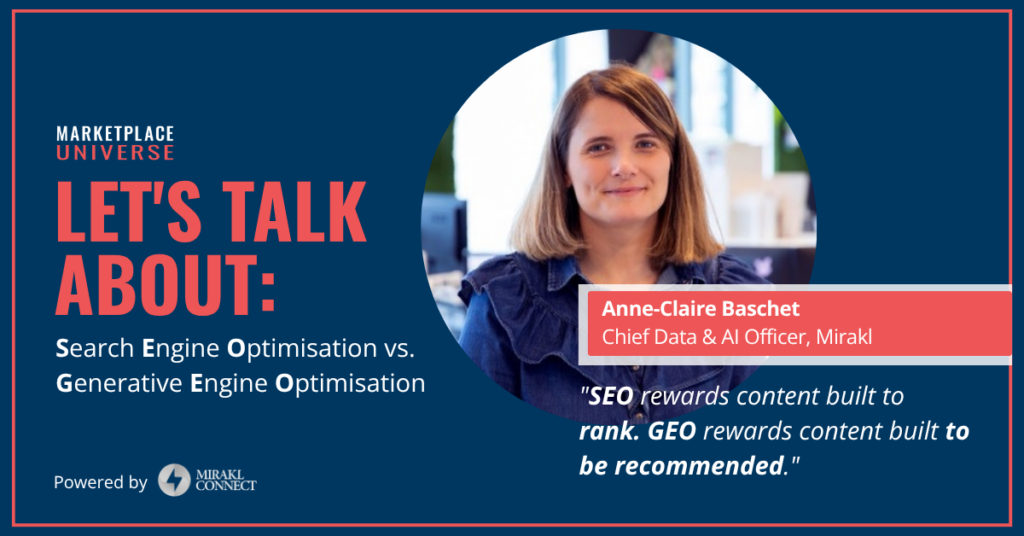
“The most important question is not SEO or GEO. It’s how good your product data is.” Anne-Claire Baschet — Chief Data & AI Officer at Mirakl and one of the clearest voices on Agentic Commerce in the industry — cuts through the budget debate on visibility. In this interview, she explains why “SEO vs. GEO” is the wrong questions – and why teams asking it will underperform in both channels. She also discusses what the right investment sequence looks like, and why marketplace operators already have a structural GEO advantage most haven’t noticed yet.
⏱ Time to Read: appr. 8 min
Let’s talk about: SEO vs. GEO – and why this narrative isn’t accurate
GEO has moved from conference agenda to budget line item in roughly 18 months. E-commerce teams across Europe are now confronting a question that barely existed two years ago: should we reallocate SEO spend toward visibility inside AI-generated search answers? The question is legitimate — generative tools like ChatGPT, Perplexity and Google’s AI Mode are reshaping where purchase decisions begin, shifting the upper funnel from search results to synthesised answers. In that answer, either your product shows up, or your competitor’s does.
But according to Anne-Claire Baschet, Chief Data & AI Officer at Mirakl — one of the leading providers of marketplace infrastructure in Europe, responsible for embedding AI structurally into the company’s products and processes — the teams who treat this as a budget allocation question are solving the wrong problem. We asked her to make the case for the right one.
SEo vs. GEO: Two layers of the same problem
Anne-Claire, in many e-commerce teams, the same discussion is happening right now: SEO is yesterday, GEO is the future – so let’s shift the focus, rebuild the strategy. Is that the right conclusion?
Anne-Claire Baschet: No — and I’d push back on the framing itself. “SEO is yesterday, GEO is tomorrow” treats the two as rivals fighting over the same budget. They’re not. They’re two layers of the same discovery problem.
Look at where revenue actually comes from today. Transactional and branded queries — the shopper who knows what they want — still resolve overwhelmingly in traditional search. That’s the click that converts. What’s migrating into AI tools is the upper funnel: the “what’s the best…”, “how do I choose…” questions. That shift is real and accelerating, but it’s additive to your discovery strategy, not a replacement for it. The teams that cut SEO to fund GEO will soften the organic revenue they already have before their AI visibility has had time to compound.
Can you break down the most important differences between ranking in Google vs. ranking in an AI search for us?
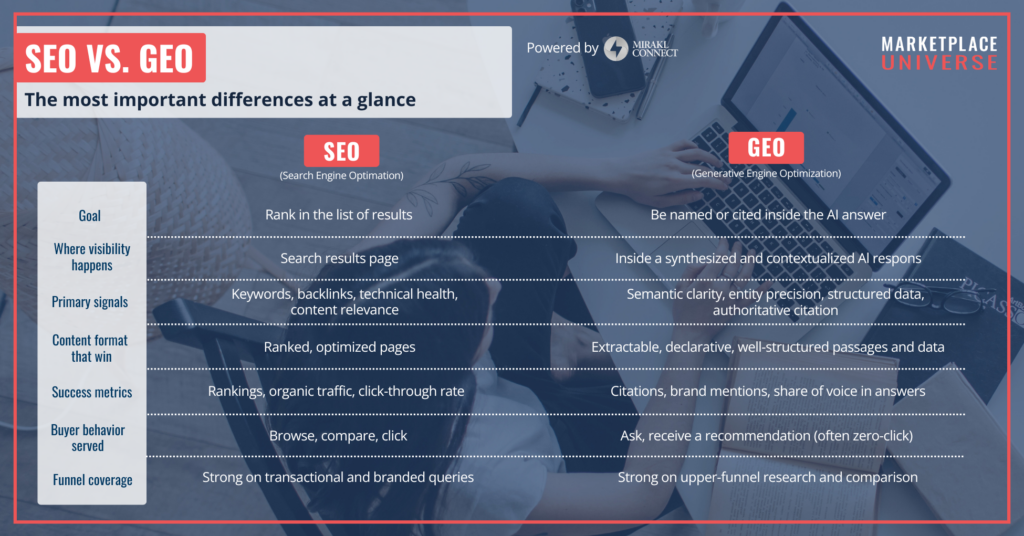
Anne-Claire: The fundamental difference: SEO rewards content built to rank. GEO rewards content built to be recommended.
Google’s playbook leaned on keyword targeting, backlinks, domain authority. Generative engines evaluate something else entirely. When researchers analyze what these systems actually cite, they find a consistent pattern: passages with specific statistics and verifiable facts, claims backed by named sources, content structured so a model can lift it cleanly. There’s also a behavioral shift behind this. According to Forrester, the average ChatGPT prompt runs 23 words. Shoppers aren’t typing fragments anymore; they’re arriving with fully formed questions.
So practically, for a retailer: less skyscraper content, more semantic precision. Does your product data actually tell a machine what the product is, what it does and who it’s for? If an AI agent can’t understand your products, it can’t recommend them. That’s the new baseline.
How to stay visible for AI engines
Where is the single biggest lever for a retailer who wants to be visible in both traditional search and AI engines?
Anne-Claire: Without question: the product catalog. Structured product data — names, brands, GTINs, materials, dimensions, use cases, availability, price — is what earns rich results in traditional search. It’s also exactly what gives a generative engine the confidence to discover, compare and recommend a product. The same JSON-LD schema that powers a rich result on Google gives an LLM the entity clarity it needs to cite you in an answer.
What most catalogs are missing is the contextual layer: “good for small kitchens,” “designed for sensitive skin,” “compatible with iPhone 15 Pro.” Those experiential attributes are what AI engines need most — and they improve your on-site search, filtering and merchandising at the same time.
That leaves a lot of space for interpretation and different approaches… How do you actually measure success in GEO?
Anne-Claire: Let me be honest first: GEO measurement is less mature than SEO measurement, and AI platforms don’t share prompt-level query data. Anyone who tells you they have this fully solved is overselling.
That said, there are practical proxies you can implement today. First, AI-referral traffic in your analytics — it’s small in absolute volume, but watch the quality. Adobe found AI-referred traffic converted 42% better than non-AI traffic in March 2026, a full reversal from a year earlier. The volume is nascent; the quality is not. Second, citation frequency and share of voice: take your top 20 commercial queries, run them through the major AI engines regularly, and track whether you’re named, cited or recommended — and against whom. Third, watch how your branded search volume moves as your AI visibility grows; a mention in an AI answer often resolves as a branded search later.
The important part is to start tracking now, so you have a baseline when the dashboards catch up.
GEo optimsation: Start here
Sounds like a lot of work… For teams with limited resources: Where do you start?
Anne-Claire: Start with the layer that pays into both: your data foundation. Before you split resources between an SEO content sprint and a GEO citation strategy, fix what they share — standardize attributes, fill the gaps, enrich descriptions with contextual data, implement clean product schema.
From there, the balance depends on three variables. Catalog size and complexity: the larger or messier your catalog, the more data quality is your binding constraint — stay there longer before channel-specific work. Your audience: B2C discovery in research-heavy categories like electronics, beauty and home is migrating into AI assistants fastest. And where your customers search today: if your revenue is dominated by branded, transactional queries, SEO still owns that click — protect it.
The one rule I’d give every resource-constrained team: GEO investment should be additive, not subtracted from SEO.
Most of the research and data on this topic comes from the US market. How do you assess the situation for European retailers?
Anne-Claire: The direction is identical; the timing and the terrain are different. European consumer adoption of AI-driven shopping typically trails the US by some quarters — which is not a reason to relax. It’s a window. The foundational work takes time, and once a model has learned its preferred sources in a market, displacing them is hard. European retailers have a rare chance to build before the behavior fully arrives.
Then there’s the terrain, and here I’d argue Europe’s complexity is actually an argument for this work, not against it. A European retailer operates across languages, regulations and local market structures that a US retailer never thinks about. Marketing copy doesn’t travel across those borders — it has to be rewritten for every market. Structured product data does travel. An attribute model — dimensions, materials, compatibility, certifications — is language-independent by design. For a retailer operating in five or ten markets, machine-readable product data isn’t just a GEO investment; it’s the most scalable asset in the business.
The marketplace Advantage
On marketplaces, control over product data rarely sits entirely with the operator – seller data varies enormously in quality and depth. What does that mean for a GEO strategy built on marketplace infrastructure?
Anne-Claire: It means the marketplace operator’s most important GEO decision isn’t a marketing decision at all. It’s a data governance decision.
You’re right that on a marketplace, the catalog is written by thousands of hands. And that variability across seller listings is exactly the kind of inconsistency that hurts AI discoverability — a model that finds three different attribute structures for the same category doesn’t know what to trust. So a standardized attribute model across sellers is a GEO investment, whether the operator calls it that or not. The operators who treat seller data quality as a platform requirement — with consistent taxonomies, enrichment standards and incentives for completeness — are doing GEO at the infrastructure level. That’s where it actually scales.
The good news: this is also where AI helps solve the problem it created. Most sellers onboard with incomplete content; that’s reality. LLM-native enrichment can now transform that raw input into structured, consistent, agent-ready data — filling missing attributes, normalizing categories, extracting details from images — at a scale no manual process could match.
And here’s what marketplace decision-makers should hold onto: the structural fundamentals favor you. AI engines reward breadth of assortment and low out-of-stock rates — they favor the retailer who can complete the basket, not just sell one product. Marketplaces were built for exactly that. Fix the data consistency, and the model works in your favor. Leave it inconsistent, and your greatest asset — assortment — becomes invisible.
Marketplace Universe Insight
For marketplace operators, GEO strategy is not a marketing decision — it is a data governance decision. Assortment breadth and low out-of-stock rates are exactly what AI discovery engines reward. But without consistent product attributes across sellers, that structural advantage remains invisible. The operators who treat seller data quality as a platform requirement are already building GEO infrastructure at scale — most of them just don’t call it that yet.
How Mirakl Connect Uses AI for the Product Catalog
The product catalog as the decisive lever — for Mirakl, that is not just a strategic thesis but a concrete product topic. With the Catalog Transformer inside Mirakl Connect, the company applies AI directly to what Anne-Claire identifies as the most critical foundation: catalog quality and completeness. It handles automatic product categorisation, attribute transformation into marketplace-specific formats, extraction of structured data from free text, and — more recently — attribute derivation directly from product images.
The numbers from our joint webinar speak for themselves: over 47 million products processed to date, 37% more complete product attributes after transformation, miscategorisation down by more than 50%, and marketplace onboarding time reduced by 91%. Watch the full recording of “The AI-powered Marketplace Strategy: How to Scale on more Channels from One Platform” here.
Key Learnings
- GEO and SEO are not rivals. They share the same foundation: structured product data. Teams that frame this as a budget reallocation decision are answering the wrong question before they have asked the right one.
- The product catalog is the single most important lever for visibility in both traditional and AI search. Structured attributes, clean taxonomy, and contextual descriptors pay into both channels simultaneously — the investment is not channel-specific.
- GEO measurement is less mature than SEO — but practical proxies are available today: AI-referral traffic quality, citation frequency across top commercial queries, and branded search volume as a downstream signal are all trackable now.
- The investment sequence matters. Fix the shared data foundation first. Channel-specific work — SEO content sprints, GEO citation strategies — comes after, not instead.
- AI-referred traffic already converts significantly better. According to Adobe, that difference was 42% in March 2026. The quality case for GEO is already there, even while absolute volume is still building.
- European retailers have a structural window. AI adoption in consumer shopping trails the US by several quarters. The time to build AI discoverability is now — before the behavior fully arrives and preferred sources in each market are established.
- For marketplace operators, seller data consistency is GEO infrastructure. Standardised attribute models and enrichment standards across sellers determine AI discoverability at scale — not marketing tactics.
Mirakl is a leading provider of marketplace and dropship technology, powering more than 450 operators — including Carrefour, Decathlon, El Corte Ingles, and MediaMarkt — to build scalable, AI-powered marketplace businesses. Mirakl Connect is the company’s commerce acceleration suite, helping brands and sellers activate assortments across multiple marketplace channels from one platform.