
In a nutshell
In a nutshell: The Shein IPO prospectus shows decelerating growth, a shrinking average order value, and a headline-grabbing net loss that several analysts dismiss as a bookkeeping artefact. The real story isn’t the tariffs Shein blames in its own filing – it’s that Temu started squeezing Shein’s margins a full year before any tariff changed. That’s why the exploding marketplace, not the warehouse, is where Shein’s fight will be won or lost – and Europe is where it starts.
⏱ Time to Read: appr. 8 min
The Loss Nobody Should Be Talking About
Three years, two failed listing attempts, and 463 pages later, Shein finally put real numbers on the table. On July 26, the fast-fashion group filed its draft Hong Kong IPO prospectus, targeting a $40-50 billion valuation – down from $98.2 billion at its 2022 peak.
The headline that traveled fastest: a $99 million net loss in Q1 2026, versus a $395 million profit a year earlier.
It’s also the headline that matters least. Several industry analysts who read the filing line by line independently arrived at the same read: the loss is a non-cash accounting effect from a fair-value adjustment on convertible preferred shares ahead of listing. Strip that line out, and the quarter was operationally profitable.
As China Commerce expert Ed Sander put it: “the net loss was caused by devaluation of shares, not bad business.”
What the Loss Is Hiding: A Shrinking Basket and a Growing Marketplace
The number that deserved the headline barely made most coverage: revenue growth collapsed from 41% (2023) to 21% (2024) to 8% (2025) – and to just 1.1% in Q1 2026.
Behind that deceleration sits a quieter shift. Active customers and total orders kept climbing every year; revenue didn’t keep pace. Divide net revenue by orders, and average order value has fallen for three straight years.
The Numbers Behind the Squeeze:
| 2023 | 2024 | 2025 | |
| Net Revenue | $32.1bn | $38.7bn | $41.8bn |
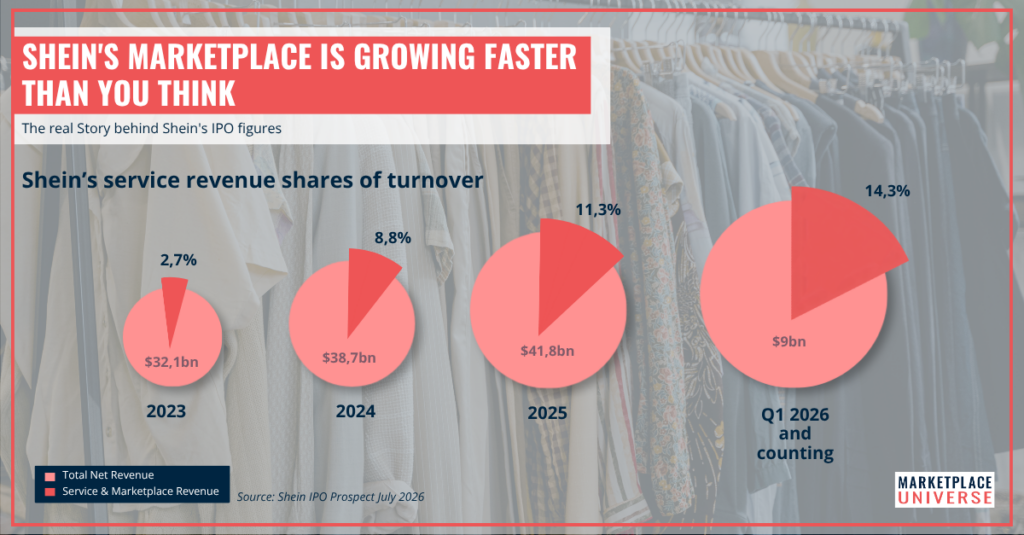
| Service Revenues | $0,87bn (2,7%) | $3,4bn (8,8%) | $4,7bn (11,3%) |
| Active Customers | 186m | 230m | 273m |
| Orders per Customer | 3.8 | 4.0 | 4.0 |
| Total Orders | 715m | 919m | 1,078m |
| Average Order Value | ~$45 | ~$42 | ~$39 |
Purchase frequency is stable. Customers aren’t leaving and aren’t buying less often– they’re spending less per order, three years running. Source: Shein’s Hong Kong IPO prospectus
This is the pattern Ed Sander flagged first: loyalty holds, but each visit brings home less value. Given Shein had to raise some US prices after the de minimis exemption disappeared, a rising AOV would have been the expected response. Instead it kept falling – the clearest sign yet that Shein is losing wallet share elsewhere, right as its own costs climb.
But behind this interesting number hides another one. Shein’s own filing explains that a marketplace order only shows up in revenue as a commission, not as the full price the customer paid – so as more orders shift to the marketplace model, average revenue per order mechanically falls even if customers are spending exactly the same. The AOV drop is real, but it’s a mix of shoppers trading down and Shein simply booking less of each marketplace sale as its own revenue. We’ll come back to that further down.
Shein Blames Tariffs. The Timeline Says Otherwise.
Shein’s own prospectus points to trade policy as the central threat: the end of the US de minimis exemption in May 2025, and the EU’s removal of its €150 duty-free threshold plus a new €3 handling fee. Most coverage has followed that framing.
But the timeline doesn’t cooperate. Operating margin was 4.3% in 2023, dropped sharply to 2.5% in 2024. That’s a full year before any tariff changed – then recovered to 4.1% in 2025, the year the US shock actually landed. If tariffs were the main wound, the dates run backwards.
The analysts of Momentum Works, who have read the full filing, points to a different 2024 event instead: Temu overtook Shein in estimated global GMV that year, competing for the same scarce inputs – consumer wallet share, ad inventory on Meta and Google, third-party air freight out of southern China, and warehouse capacity abroad. That’s a fight over resources, not a customs bill.
“That, not the tariff headlines, is the clock worth watching,” Momentum Works wrote of the pressure building since 2024.
German e-commerce analyst Alexander Graf’s read lands close to the same place, though with a different conclusion: he still sees the underlying model as sound. “Peak Shein is far from reached,” he argued in his own breakdown of the filing – pointing to Shein’s ability to – offset a shrinking US share elsewhere, and to the fast-growing, higher-margin marketplace business as the real story the deceleration obscures.
Europe Is Where the Next Round Gets Decided
Europe isn’t just catching up to the US shock – it’s already Shein’s bigger Western market, and has been since before the shock even started. In every single reported period, Europe’s revenue has outpaced the US: $10.2 billion versus $9.5 billion in 2023, widening to $14.8 billion versus $10.1 billion by 2025 – a lead of roughly 46%. Even in Q1 2026, Europe held a $2.9 billion to $2.0 billion advantage. That reframes the whole EU tariff story: this isn’t regulation catching up with a secondary market, it’s hitting the region that already generates more Shein revenue than the United States does.
The bloc removed its €150 duty-free threshold and introduced a €3 handling fee on July 1, 2026 – weeks before this prospectus was filed. Shein itself flags that the European impact could match or exceed what it saw in the US.
Unlike in the US, Shein’s European warehouse footprint has centered on a single major hub in Belgium – a thinner buffer than the multi-site US network. But Shein isn’t starting from zero: it has already opened a Polish logistics hub this year, built explicitly to support local marketplace sellers, and is recruiting third-party retailers across the continent – more than 600 in Germany alone, plus a partnership with the Madrid Chamber of Commerce to bring Spanish businesses onto the platform. The US playbook – localize, clear in bulk, absorb the shock through infrastructure rather than price alone – is being rolled out in Europe in parallel with the new fee, not after it.
Shein’s Marketplace Is the Real Growth Engine Now
Between the loss headline and the tariff story, the actual pivot in this prospectus goes almost unmentioned: service revenue – Shein’s cut from third-party marketplace sellers and its Xcelerator brand program – has grown from 2.7% of net revenue in 2023 to 14.3% by early 2026.
That means: Shein’s marketplace is also already bigger than most people assume. The filing discloses that marketplace commissions generally run 10% to 20% of transaction value. Even after setting aside a meaningful chunk of that $4.7 billion service-revenue line for fulfillment fees rather than pure commission, and applying Shein’s own disclosed rate to what’s left, a conservative estimate puts marketplace GMV somewhere between $20 billion and $30 billion for 2025 alone – equivalent to more than 60% of the size of Shein’s entire $37.1 billion product business. Shein doesn’t publish that GMV figure itself, which, in a filing that discloses almost everything else, is a choice worth noting.
👉 Marketplace Universe Insight: Shein doesn’t disclose marketplace margin directly, but the direction is clear: brand-enablement and service revenue reportedly runs at roughly double the group’s overall operating margin, since Shein collects a commission without carrying inventory risk. An Xcelerator partner brand, per the filing, can grow revenue 15-fold in its second year on the platform while lifting its own operating margin by more than 30 percentage points. Partner brands already on board include Everlane and Missguided; in Germany alone, Shein counts more than 600 local sales partners.
That’s the quiet logic behind the German seller drive and the Polish logistics hub: every local retailer Shein signs up adds revenue without adding a unit to its own cost-of-sales line.
Our Take: Shein’s Marketplace Is Already the Story
Reading this prospectus as a referendum on whether Shein is in trouble misses the more useful question. The growth numbers are weak – a business decelerating from +41% to roughly +1% in three years doesn’t get to wave that away, IPO bookkeeping effects or not. But the number that matters most isn’t in any headline: Shein’s marketplace, on our own conservative estimate, already moves $20–30 billion in GMV – more than 60% the size of its entire product business, and a figure Shein doesn’t publish itself. That’s not a side project anymore. That’s close to a second Shein, running quietly inside the first one.
This is also the real answer to the tariff question. The pressure isn’t customs officers – it’s Temu, and it started a year before anyone blamed a tariff. Shein can’t out-cheap Temu in the segment that made it famous, and its own numbers show it isn’t trying to: the fastest-growing, best-margin part of the business is the marketplace, and it’s already large enough to matter more than the core catalog’s next percentage point of growth. Expect Shein to push upmarket into mid-price territory less through its own product line and more by recruiting the local retailers who already own that positioning – in Germany, in Spain, and wherever else in Europe.
So what we see here is a marketplace that’s already bigger than most of the industry assumed, quietly built and about to get a lot more visible. The fight for European retail’s middle ground won’t be won with cheaper t-shirts. It’ll be won with sign-up forms for local sellers – and Shein is already ahead on collecting them.
Key Learnings
- The Shein IPO’s Q1 2026 net loss is a non-cash accounting artefact tied to preferred-share revaluation, not operational distress – but the growth deceleration to 1.1% is real.
- Average order value has fallen for three consecutive years (~$45 to ~$39) while purchase frequency stayed flat – shrinking wallet share, but partly a bookkeeping effect of the marketplace model too.
- The timing of the 2024 margin squeeze, before any tariff change, points to Temu as the more likely root cause than the trade policy Shein cites in its own filing.
- Europe’s version of the US shock is only weeks old; Shein is already building matching infrastructure and recruiting local sellers rather than waiting to react.
- Service and marketplace revenue, not the core fashion business, is Shein’s fastest-growing, highest-margin segment – up from 2.7% to 14.3% of net revenue in three years.
- Back-calculated from Shein’s own disclosed commission range, marketplace GMV is conservatively in the $20–30 billion range for 2025 – already more than 60% the size of Shein’s own product business, and a figure Shein itself doesn’t publish.
- The next competitive battle in European fast fashion is likely to be fought over local seller partnerships, not price.
Enjoyed this article? The Marketplace Universe Weekly is our free newsletter – every Monday, the latest marketplace news, platform updates, our newest posts, and the insights that matter, delivered straight to your inbox. So you never miss a thing. 👉 Subscribe here: https://marketplace-universe.com/newsletter/