
In a nutshell
AI agents that shop on behalf of consumers are moving from concept to infrastructure at speed. The early adoption numbers are real, the first protocol standards are live, and the rules of visibility are being rewritten at the data layer — not the marketing layer. This article maps where agentic commerce stands in mid-2026, how fast the market is growing and why, what the genuine limits still are, and what brands can do about it now.
⏱ Time to Read: appr. 12 min
What Agentic Commerce Actually Is (and Isn’t)
Agentic commerce describes a model in which AI agents act autonomously, or semi-autonomously, on behalf of consumers across the full commerce journey: product discovery, comparison, negotiation, checkout, and post-purchase management. The user sets a goal. The agent executes.
Imagine a shopper who needs new running shoes. They tell their AI assistant: best options under €150, next-day delivery to Germany, size 43. By the time they finish their coffee, the agent has compared inventory across platforms, verified stock and pricing, applied any loyalty discounts, and placed the order — without the shopper ever visiting a brand’s website or marketplace listing.
That scenario is no longer hypothetical. The question now is whether your brand is ready to be found by AI agents when it happens.
The Numbers: How Fast This Is Moving
The commercetools Agentic Commerce Radar, published in May 2026, and supporting data from multiple analyst sources tell a consistent story. Consumer adoption at the discovery layer is already mainstream. The transaction layer is beginning to follow.
Consumer adoption — where we are today:
According to Riskified consumer research, compiled in the commercetools radar:
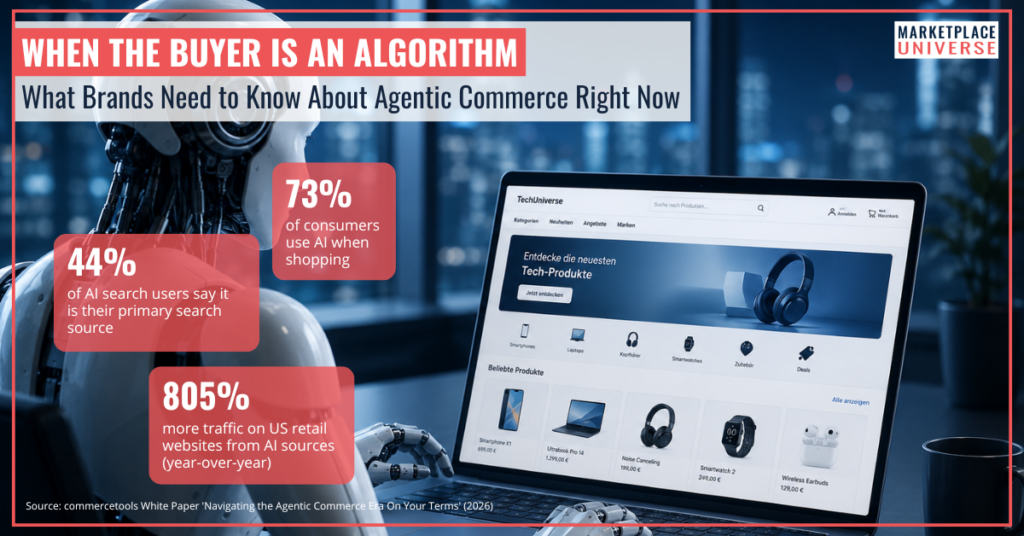
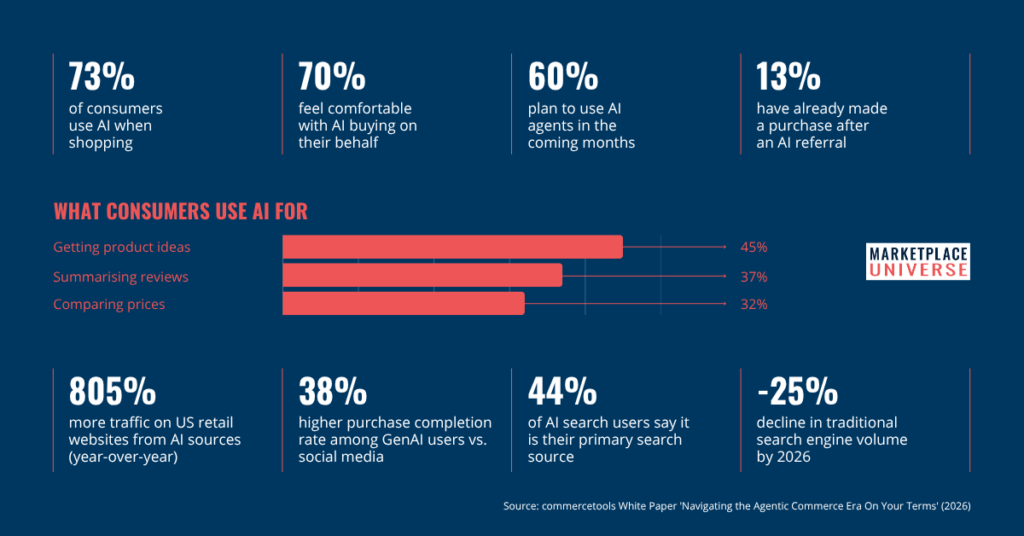
- 73% of consumers are already using AI in their shopping journey — for product ideas (45%), review summaries (37%), and price comparison (32%)
- 60% of shoppers expect to use AI agents for purchases within the next 12 months (Martech)
- 44% of users who have tried AI-powered search say it has become their primary and preferred source for internet searching (McKinsey)
- But only 13% have actually completed a purchase after being referred by an AI assistant — with 70% saying they are at least somewhat comfortable with an agent making purchases on their behalf (Riskified)
That last gap — between comfort and actual completion — is the defining dynamic of agentic commerce right now. The majority of consumers are using AI for research and discovery. Very few are completing purchases through agents yet. The infrastructure and habits needed for full transaction delegation are forming, but they are not there.
The downstream traffic and conversion impact:
According to Adobe Analytics data reported by Digital Commerce 360, AI-driven traffic to US retail sites surged 805% year-over-year on Black Friday 2025. More recent Adobe data from Q1 2026 shows that AI-referred shoppers now convert 42% better than non-AI traffic — a complete reversal from a year prior, when they converted 38% worse. Traditional search engine volume, meanwhile, is projected to decline 25% by 2026 as consumers shift to GenAI channels, according to Gartner.
Where the market is heading:
A Morgan Stanley forecast estimates that nearly 50% of online shoppers will use AI agents by 2030, accounting for approximately 25% of their spending and adding around $115 billion to the US e-commerce sector alone. For B2B, the trajectory is steeper still — Gartner projects that 90% of B2B buying will be AI agent-intermediated by 2028.
Why Consumers Are Adopting It — and What That Means for Brands
The adoption driver is not technology enthusiasm. It is genuine frustration with the existing shopping experience.
Comparison shopping across multiple platforms is tedious. Review synthesis is time-consuming. Inventory availability changes by the hour. Return policies differ by retailer. For high-frequency or research-heavy purchases, AI agents remove real friction — and consumers know it.
This matters for brands because it means the adoption curve will not reverse. The question is not whether agents will mediate more purchases, but how quickly.
👉 Marketplace Universe Insight: When a consumer delegates their purchase decision to an AI agent, brand marketing — the campaign, the imagery, the emotional narrative — has no surface to land on. The agent does not read copy. It reads data: price, availability, delivery time, return policy, product attributes, ratings. If that data is incomplete, inconsistent, or missing from the sources agents query, the brand simply does not exist in that transaction.
The shift from the traditional sales funnel to an agent-mediated purchase does not eliminate brand relevance entirely — but it relocates where that relevance is built. It moves earlier, to the data layer, and later, to the post-purchase experience. The moment of selection increasingly belongs to the algorithm.
The Hard Limits: What’s Not Working Yet
The numbers above are real. So is the hype around them. And the hype tends to obscure the genuine structural limits that still apply in mid-2026.
Full transaction delegation remains thin. According to Riskified consumer research, 70% of consumers say they are comfortable with an AI agent making purchases on their behalf — but only 13% have actually done it. OpenAI’s Instant Checkout feature, launched in September 2025, quietly ran into this wall: users were asking plenty of shopping questions inside ChatGPT but not completing purchases. By early 2026, OpenAI had walked back the native checkout model and pivoted to a discovery-first approach, routing transactions to merchant-controlled checkout environments instead. The lesson: even where the infrastructure exists, habits and trust take time to follow.
Data fragmentation undermines agent reliability. AI agents can only act on information they trust. Inconsistent product data — different titles, attributes, and pricing across channels — creates uncertainty. Research from Rithum, referenced in commercetools’ white paper “Navigating the Agentic Commerce Era On Your Terms,” found that 75% of retail leaders say AI is advancing faster than their organizations can adopt it, and 49% of brand workflows still rely heavily on manual processes. Agents built on fragmented data produce fragmented recommendations.
The post-purchase experience is fully brand-owned — and fully exposed. An agent can surface and order a product. It cannot process a return. That interaction remains owned by the brand or retailer. Brands investing in agentic entry points while neglecting post-purchase experience are building on unstable ground.
Regulatory clarity is still forming. The EU AI Act and related consumer protection frameworks are still being interpreted in their application to autonomous commercial transactions. Consent frameworks for agent-mediated purchases are not yet standardized. European brands need to monitor this actively.
Three Protocol Standards Brands Need to Know
Protocols are the infrastructure that determines whether AI agents can find, evaluate, and transact with your products. Three distinct standards are currently live or emerging — and they are not yet converging.
| Protocol | Led by | What it does | Status |
| MCP — Model Context Protocol | Anthropic | Defines how AI agents access external tools and data: product catalogs, inventory, customer information | Foundation layer, broadly adopted |
| ACP — Agentic Commerce Protocol | OpenAI + Stripe | Purpose-built for commerce: product discovery, cart management, secure checkout via standardized APIs | Live since September 2025; Shopify, Etsy, Walmart |
| UCP — Universal Commerce Protocol | Standardizes how product data and purchasing flows are exchanged across platforms and payment systems | Live since January 2026; Shopify, Wayfair, Target, Walmart |
These three are complementary, not competing. MCP provides the data access layer. ACP routes OpenAI/ChatGPT-adjacent transactions. UCP routes Google-adjacent transactions. In April 2026, Amazon, Meta, Microsoft, Salesforce, and Stripe all joined the UCP Tech Council — signaling that UCP is emerging as the open governance standard that major players are coalescing around.
👉 Marketplace Universe Insight: Brands that want to be present across the full agentic landscape need to be thinking about all three. The good news: the foundation is the same for all of them — clean, structured, real-time product data. A brand that solves its data infrastructure problem is not solving it three times over. It is solving it once and becoming protocol-ready by default.
The Amazon Angle: Control, Then Integrate
Amazon’s relationship to agentic commerce is its own story — and a revealing one.
Amazon’s first move was defensive. The company blocked ChatGPT and other AI crawlers in its robots.txt file, preventing OpenAI’s agents from surfacing Amazon product listings in real time. The stated rationale: protecting against misrepresentation of automated traffic as human. The commercial logic: Amazon’s $4 billion advertising business depends on controlling who can access its product data and on what terms.
What followed suggests a strategic recalibration rather than a clean reversal. In May 2026, a job listing for a Principal Technical Program Manager to lead a dedicated 40-person agentic commerce team surfaced publicly — specifically tasked with building controlled integrations between Amazon’s marketplace and third-party AI platforms including ChatGPT. Reported by PPC.land and TechBriefly, the listing signals that Amazon is now building its own integration layer — on its own timeline, under its own commercial conditions. In April 2026, Amazon also joined the UCP Tech Council alongside Meta, Microsoft, Salesforce, and Stripe, bringing itself inside the governance structure of the open standard it had initially stood apart from.
Amazon’s “Buy for Me” feature — announced in early 2026 — takes this further: it allows Rufus, Amazon’s AI shopping assistant, to complete purchases from other brands’ websites when Amazon does not carry the product itself. Amazon is positioning itself not just as a marketplace, but as a shopping agent layer that captures purchase intent regardless of where the transaction ultimately happens.
For European brands, the implication is direct: Amazon is not absent from the agentic future. It is engineering the terms on which it participates. Brands with Amazon presence need to monitor this closely — because the data and integration requirements for Rufus-visibility may differ substantially from those for ACP or UCP.
Answer Engine Optimization: The Concrete Action Available Today
The question practitioners eventually arrive at: what can we actually do right now?
The answer may lie in Answer Engine Optimization — AEO. Because AI agents function as search engines that synthesize and act rather than list and rank, content and product data need to be structured in a way that makes them directly accessible to those systems.
As Aditya Sinha from Sanbi AI puts it: “This is the defining challenge for brands in 2026: if your data isn’t machine-readable, you don’t exist in the agentic shopping funnel.”
AEO is distinct from traditional SEO in one critical way: SEO optimizes for human click-through from a ranked list. AEO optimizes for agent comprehension and direct action. An agent does not present options for selection — it synthesizes available information and either recommends or executes. A brand not represented in the structured data sources an agent queries is simply not included.
The AEO checklist for brands and retailers:
- Complete, consistent product attributes across all channels (name, category, material, dimensions, price, availability, delivery options, return policy)
- Schema.org markup implemented at minimum (Product, Offer, AggregateRating)
- Real-time inventory and pricing via API — agents deprioritize inaccurate data
- Consistent brand information across all platforms — inconsistency lowers recommendation probability
- Review and rating data present and current — agents weight user-generated signals heavily
- Conversational product attributes — data that answers intent-based queries, not just spec-sheet fields (“warm enough for Berlin in January” requires temperature ratings; “good for wide feet” requires width data)
👉 Marketplace Universe Insight: The brands best positioned for agentic commerce are often not the largest brands, but the most data-disciplined ones. A mid-sized European outdoor brand with complete, structured, intent-rich product data will outperform a global conglomerate with a fragmented catalog in agent-mediated recommendations. That is a genuine competitive opportunity — available right now.
Key Learnings
- The consumer shift is already happening at the discovery layer. 73% of consumers use AI in their shopping journey. Traffic from AI sources to retail sites grew 805% year-over-year. The infrastructure is being built in real time.
- The agent doesn’t read your campaign. It reads your data. When an AI agent is the buyer, brand relevance is determined by the completeness and accuracy of structured product data — not by creative or messaging.
- Three protocols are emerging simultaneously: MCP, ACP, and UCP. They are complementary. A solid data foundation makes a brand protocol-ready across all three without solving the problem three times over.
- OpenAI’s Instant Checkout struggled — and the pivot is instructive. Native AI checkout didn’t convert at scale. The current model routes to merchant-controlled checkout. Post-purchase experience remains fully brand-owned, and it matters more than ever.
- Amazon’s strategy is: control first, integrate on your own terms. It blocked AI crawlers, established its own agent rules, then joined the UCP council and started building integrations. Its “Buy for Me” feature positions Amazon as a shopping agent layer across the entire web — not just its own marketplace.
- AEO is the concrete action available today. Structured, complete, machine-readable, intent-rich product data is what makes a brand reachable by AI agents. This is an ongoing data discipline, not a one-time implementation.
- Data discipline, not brand size, determines agentic visibility. The brands that will capture disproportionate share in agent-mediated commerce are the most data-disciplined ones — regardless of marketing budget.
Enjoyed this article? The Marketplace Universe Weekly is our free newsletter — every Monday, the latest marketplace news, platform updates, our newest posts, and the insights that matter, delivered straight to your inbox. So you never miss a thing. 👉 Subscribe here: https://marketplace-universe.com/newsletter/
29.05.2026 – Written by Ricarda Eichler, Journalist and Author for OHN