
In a nutshell
Collectibles span everything from a €5 trading card to a €50,000 vintage watch, and the marketplaces that handle them have made very different bets on what a listing needs to come with. This piece maps the categories, the price ranges, the players, and — the part that actually matters for marketplace strategy — what collectibles specifically demand that other product categories don’t.
⏱ Time to Read: appr. 10 min
More Than Nostalgia: What Counts as a Collectible
“Collectibles” is a wide umbrella. Grand View Research puts the global market at $320.3 billion in 2025, growing to $335.7 billion in 2026 — though estimates vary considerably by research firm, with some putting the figure closer to $600 billion depending on category definitions. ECDB tracks a much narrower slice of this under “Collectibles, Model Kits and Drones” within its Hobby & Leisure category, putting global online sales at $18.4 billion in 2025 — a reminder that even the data sources don’t slice this category the same way; ECDB’s figure also folds in model kits and drones, which aren’t really collectibles at all.
Only 15–20% of that category is estimated to happen online, with the rest still moving offline through conventions, dealers, and in-person trading — one more sign that collectibles behave differently from the rest of retail. Europe accounts for over 37% of that global revenue, and Germany specifically is forecast to post some of the region’s highest growth rates.
What actually falls under the umbrella:
- Trading cards — sports cards, Pokémon, Magic: The Gathering, Yu-Gi-Oh!, and other trading card games (TCGs)
- Sneakers and streetwear
- Watches — vintage and modern luxury timepieces
- Handbags and luxury accessories
- Coins, banknotes, and medals
- Stamps (philately)
- Toys and figurines — LEGO, designer toys, Funko Pop, vintage action figures
- Vinyl records and other physical media
- Art and antiques — the single largest revenue category globally, at roughly a third of the total market
Two things distinguish this category from ordinary retail. First, condition is often self-reported and category-specific rather than standardised. A record graded “Very Good Plus” and a trading card graded “PSA 10” measure completely different things: PSA (Professional Sports Authenticator) is a third-party grading company that scores cards from 1 to 10 based on centring, corners, edges and surface, with 10 being the rarest, cleanest grade — and its certificate is what buyers are actually paying for, not just the card itself. Second, the same object can be worth wildly different amounts depending on rarity, provenance and market timing, which is exactly why authentication becomes a structural problem rather than a nice-to-have.
There’s also a reason this category behaves so differently from the rest of retail: very little of it is bought to be used. A vintage handbag might never leave its dust bag, a sealed booster box might never be opened, a first-pressing record might never touch a turntable. The value lives in scarcity, condition and story rather than function, which is precisely why buyers care so much about who’s vouching for authenticity — there’s no way to “just try it and see” the way you would with a jumper or a kettle. Much of this behaviour is adults reconnecting with childhood rather than acquiring something new — an industry trend often shorthanded as “kidults” — which is why Pokémon, LEGO, and vintage toys keep outperforming categories with no personal history attached to them.
From Pocket Change to Five Figures: The Price Spectrum
Real sales illustrate the range better than any table could:
- At the low end: cards from the so-called “junk wax era” of 1986–1994, when manufacturers like Topps and Fleer printed baseball cards by the hundreds of millions. Decades later, most of them sell for a few cents to a couple of euros each — proof that age alone doesn’t create value, only scarcity does.
- At the other end of the same category: Goldin, eBay’s auction arm, sold a signed 1986 Fleer Michael Jordan rookie card for $2.7 million in October 2025, the highest price ever paid for a trading card.
- Ordinary vinyl records follow the same pattern — the bulk of Discogs’ catalogue, which drives over $500 million in annual sales, consists of common pressings trading for a few euros, not rarities.
- Memorabilia can swing just as wide: Catawiki sold a 1962 Tintin album, signed by both Hergé and several Apollo astronauts, for €71,000 in September 2025, and currently has a Pokémon World Championship trophy card in auction estimated above €50,000.
- Watches sit almost entirely at the upper end: Chrono24’s own records include a Richard Mille RM 052 — a skull-shaped tourbillon — which sold for $800,000.
The spread matters strategically: a marketplace built around €5 stamp trades doesn’t need the same trust infrastructure as one selling €2,000 watches. That’s the thread the rest of this piece pulls on.
It’s also worth being explicit about why the top end of that range exists at all. A growing share of collectibles buyers aren’t purchasing to enjoy the object day to day — they’re treating it as an alternative asset, the same logic that applies to art or classic cars. A sealed trading card box or a rare vintage watch can gain value faster than more conventional investments in the right market window, and that reframes what a marketplace needs to provide: not just “does this work”, but “will this hold or gain value, and can I prove what I actually own.” That’s a fundamentally different promise than most e-commerce categories are built to make.
👉 Marketplace Universe Insight: Once an object is being bought as an investment rather than a purchase, the marketplace’s job quietly shifts from facilitating a sale to underwriting a claim about value. That’s a much bigger promise than “item as described” — and it’s why collectibles carry more trust infrastructure than almost any other retail category.
The Players: Who Actually Sells Collectibles Online
No single platform owns this category. It’s split across generalists, category specialists, and niche community platforms, each operating at a different scale.
➡️ eBay is the largest generalist touching collectibles in Europe. ECDB puts its 2025 GMV at €67.9 billion, with Hobby & Leisure — the category umbrella that includes collectibles — as its single largest segment at roughly 26% of sales. On eBay’s Q1 2026 earnings call, CEO Jamie Iannone named trading cards as the largest contributor to that quarter’s GMV growth, boosted by Pokémon’s 30th anniversary.
➡️ Catawiki, the Amsterdam-based curated auction platform, reported €771.5 million in GMV for 2025 per ECDB, growing 8.1% that year but decelerating to a forecast 5.4% in 2026. Its own reported revenue — the commission it actually keeps — was €105.4 million in 2024, a useful reminder that GMV and revenue are very different numbers for a marketplace.
➡️ Chrono24, the Karlsruhe-based watch specialist, lists over 600,000 watches from more than 3,000 professional dealers and 30,000 private sellers.
➡️ Vestiaire Collective, the Paris-based luxury fashion resale platform, generated $525 million in 2025 revenue per ECDB, and just extended its authenticated inventory into Zalando’s checkout across 14 European markets in May 2026 — a sign that authenticated resale is becoming a distribution feature for mainstream retailers, not just a marketplace niche.
➡️ Cardmarket, based in Berlin, is Europe’s largest trading card marketplace: a fixed-price catalogue (no auctions) with roughly 500,000 users and 100 million listed offers, charging a flat 5% seller commission.
A handful of specialist platforms round out the picture. Discogs handles vinyl records and physical media, with over $500 million in annual sales. BrickLink covers LEGO parts and sets, and has been owned by the LEGO Group itself since 2019. Delcampe specialises in stamps, coins, banknotes and postcards. StockX covers sneakers and is now expanding into a looser “Listings” format. And local classifieds platforms like Shpock and Kleinanzeigen carry plenty of collectibles too, just without any dedicated trust infrastructure behind them.
One newer model is worth a brief mention: Timeless, a Berlin startup, buys the physical collectible itself — a watch, a classic car, a rare bottle — and sells tokenised fractional shares in it. That sidesteps the peer-to-peer trust question entirely, since the object is authenticated once, centrally, before anyone else touches it.
Selling Live: Why Collectibles Took to Livestreaming First
Live shopping has found a more natural home in collectibles than almost anywhere else in e-commerce. A seller can show condition on camera, flip a card under different light, or answer a question in real time — the kind of reassurance a static photo just can’t give, especially for buyers who’ve been burned by a misleading listing before.
Whatnot built its entire business on this format and reached roughly $8 billion in 2025 sales doing it, mostly through live sports card breaks, Pokémon auctions, and sneaker drops. eBay has followed the same logic with eBay Live (see our deep dive on eBay Live), folding livestreamed selling directly into its core marketplace rather than building a separate platform. StockX is taking the same route with StockX Live, rolling out later in 2026 — a signal that livestreaming is becoming a standard distribution format for this category specifically, not just a Whatnot niche.
Trust Is the Product: What Collectibles Demand From a Marketplace
This is where collectibles differ from almost every other retail category: the word “authenticated” means something different depending on which marketplace uses it, and none of the definitions is a legal guarantee of genuineness.
The clearest way to see this is as a spectrum rather than a checklist:
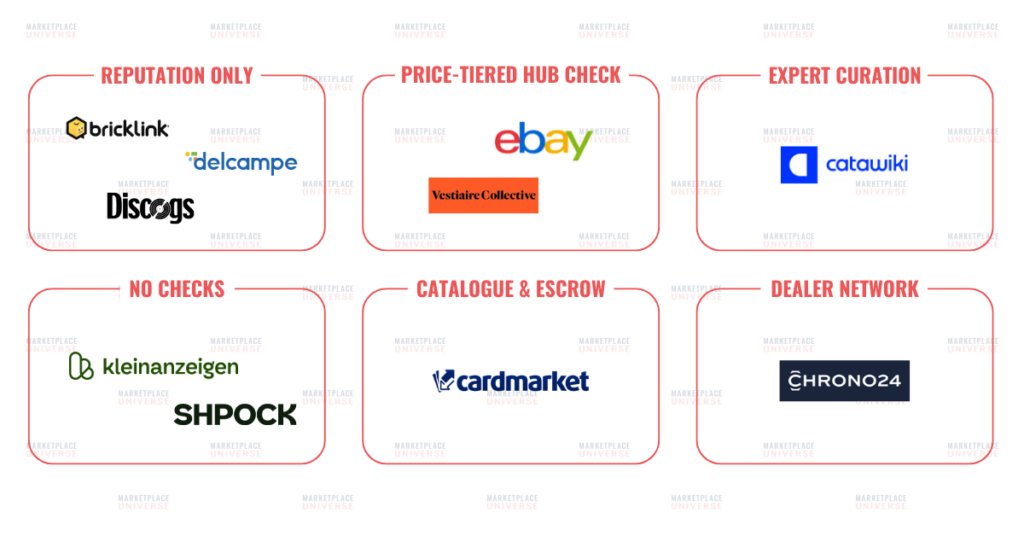
| Trust model | Platforms | What it actually means |
|---|---|---|
| No verification | Shpock, Kleinanzeigen | Buyer and seller sort it out themselves — fine for low-value items, risky above a few hundred euros |
| Reputation only | Discogs, BrickLink, Delcampe | Self-reported condition grading (e.g. Discogs’ Goldmine Standard) plus seller feedback scores — nothing is physically checked by the platform |
| Catalogue + escrow | Cardmarket | Fixed pricing and held payments reduce payment risk, but nobody checks whether the card itself is genuine |
| Price-tiered hub authentication | eBay, Vestiaire Collective | Mandatory physical inspection above a price threshold, optional paid inspection below it |
| Dealer-network certification | Chrono24 | Vetted, audited watchmakers authenticate before a watch is even listed |
| Expert curation | Catawiki | In-house experts review every submission before it goes live — authentication is the entire product, not a bolt-on |
It’s worth distinguishing between payment protection and authentication here: Kleinanzeigen’s “Sicher bezahlen” escrow guards against fraud and non-delivery, but nobody checks whether the item itself is genuine — a meaningfully different promise from Cardmarket’s escrow-plus-catalogue model, let alone eBay’s physical inspection.
Catawiki’s expert-curation promise is currently under the most scrutiny of any model on this list. A 2025 investigation by Dutch broadcaster EenVandaag reviewed 170 of Catawiki’s self-described experts and found 60 with questionable credentials; Dutch consumer group Consumentenbond argued the platform may fall short of its EU Digital Services Act obligations to act on misleading listings.
“At Catawiki, quality and reliability come first. We combine technology with hundreds of in-house experts who assess every item before it’s listed on the site.”
— Catawiki, in a written response to EenVandaag, as reported by ArtDependence
Catawiki’s own terms already state it cannot guarantee an item’s legitimacy — responsibility ultimately sits with the seller.
👉 Marketplace Universe Insight: Where a category sits on this spectrum isn’t arbitrary. Trading cards and vinyl lean on self-graded condition because forgery risk is comparatively low; watches and handbags get hub inspection or dealer certification because counterfeiting is lucrative and hard to catch without expertise.
This spectrum isn’t static, either. Two platforms are moving in opposite directions right now:
- StockX just loosened its own model, launching “Listings” for used sneakers and vintage apparel where verification is optional rather than default.
- Vestiaire Collective, in the same window, extended its hub-authentication model into Zalando’s mainstream checkout.
Worth watching — though it’s a separate story from the trust question itself.
Grading: The Authentication Layer That Lives Outside the Marketplace
Not all authentication happens on a marketplace at all. A whole industry of independent grading companies sits between collector and platform, and its certificates carry weight everywhere, not just on one site.
For trading cards, the names that matter are PSA (Professional Sports Authenticator, the market leader since 1991), BGS (Beckett Grading Services, known for detailed subgrades), CGC (Certified Guaranty Company, originally a comics grader, now dominant in Pokémon), and SGC, particularly strong for vintage cards and increasingly popular in Europe. Coins go to NGC or PCGS; comics go to CGC as well.
The process is the same everywhere: a collector sends the raw item in, an expert examines it against fixed criteria — for cards, that’s centring, corners, edges and surface — and assigns a numeric grade, typically on a 1-to-10 scale, with a perfect “Gem Mint 10” at the top. The item is then sealed in a tamper-evident case with the grade printed on the label. Turnaround runs from weeks to several months depending on how much is paid, and backlogs during hype cycles are common.
This is structurally different from marketplace-run authentication. Catawiki’s experts and Chrono24’s dealer network authenticate an item at the point of sale, for that one transaction. A PSA or CGC grade is portable — it travels with the card across eBay, Cardmarket, or Whatnot, and the certificate itself becomes part of what’s being priced. That’s also why eBay partners with PSA for its Authenticity Guarantee on trading cards rather than building its own grading operation: it’s borrowing an already-trusted credential instead of creating a new one.
A newer layer is starting to sit alongside human grading rather than replace it: eBay’s sneaker authentication issues a physical NFC tag on verified pairs, scannable by phone to confirm the item passed inspection — a small step toward blockchain-style, tamper-proof physical certificates that could eventually extend to other categories.
Key Learnings
- Collectibles span an unusually wide price range within a single category label — from a €0.05 overproduced trading card to an €800,000 watch — which is exactly why one-size-fits-all trust infrastructure doesn’t work.
- A significant share of high-value collectibles are bought as investments rather than for use, which changes what a marketplace is actually promising a buyer.
- Market-size estimates vary substantially by source and methodology — from roughly $18 billion (ECDB’s narrower category) to over $600 billion (the broadest industry definitions); treat any single headline figure as directional.
- “Authenticated” is not one standard. eBay, Catawiki, Chrono24, Cardmarket and Delcampe each define and enforce it differently — and the difference is structural, not marketing.
- Payment protection and item authentication are not the same thing: Kleinanzeigen’s buyer protection guards against fraud, not fakes.
- A large independent grading industry (PSA, CGC, BGS, SGC) sits outside any single marketplace, and its certificates often matter more to resale value than which platform the item is listed on.
- Catawiki’s curation-as-product model is currently facing real regulatory and journalistic scrutiny in the Netherlands, tied to EU Digital Services Act obligations.
- The spectrum is moving, not fixed: StockX is loosening its verification model in the same months Vestiaire Collective is extending its authentication into mainstream retail.
23.07.2026 – Written by Ricarda Eichler, Journalist and Author for OHN