
In a nutshell
The Nordic e-commerce market is on track to reach 52.6 billion euros by 2030 – affluent, highly digital, and more open to cross-border shopping than many realise. A recent PostNord study maps where cross-border shoppers prefer to buy, how Temu, Zalando and Amazon are positioned across Sweden, Denmark, Finland and Norway – and which shifts are already underway. The bottom line: Temu is gaining in three out of four countries, Amazon is losing ground everywhere, and brands approaching the Nordics with a one-size-fits-all strategy might struggle.
⏱ Time to Read: appr. 5 min
Why the Nordic market is underestimated
The Nordics tend to end up in the appendices of most expansion strategies – somewhere behind Germany, UK, France, Poland and other, bigger markets. That’s a mistake.
According to ECDB, annual e-commerce revenue across the region will reach 39.7 billion euros in 2026, growing to 52.6 billion euros by 2030. Internet penetration stands at 98.9 percent, with near-universal coverage expected by 2030. According to the PostNord study, 86 percent of Nordic consumers made an online purchase in the last 30 days, and more than seven in ten made a cross-border purchase in the past year. These are not emerging market numbers – this is a mature, high-spending market with highly digitalised consumers.
👉 Marketplace Universe Insight: The Nordics are not an add-on to a DACH strategy. They are a distinct, fragmented market – with different marketplace preferences in each country that sellers and brands need to understand and address separately.
The top 3 international marketplaces by country
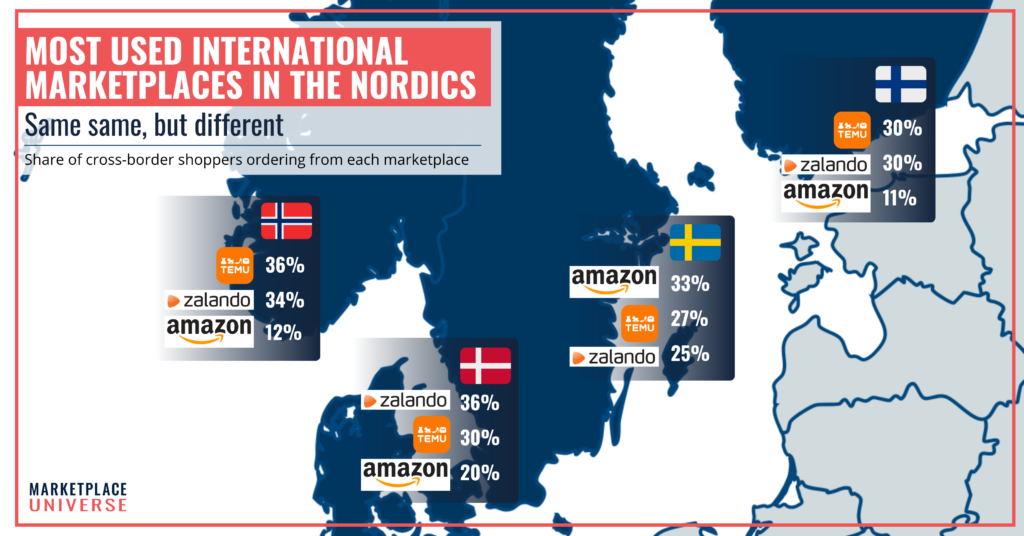
Three platforms define the Nordic cross-border marketplace space: Temu, Zalando and Amazon. Their relative weight differs significantly by country – and the shifts compared to 2025 are significant enough to warrant a strategic rethink.
| Country | 1st place | 2nd place | 3rd place |
| 🇸🇪 Sweden | Amazon 33% (34%) | Temu 27% (23%) | Zalando 25% (27%) |
| 🇩🇰 Denmark | Zalando 36% (35%) | Temu 30% (26%) | Amazon 20% (23%) |
| 🇫🇮 Finland | Temu 30% (25%) | Zalando 30% (29%) | Amazon 11% (16%) |
| 🇳🇴 Norway | Temu 36% (41%) | Zalando 34% (34%) | Amazon 12% (16%) |
Source: PostNord, “E-commerce in the Nordics 2026 Spring”. Figures in brackets: 2025 comparison values.
Sweden
Sweden is the most mature e-commerce market in the Nordics: 88 percent of consumers made an online purchase in the last 30 days, while cross-border affinity at 57 percent is the lowest in the region. Amazon holds the top spot but is losing ground slightly. The real winner of the year is Temu, which climbs from 23 to 27 percent and pushes Zalando off second place. Price beats brand loyalty – even in the affluent Swedish market.
Denmark
Denmark is the strongest cross-border market in the Nordics: 80 percent of consumers made a purchase from abroad in the past year. Zalando leads comfortably, driven by the top purchase category of fashion and footwear. For DACH brands, the most strategically relevant number is a different one: Germany has maintained its position as the most popular country of origin for cross-border purchases, jumping from 35 to 42 percent – well ahead of China at 31 percent. This means that brands already active in the German market can often serve Danish demand without starting from scratch.
Finland
Finland is showing the most significant structural shifts. Temu has overtaken Zalando in first place, driven by persistent price sensitivity in an economically sluggish market. Even more striking: Amazon loses five percentage points, falling from 16 to 11 percent. That is not statistical noise – it is a structural signal.
👉 Marketplace Universe Insight: Finland is the market where price-driven platforms are advancing most strongly. Not just Temu – second-hand platforms such as Vinted and the Finnish platform Tori are also gaining ground according to the study. This is reshaping the price landscape for every seller active in the market.
Norway
Norway is the only Nordic country showing a notable Temu decline in 2026: down five percentage points to 36 percent. At the same time, the cross-border geography is shifting – Sweden has replaced China as the most popular country of origin, and Denmark has entered the top three for the first time. The study attributes this to a growing preference for closer markets: faster delivery, easier returns, higher consumer trust. For brands already active in Sweden or Denmark, this represents an underestimated entry point into the Norwegian market.
What the shifts mean for brands and sellers
Temu is not a temporary phenomenon. In three out of four Nordic countries, Temu has gained ground or holds the top spot – even if Norway is showing an early countermovement. Brands that view the Nordics as a premium market and dismiss Temu as irrelevant are misreading the data.
Amazon is losing ground consistently across all four countries – most sharply in Finland and Norway. The scale of the declines varies, but the direction is the same everywhere. Brands that have built their Nordic strategy primarily around Amazon should take a hard look at where things are heading.
Zalando remains the structurally strongest fashion partner. It sits in the top two in all four countries and holds market leadership in Denmark. For fashion brands without a Nordic marketplace presence, Zalando remains the logical first step – and that remains true in 2026.
What has changed, however, is the need for a country-specific approach. Zalando-first works very differently in Denmark than it does in Finland. Amazon investments that make sense in Sweden follow a different return logic in Norway. A single Nordic strategy is not a strategy.
There is also a regulatory factor the study explicitly flags: the planned removal of the €150 customs duty exemption for goods shipped from third countries would structurally reduce the price advantage of Chinese platforms – and in doing so, reopen the competitive field for established sellers.
Key Learnings
- A single Nordic strategy is not a strategy. Country-specific marketplace prioritisation is non-negotiable.
- The Nordic e-commerce market is growing to 52.6 billion euros by 2030, with internet penetration at 98.9 percent. This is not a niche market.
- Temu is gaining in three out of four Nordic countries: in Finland it takes market leadership from Zalando, in Sweden it moves past Zalando into second place.
- Amazon is losing share in all four countries – most sharply in Finland with minus 5 percentage points and in Norway with minus 4 percentage points.
- Germany is the most popular cross-border country of origin in Denmark at 42 percent – ahead of China at 31 percent. A direct expansion signal for DACH brands.
- Finland shows the strongest price sensitivity in the Nordics and the most pronounced structural shifts in favour of price-driven platforms.
- Norway is the first Nordic country with a noticeable Temu decline – and a growing preference for Nordic neighbouring markets over China.
Would you like to learn more about the Nordic countries? Then check out this in-depth article: How to Successfully Sell to the Nordics
Enjoyed this article? The Marketplace Universe Weekly is our free newsletter — every Monday, the latest marketplace news, platform updates, our newest posts, and the insights that matter, delivered straight to your inbox. So you never miss a thing.
👉 Subscribe here: https://marketplace-universe.com/newsletter/