
Marketplaces in Italy 2026: A Market Still Waiting for Its Own Champions
Last updated: 07.09.2026
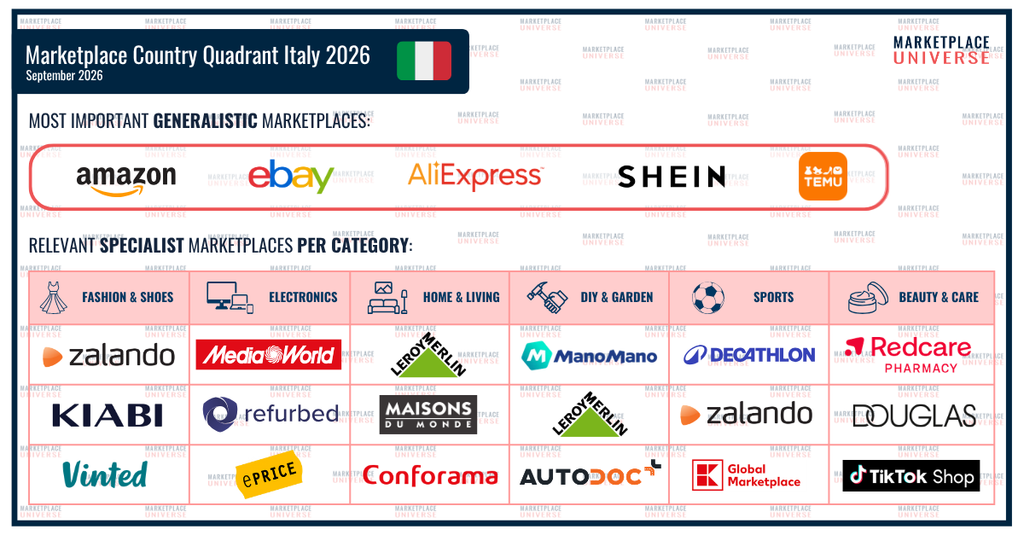
Italy remains Europe’s most Amazon-dependent major market — but 2026 brings the first real cracks in that dependency. Kaufland enters with a generalist marketplace built from scratch, TikTok Shop is quietly becoming a beauty powerhouse, and one of the country’s most recognisable retail names, YOOX, has quietly abandoned its marketplace ambitions altogether. Our updated Marketplace Country Quadrant Italy shows a landscape that is diversifying — just not from the inside.
⏱ Time to Read: appr. 6 min
Market Overview
Italy’s e-commerce revenue reached €38.5 billion in 2025, according to ECDB, and is forecast to climb to €41.3 billion in 2026 — a year-over-year growth rate of 6.8%. The online share of total retail continues its steady climb, from 12.2% in 2025 to a projected 12.8% in 2026, part of a longer trajectory that ECDB expects to reach 15.2% by 2030.
Cross-border behaviour remains a defining feature of the market too: of the 15.1% of Italian e-commerce revenue that went to purchases abroad in 2025, an overwhelming 92.5% flowed to Chinese platforms — a concentration far higher than in any other major European market.
No number captures Italy’s marketplace landscape better, however, than Amazon’s own. According to ECDB, Amazon generated €25.02 billion in GMV in Italy in 2025 — a 52% share of the entire Italian e-commerce market, and growing, with GMV up 12.8% year-over-year. That’s not just a European high for Amazon; it’s the highest share Amazon holds in any of Europe’s five largest markets, ahead of Germany (39%), the UK (37%), France (27%) and Spain (20%). More than one euro in every two spent online in Italy goes through Amazon. And Amazon’s dominance is part of a broader concentration trend: the top ten online retailers in Italy now account for 93% of total market share, up sharply from 73% just two years ago in 2023.
What’s Changed? Cracks in the Amazon Wall
Compared to last year, several structural shifts stand out:
New in Fashion: Vinted and Kiabi join Zalando. Farfetch stays in the text only — still active, but weakened under Coupang.layer Shein makes less than one tenth of Amazon’s turnover. So without Amazon, there is no Italian e-commerce, basta.
YOOX’s marketplace era is over. Third-party programme shut down 10 February 2025, after three years. YOOX continues as a 1P off-price retailer only.
Kaufland arrives — placed in Sports. Live since September 2025, ~3,000 sellers, still modest traction. Placed in Sports rather than Electronics or Home & Living, since that’s the thinnest category bench.
TikTok Shop found its category. Live since March 2025, 21,000+ active sellers, strongest in Beauty. Unlike the UK (full generalist), we place it as a Beauty & Care specialist for now.
Refurbed replaces Back Market. Stronger Italian footprint: €190M+ cumulative GMV, 500,000+ products sold.
Unieuro moved to watchlist. Marketplace still not launched as of mid-2026, despite being “imminent” in last year’s edition.
TradeInn is out. Turns out to be a 1P retailer bundling own vertical brands (Bikeinn, Runnerinn), not an open marketplace.
Redcare replaces PromoFarma. Redcare has real Italian infrastructure (Milan distribution centre, own entity); PromoFarma leans on a Portuguese pharmacy licence.
No more double-listings. ManoMano now only under DIY & Garden, MediaWorld only under Electronics. Conforama and Auto-doc fill the resulting gaps.
The 2026 Quadrant in Detail
Generalists
- Amazon — still the undisputed centre of gravity of Italian e-commerce, dominant across virtually every category.
- Shein — the clear number two among generalists, its Fashion origins now firmly behind it.
- eBay — steady presence, particularly strong in cross-category and re-commerce behaviour.
- AliExpress — the reference point for price-conscious cross-border buyers.
- Temu — rapid penetration growth since 2023, part of the broader Chinese-platform dominance visible in Italy’s cross-border spending data.
Specialists by Category
Fashion & Shoes: Zalando leads, with Vinted representing the country’s thriving C2C fashion resale market and Kiabi bringing family-fashion retail-marketplace relevance.
Electronics: MediaWorld has emerged as Italy’s leading retailer-marketplace in the category since its Mirakl-powered launch in July 2024, backed by a €100 million digital investment. ePrice remains the historic Italian name in the space. Refurbed leads the recommerce segment.
Home & Living: Leroy Merlin and Maisons du Monde continue to anchor the category, joined by Conforama under its post-2024 Bricofer ownership. A note of caution on Maisons du Monde: while its Italian marketplace activity is reportedly still growing, the French parent company is fighting to avoid insolvency, having posted a €406 million net loss in 2025 and awaiting shareholder approval on a rescue financing package by 15 September 2026. Worth watching closely into next year.
DIY & Garden: ManoMano and Leroy Merlin remain the category’s backbone, joined by Auto-doc as an interesting cross-over model bridging automotive parts and DIY.
Sports: Decathlon remains the clear category leader. Zalando covers much of the sports-fashion overlap. Kaufland enters as an early-stage challenger — one to watch rather than one that has already arrived.
Beauty & Care: Douglas continues to anchor the category with its Southern European marketplace operations. Redcare brings pharmacy and parapharmacy relevance backed by real Italian infrastructure. TikTok Shop rounds out the category as its fastest-growing platform.
Market Analysis: Marketplace Universe Opinion
Italy’s marketplace story in 2026 isn’t about local platforms rising to challenge Amazon. That still hasn’t happened. What’s changed is where the challenge is coming from — and it isn’t from Italy.
This year’s biggest new entrant, Kaufland, is a German retail group extending existing European infrastructure, not a local player scaling up. Meanwhile, Italy’s most visible homegrown marketplace, YOOX, shut its third-party programme down entirely. And unlike France, where grocery giants like Carrefour and E.Leclerc run open Mirakl marketplaces, Italy’s biggest food retailers — Conad, Coop, Esselunga, Selex — still don’t open their e-commerce to outside sellers at all.
The pattern: foreign supply keeps diversifying (Kaufland, TikTok Shop, Chinese platforms), while domestic marketplace infrastructure stays flat. For brands and sellers, the takeaway is unchanged — Amazon is still the mandatory starting point, and the real decision is which of the growing pool of foreign-owned specialists deserve the next investment.
Want to add your voice?
Did we miss an emerging player, or see something differently? Help us sharpen the Quadrant for 2027!
Do you have anything to add to our country quadrant for Italy? Let us know: info@marketplace-uni.com
Interested in a different country or a specific product category? Check out all our quadrants here: https://marketplace-universe.com/insights/quadrants/