Deep Dives

Case Study Marketplace Onboarding

Case Study: Fast Marketplace Onboarding

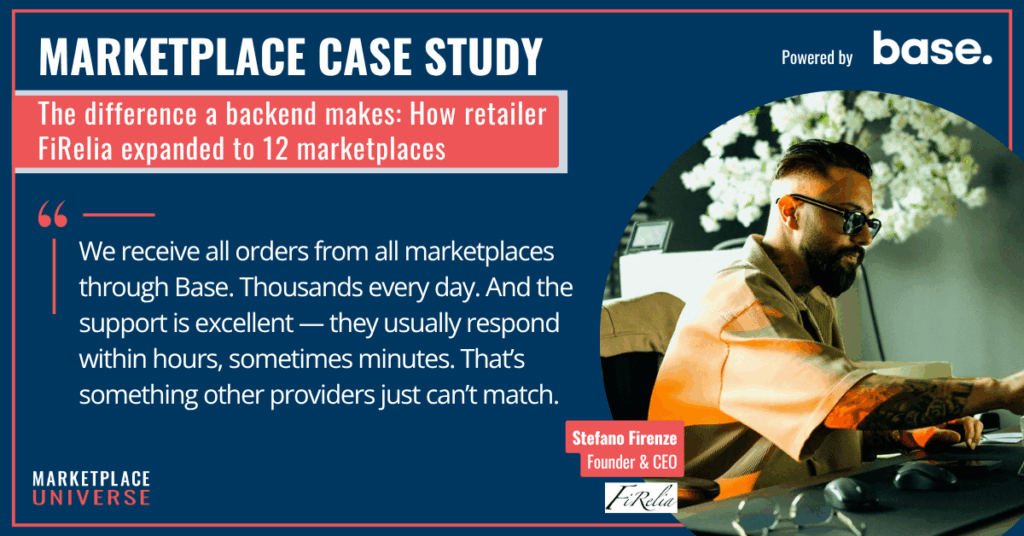
Case Study: How Retailer Firalia turned Marketplace Onboarding into a Breeze Powered by base When COVID-19 hit, Cologne-based online seller Stefano Firenze and his retail company FiRelia saw demand explode. Having started out in 2013 selling fashion on eBay and Amazon — first clothing, then shoes — his business took an unexpected turn when he pivoted to protective equipment during the pandemic. “We were one of the first to sell face masks on Amazon. At the peak, we had around 20,000 orders per day.” With only three people on his team, he had to scale quickly — ultimately growing to 20 employees. The team learned how to manage high volumes and rapid operations under pressure. But they also knew the boom wouldn’t last. “We saw that this was a temporary phase. That’s when we pivoted to electronics — phone accessories, electric toothbrushes, that kind of thing.” The Limits of His Old System Until 2024, Stefano had spent ten years using the same backend provider, but the setup made it difficult to expand to new marketplaces. “Every time we wanted to integrate a new platform, we had to build the APIs ourselves.” That’s when his team started looking for alternatives — and decided to switch to Base. What convinced them? A large number of pre-built integrations, good value for money, and a fast onboarding process. Base is a Poland-based e-commerce operations platform that connects online sellers with hundreds of marketplaces, shop systems, shipping providers and ERPs. Headquartered in Warsaw, the company supports more than 30,000 merchants worldwide and is especially known for its broad integration landscape, fast implementation, and highly responsive support — key factors for sellers looking to scale quickly without adding complexity. Scaling Up Without Growing the Team The switch to Base in November 2024 ran smoothly and quickly, Stefano recounts. Since then, he has added five new marketplaces — among them Allegro, MediaMarktSaturn  and others. He now sells across 12 platforms in total, including Amazon, eBay, Otto, Kaufland, and more. “Some marketplaces approached us. Others we researched ourselves.”Despite the growth, the team remained lean: today, Stefano runs a 15-person operation, with 10 employees in the warehouse and manages an assortment of 500 to 600 SKUs, mostly fast-moving items. Product testing is ongoing: old products are phased out, new ones added. The assortment is consistent across all marketplaces. Why Base Made the Difference “We receive all orders from all marketplaces through Base. Thousands every day. And the support is excellent — they usually respond within hours, sometimes minutes. That’s something other providers just can’t match.” The switch to Base has made it easier to manage complexity, test new markets, and keep operations centralized. Repricers are used on competitive platforms like Allegro, though Stefano notes the challenges: “It’s hard to win the Buy Box — competition is tough. But that’s how it is. Sometimes you win, sometimes you don’t.” Interestingly, Stefano rarely turns off a marketplace, even if performance is low. He prefers to keep the presence and monitor long-term. Because of his lean software setup, keeping up a channel takes little effort, after all.  For now the retailer is happy with his marketplace setup – and with the knowledge that whenever he wants to expand, he can now do so at the drop of a hat thanks to his software setup. “We’re keeping an eye on a few platforms for Q3 and Q4, maybe one or two more launches this year.” Key Takeaways from FiRalia’s Story

How to prepare to Cyber Week an MediaMarktSaturn Marketplace

Ready for the electronics hustle? How to successfully prepare for Cyber Week on MediaMarktSaturn Marketplace

Ready for the electronics hustle? How to successfully prepare for Cyber Week on MediaMarktSaturn Marketplace If you want to be well-positioned for Cyber Week, you need to start planning early. That may sound like a no-brainer – yet in the hustle of daily operations, time often slips away, and suddenly planning gets tight again. That’s why it’s smart to begin early: selecting assortments, choosing the right channels, preparing logistics, and more. Especially when it still seems like there’s plenty of time left.  But what does good Cyber Week preparation really look like? We asked Alexander Klinger, Department Manager Marketplace DACH at MediamarktSaturn – a marketplace which relies heavily on the significance of Cyber Week for their business.  Marketplace Universe: Alexander, how important is Black Week for MediaMarktSaturn and your marketplace sellers? And which categories perform especially well? Alexander: Black Week is by far the most important event of the year for MediaMarktSaturn and our marketplace sellers. In Germany and Austria, we nearly doubled our previous records during these seven highest-revenue days of 2024. Notebooks, gaming PCs, and robot vacuums performed exceptionally well, as did our new verticals. Some offers like Lenovo notebooks, e-scooters, or Roborocks truly went through the roof. What requirements must sellers meet in order to participate in your marketplaces during Cyber Week? Alexander: We inform our sellers about the criteria for each campaign at least two weeks in advance. For Cyber Week, we’ll send out these details 4 to 6 weeks ahead of time to allow enough preparation. Requirements include a minimum discount compared to the best price of the past 30 days, sufficient stock levels, and a maximum shipping time of two days. There are also specific category guidelines. Handpicked products for the homepage Which offer formats perform best during Cyber Week – such as daily deals, percentage discounts, or bundles? Alexander: Our main campaign on the homepage performs best and offers the most visible placement. Depending on how strong the deals are, we handpick products for this section – only the very best make it into the highlights. That ensures maximum value for both sellers and customers. In addition, we run themed campaigns that also perform very well. Beyond that, sellers can benefit from increased traffic on our site by being featured in recurring campaigns like our weekly tech highlights or weekend specials. What determines whether an offer gets especially prominent placement during Cyber Week? Alexander: Our account management teams work on the deals together with our sellers. Only sellers with a reliable customer experience qualify – meaning low refund rates, good on-time shipping, and strong seller ratings. Price is also crucial: we focus on the best possible deals compared to the product’s lowest price over the past year. Only top-tier deals are accepted. We also ensure a balanced deal portfolio to cover all categories with great offers. How much does product data quality – like titles and images – influence placement and conversion during campaigns? Alexander: Product data quality is very important to us, as high-quality content always has a positive impact on click and conversion rates. That’s why we have manual checks done by our content team, which provides sellers with feedback if there are issues. This often happens with images: our content guidelines clearly define what’s allowed on the main image and what isn’t. The same applies to technical specs like minimum image size. What role do advertising formats like Sponsored Ads, premium placements, or onsite banners play during Cyber Week – and how early should sellers book them to get maximum visibility? Book ads 4 to 6 weeks before Alexander: Advertising formats in our webshop are, of course, the easiest way to monetize the massive increase in traffic. They also bring great visibility for sellers and their brands. Available formats include Sponsored Product and Sponsored Brand Ads, A+ Content, and Space-as-a-Service and Instore Ads in our stores. For maximum visibility, sellers should book these 4 to 6 weeks before Cyber Week. Our self-service options allow them to manage their budgets independently. How do you evaluate seller performance during the event – in terms of conversion rates, cancellation rates, or customer reviews? And do high-performing sellers gain advantages in future campaigns? Alexander: During the event, we adjust the deals daily if certain products are over- or underperforming. We look at click-through rates, conversion rates, prices, and cancellations, which indicate overall customer appeal. That said, we treat all sellers equally: those who meet quality criteria have a better chance of getting their products featured. avoid typical mistakes What typical mistakes do you see sellers make in preparing – especially newcomers? And what three things should sellers tackle right now to get ready for Cyber Week? Alexander: A common mistake for major events like Cyber Week is that sellers’ fulfillment is not properly set up. Many are also unprepared to handle the spike in customer inquiries and returns. To be well-prepared, sellers should already be optimizing their content and ensuring sufficient stock for the peak season. At the same time, they should work on their quality KPIs, such as reducing incident or late shipment rates. That way, they improve their chances of being selected for Cyber Week placements. Want to know more? Write to mms.partner.de@mediamarktsaturn.com

Kaufland Guide: 7 Steps to Internationalization

How to sell international on Kaufland Global Marketplace

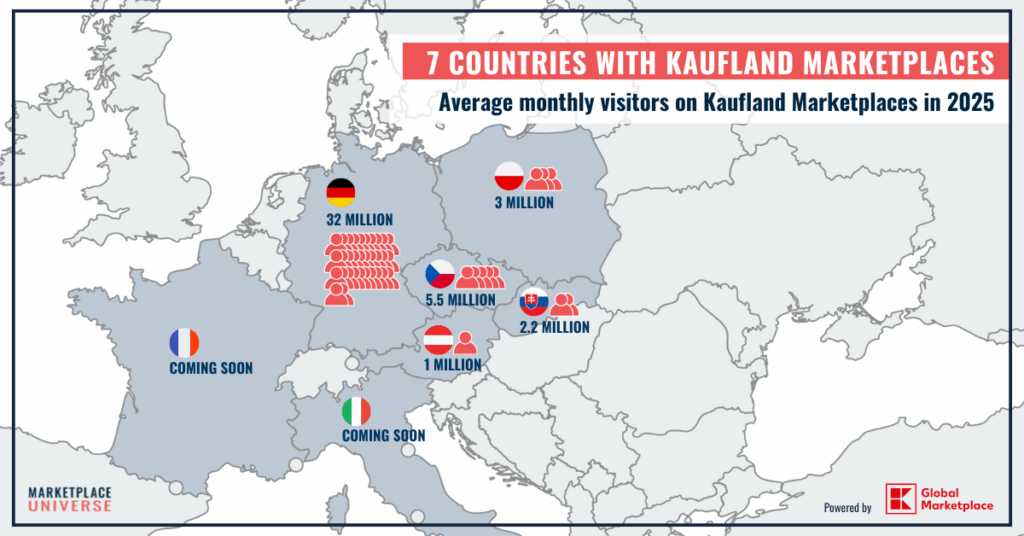
When we talk about international expansion, we often focus on market research, business models, channel strategies, and high-level decisions. So what does expansion really look like for brands and sellers in day-to-day practice? And how can going cross-border be made as simple and efficient as possible? Kaufland Global Marketplace is good example for a marketplace that really tries to help its sellers on their road to internationalization. Because this marketplace operator has achieved something that’s still rare in the European marketplace landscape: a unified, cross-country system. With just a few clicks, sellers can go live in up to seven European markets simultaneously – significantly reducing both technical and operational complexity. Here is their guide “How to sell international on Kaufland Global Marketplace”. Seven Markets, One System: Why Kaufland is Worth Considering Over the past few years, Kaufland Global Marketplace has focused on simplifying international expansion. Through a central platform, sellers can currently access marketplaces in seven countries: Germany, Czech Republic, Slovakia, Poland, Austria – and starting in late summer 2025, also France and Italy. In total, this means access to up to 139 million potential online shoppers. The Seller Portal is the command center: it allows sellers to manage and translate everything from product data and legal texts to shipping rules – all tailored to the relevant country. Even after-sales service can be handled centrally across markets. One Registration – Many Channels to sell international Sellers only need to register once to access all Kaufland marketplaces. At onboarding, they can choose to launch in one or multiple countries – and additional markets can be added at any time without re-registration. Requirements to get started: The Pricing Kaufland Global Marketplace treats its multi-market offering as a unified package – and this is reflected in the fee model. Sellers pay a flat monthly fee of €39.95 (Basic) or €59.95 (Plus), plus a category-based commission. The big advantage: adding additional countries incurs no extra cost. Listing products is also free and unlimited across all marketplaces. How the Operational Rollout Works Especially valuable for sellers with existing system landscapes: the rollout can be largely automated. Kaufland offers free tools for data transfer and translation, and over 130 integration partners ensure smooth connectivity with popular ERP and shop systems. The Seven Steps to Internationalization In its guide, Kaufland Global Marketplace clearly walks sellers through the onboarding steps with dashboard screenshots and explanations: Conclusion: Less Complexity, More Reach For many brands and sellers, internationalization is no longer optional – it’s essential for growth. And while marketplaces promise fast access to new markets, the reality often involves complex tech setups, fragmented structures, and inconsistent policies. Kaufland Global Marketplace takes a different approach: one platform, one logic, one interface – across seven markets. This drastically lowers the barrier to entry and enables scalable growth from day one. A compelling model – and one that other marketplaces would do well to learn from. 💡 The complete guide with all its practical tips that shows how to sell international on Kaufland Global Marketplace is available free of charge here:

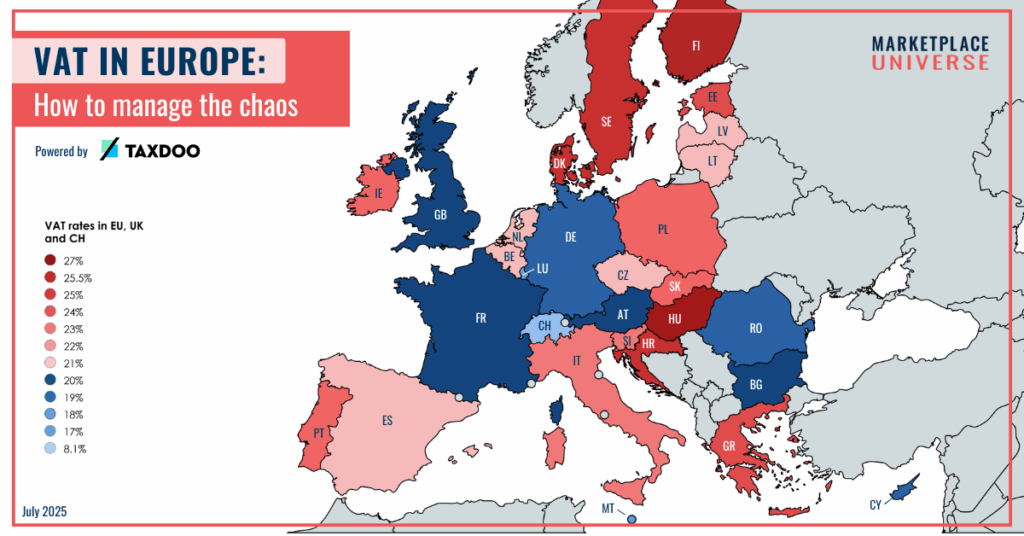
Landscape with VAT Rates in Europe powered by Taxdoo July 2025

VAT-Traps: 7 Critical Rules Every Marketplace Seller in Europe Needs to Know

Selling through online marketplaces offers enormous opportunities for brands and retailers – especially in cross-border commerce. But anyone wanting to sell internationally must deal intensively with one topic: VAT. And it’s a tricky one. Despite EU-wide rules, the reality remains complex. Different VAT rates, national exemptions, and ever-changing regulations make VAT one of the biggest stumbling blocks in European e-commerce. That’s why we’ve put together this guide: VAT-Traps: 7 Critical Rules Every Marketplace Seller in Europe Needs to Know. It highlights the key differences, common pitfalls, and action points – especially for marketplace sellers and brands with international ambitions.

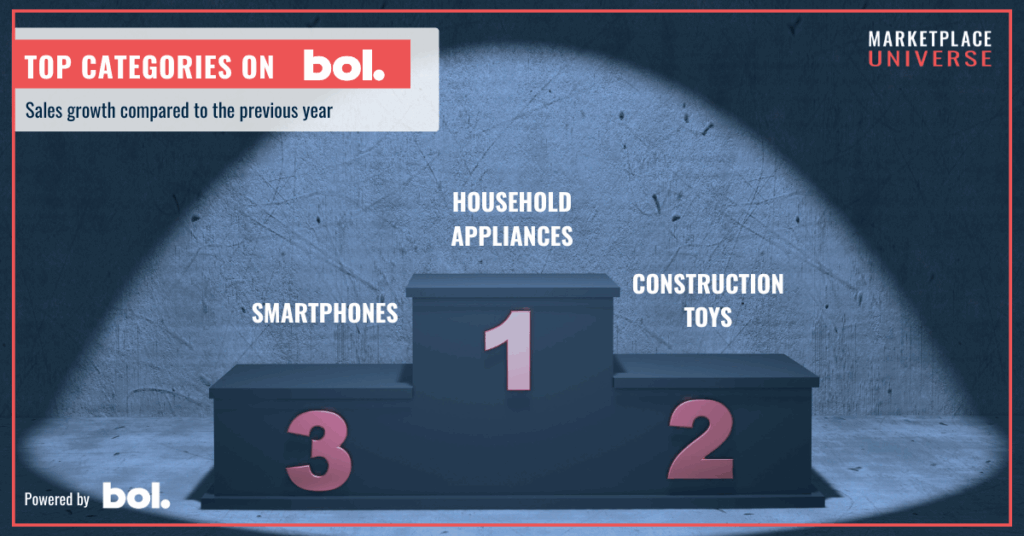
Top growth categories on bol

Categories and Assortments: What’s Working on bol

With an estimated GMV of around 5.6 billion USD and over 1.6 billion USD in revenue in 2025 alone, bol represents the dominant marketplace model in the region. But which product segments are performing well? Where do assortment gaps exist? And what should new sellers focus on? The following insights into Categories and Assortments: What’s Working on bol provide guidance.

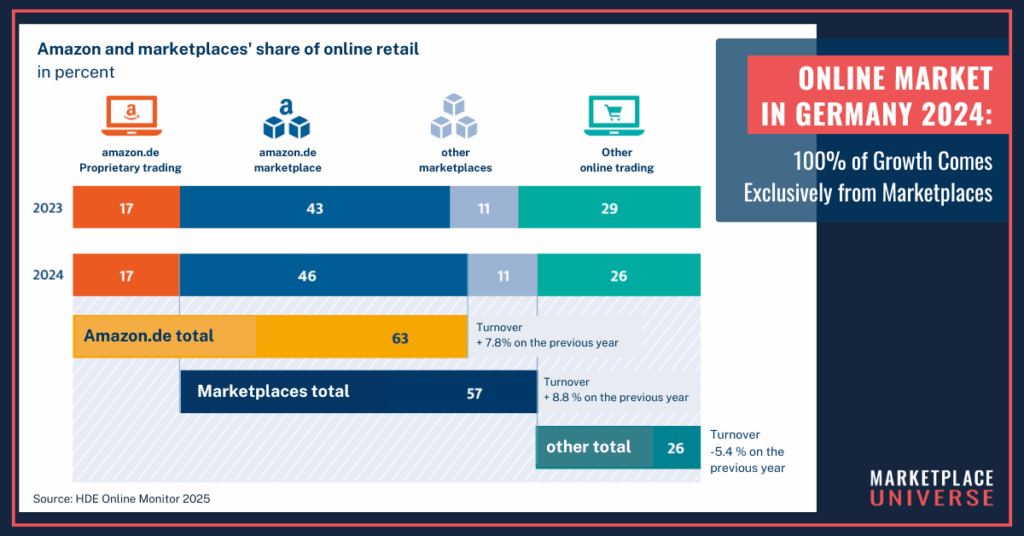
Marketplace market share in Germany HDE Online Monitor 2025

The German Online Market 2025

After two difficult years, the German online market grew again in 2025 for the first time, according to the HDE Online Monitor.

eBay car parts and Workshop Service

Best Practice: Car Parts and Workshop Service on eBay

eBay is a generalistic marketplace, active and relevant in every category – but it is a true giant for car parts: Currently, around 700 million vehicle parts are available on eBay globally. According to the company, eBay is the number one platform for automotive parts and accessories in both the UK and Germany. And eBay is continuing to push the marketplace model further: for the past nine months, eBay has been offering a combined parts-and-installation service in collaboration with repareo. With the “Best Practice: Car Parts and Workshop Service on eBay” We took a closer look at the concept – and encountered true platform spirit. Blueprint: Tire Service eBay is an essential player in the German car parts trade: one vehicle part is sold every second, and one tire every 19 seconds via the platform. These impressive figures were presented by Christian Wenzel, CEO of car parts seller and e-commerce service provider ecanis, at the Marketplace Convention in Cologne last October. Just one example: 10,000 liters of motor oil are sold daily through eBay. So, it was only logical for eBay to expand into adjacent services – not least to make the offering even more attractive. It all started back in 2017 with a tire installation service, which can be booked at the same time as purchasing tires on eBay. The service is available in Germany, the UK, and the USA. Tires were a logical starting point: installation is fairly standardized across vehicles, making the process easy to scale. Car Parts & Workshop Service on eBay Five years later, an internal eBay survey revealed high demand for expanded offerings: high repair costs, lack of trust in garages, and a growing desire for online appointment scheduling were cited by 79% of respondents as reasons to offer more comprehensive service options. eBay responded: in September 2024, the new workshop service launched in Germany. It includes: Partnership with repareo The service is powered by repareo, a booking platform with thousands of affiliated garages across Germany. Repareo handles the technical onboarding of new workshops and manages the appointment system. eBay, in turn, provides access to parts, manages the purchase process and payment. Customers pay a fixed price upfront, ensuring full cost transparency. Currently, 30 different services are available – from battery and oil changes to timing belt replacements. With this service, eBay is delivering on a true platform strategy by bringing together different user groups: parts sellers, workshops, and drivers. It’s a classic win-win-win: And eBay? The platform benefits from increased user and seller activity. Thanks to repareo, eBay’s own operational burden remains low – the partner handles everything from workshop integration to quality assurance. If a workshop fails to meet the required standards, it can be removed from the program. In return, eBay ensures seller quality: to participate, sellers must: Sales Boom on the Horizon? This model could become even more lucrative for sellers. If the EU proceeds with its plan to require annual vehicle inspections (instead of every two years) for older vehicles, demand for relevant parts and services could spike. According to Mark Steier of Wortfilter.de, this would affect nearly 22 million vehicles in Germany – almost half the current fleet. He sees eBay, as the leading platform for car parts, at the epicenter of this demand boom. His advice for sellers: The combination with eBay’s workshop service can further boost revenues. Conclusion At present, the combined car parts and workshop service is only available in Germany. Despite its success, eBay currently has no plans to expand it to other countries. Similarly, additional service models for other product categories are not on the roadmap – at least for now. Why? Because creating a true win-win-win scenario like this requires the right use case – and most importantly, the right cooperation partner as the best practice: car parts and workshop service on eBay together with repareo shows. There’s still plenty of room for innovation.

Selling to Switzerland: Unique Rules, Strong Potential

Selling to Switzerland: Unique Rules, Strong Potential

The Swiss e-commerce market offers highly attractive conditions for international sellers. But selling to Switzerland comes with specific rules – simply because Switzerland is not an EU member state and has three language regions. This results in special circumstances with regard to taxes, customs duties, and customer service.

Roger Grothmann Taxdoo Interview What Makes a Good Tax Advisor for Marketplace Sellers?

Interview: What Makes a Good Tax Advisor for Marketplace Sellers?

It almost sounds like the beginning of a bad joke: “Two clueless people meet…” – but in reality, this is often the unfortunate situation when tax advisors and auditors at the tax office are faced with the tax returns of marketplace sellers. Things can get especially dire when cross-border revenues are involved. We asked Roger Grothmann in an interview what makes a good tax advisor for marketplace sellers? Roger is the founder of Hamburg-based tax technology company Taxdoo.

Stop profit loss - 5 tips for better marketplace profitability

5 Tips for Better Marketplace Profitability

Profitability has been one of the most important topics for brands and retailers over the past 12 months – and it will continue to be a key focus. Selling on marketplaces, however, often makes it tricky to understand what actually remains at the end of the day. When brands operate across multiple platforms, they need reliable and comparable data to identify cost traps. Only then can they develop a strategy for improving profitability. Together with our partner ChannelEngine, we’ve put together 5 tips for better marketplace profitability.

Scroll to Top