
Amazon Accelerate 2024
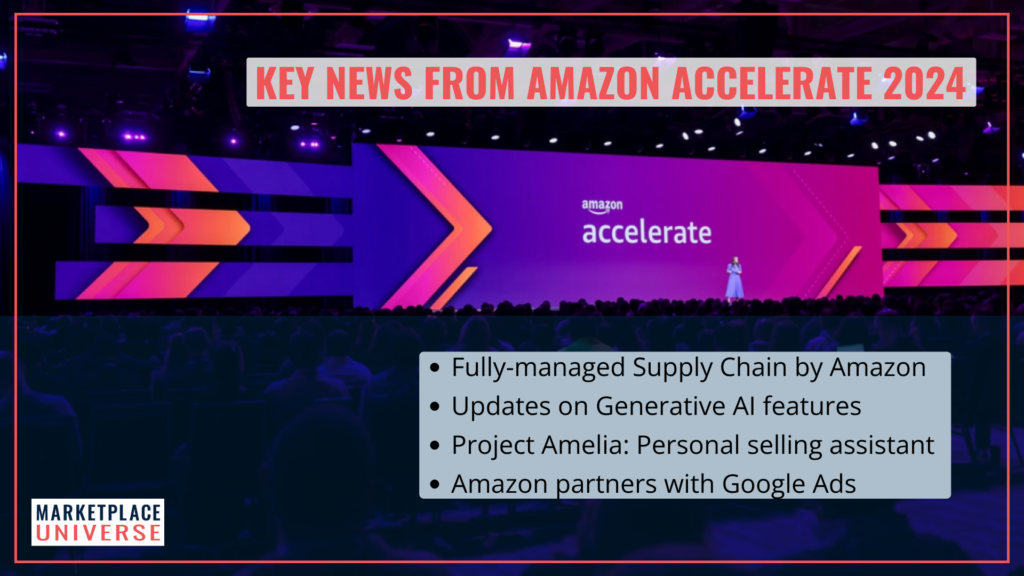
Major Innovations in AI, Social Commerce, and Supply Chain Every year, Amazon Accelerate sets the stage for the latest trends and innovations for the Amazon landscape, and 2024 was no exception. Held in Seattle, the event draws sellers and business leaders eager to learn how Amazon’s new tools can help them succeed in a rapidly changing retail environment. This year, the focus was on AI-powered solutions and new tools for social commerce and supply chain management, offering sellers a glimpse of how Amazon plans to shape the future of online selling. 1. Project Amelia: AI-Powered Seller Assistant One of the key announcements at Amazon Accelerate 2024 was Project Amelia, an AI-powered personal assistant for sellers. Currently in beta for US sellers, Project Amelia is designed to provide personalized insights, business metrics, and proactive solutions. By integrating data across Seller Central, it enables sellers to ask specific questions like “How is my business performing?” and receive real-time answers based on sales trends, inventory, and performance metrics. Project Amelia also offers the potential for proactive issue resolution, with future updates expected to allow the AI to identify problems and take corrective actions on behalf of sellers. Amazon has plans to expand this AI assistant to international markets later this year, marking a significant shift in how sellers will manage their businesses on the platform. 2. Generative AI for Product Listings and Content Creation Another major focus of the conference was Amazon’s expansion of Generative AI capabilities for product listings. Amazon’s AI tools have already been used by over 400,000 sellers globally to streamline the process of creating product listings. With these tools, sellers can input minimal information—such as a product description, URL, or image—and Amazon’s AI will generate comprehensive product titles, bullet points, and descriptions. At Accelerate 2024, Amazon announced that it will soon offer bulk AI-generated listings, enabling sellers to upload a spreadsheet with basic product details and have AI create multiple listings at once. This is designed to speed up the listing process and ensure product information is optimized for customer engagement. In addition to product listings, Amazon has expanded its A+ Content features, which allow brands to create rich, visual product detail pages. The introduction of AI-generated A+ Content will automate the creation of image carousels, comparison charts, and lifestyle imagery, helping sellers build more engaging product pages without extensive in-house resources. 3. Expanding Social Commerce with Buy with Prime Amazon continues to strengthen its Buy with Prime (BWP) program, with new partnerships aimed at integrating the service across major social platforms. BWP now allows sellers to display Prime badges—indicating fast and free shipping—on Google Ads and TikTok listings. Early tests show that adding the Prime badge to social commerce listings resulted in a 63% increase in click-through rates. Additionally, by 2025, PayPal will become a checkout option for Buy with Prime, allowing customers to link their Amazon and PayPal accounts for a more seamless checkout experience. 4. Personalizing Product Recommendations Amazon is also using Generative AI to improve product recommendations and descriptions. Based on customer browsing and purchase history, the platform can personalize product descriptions and recommendations, making them more relevant to individual customers. For example, if a customer frequently searches for gluten-free products, the AI may add the term “gluten-free” to relevant product descriptions, enhancing the shopping experience by presenting customers with more tailored options. This personalization is especially impactful on mobile devices, where screen space is limited, helping to match the right products with the right customers more effectively. 5. AI-Powered Video Ads As part of its broader AI strategy, Amazon introduced a new Video Generator tool that enables sellers to create AI-generated video ads using only a product image. This tool automatically creates videos showcasing a product’s features, providing sellers with a cost-effective way to engage customers through rich media content. The Video Generator tool leverages Amazon’s retail insights to produce customized, visually appealing ads in a matter of minutes. This new feature lowers the barrier for video content creation, making it easier for sellers to add video marketing to their advertising strategy. 6. Supply Chain Innovations and Faster Fulfillment Amazon also announced improvements to its supply chain and fulfillment services. Amazon Warehousing & Distribution (AWD) now accepts shoes and expirable goods, with plans to extend eligibility to heavy and bulky items by 2025. Additionally, Amazon reduced the delivery time for its Multi-Channel Fulfillment (MCF) service from 5 to 3 days, improving delivery speeds at no additional cost. These updates aim to streamline seller operations, reduce costs, and improve inventory management. AWD’s enhanced replenishment algorithms allow sellers to optimize stock levels and maintain higher in-stock rates, leading to more consistent customer satisfaction. 7. Enhanced Seller Support and Automation Amazon also introduced new features to improve seller support. Live Chat Support is now available to US sellers, providing dedicated assistance for resolving issues in real-time. This live chat support will be expanded to cover more complex issues in the future. Additionally, Amazon has rolled out a system for automated reimbursements for lost inventory at fulfillment centers. This new feature will automatically track and compensate sellers for missing inventory, reducing the need for manual claims. Conclusion Amazon Accelerate 2024 showcased several new innovations, particularly in Generative AI and social commerce, aimed at enhancing the seller experience and improving operational efficiency. While many of these tools are initially launching for US sellers, Amazon plans to expand them to international markets, including Europe, in the near future. The advancements in AI-driven product listings, personalized recommendations, and supply chain improvements reflect Amazon’s commitment to streamlining e-commerce for both sellers and customers.