
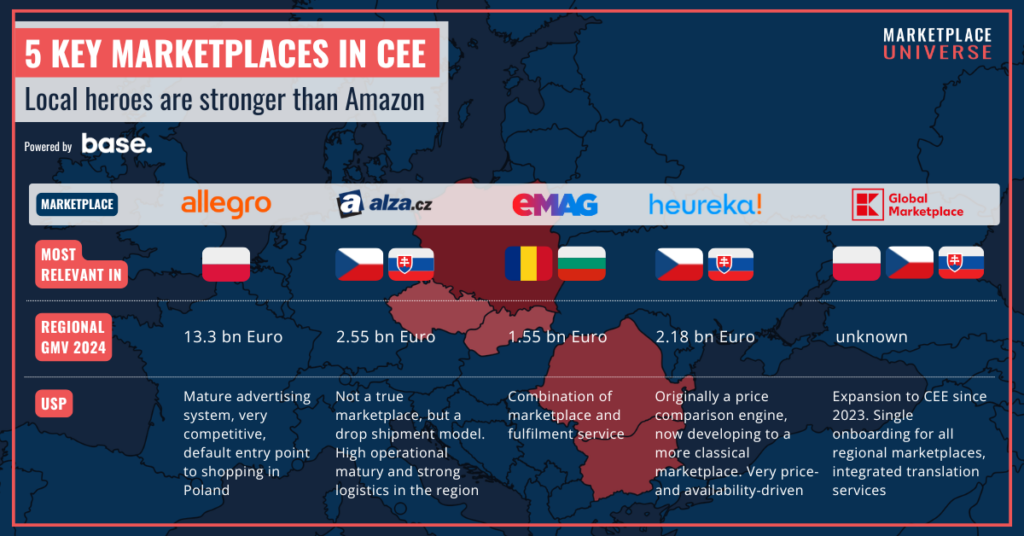
CEE Deep Dive: Top 5 Marketplaces Many Brands Overlook
CEE is not a low-cost extension of Western Europe but a marketplace-first region dominated by strong national ecosystem players such as Allegro, eMAG and Alza.
CEE is not a low-cost extension of Western Europe but a marketplace-first region dominated by strong national ecosystem players such as Allegro, eMAG and Alza.
As we close out 2025, it’s clear this wasn’t just another year of incremental growth – it was a year of structural re-architecture. The marketplace model has moved from being a “digital shelf” to an integrated, AI-driven, and internationally fluid ecosystem. For sellers, the “Bigger Picture” of 2025 is the transition from managing listings to managing complex, cross-border value chains.
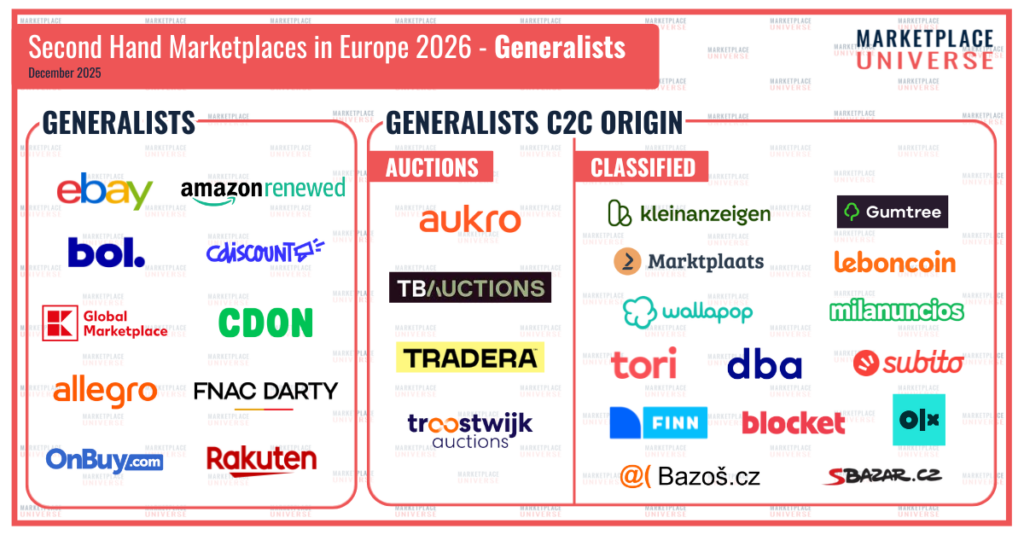
Our first Second Hand Quadrant is here – and it clearly shows how rapidly the European second-hand market is professionalizing. Generalist marketplaces are expanding their offerings, C2C platforms are opening up to sellers, and specialized players are strengthening their positions in niche segments. The result is a hybrid ecosystem that offers significant opportunities for merchants.
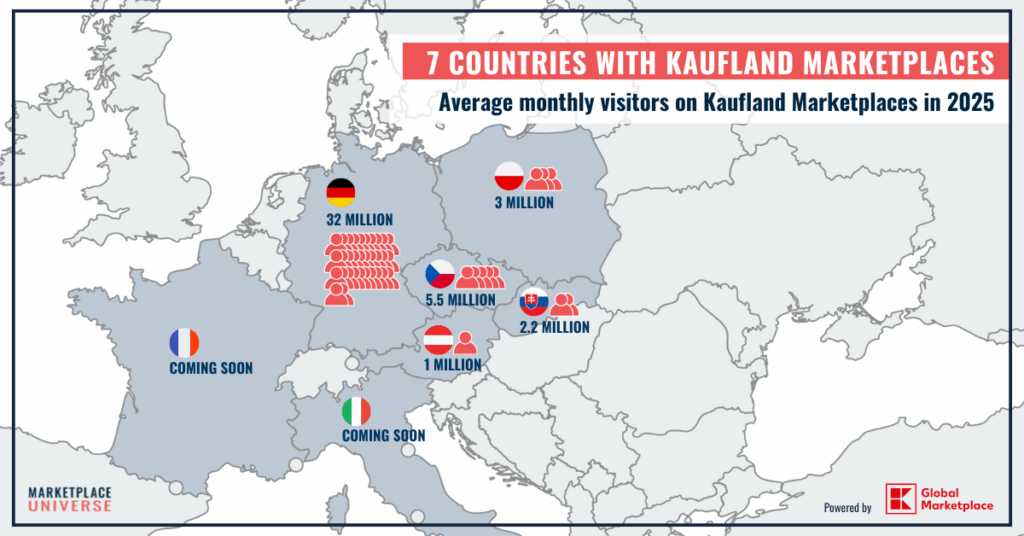
When we talk about international expansion, we often focus on market research, business models, channel strategies, and high-level decisions. So what does expansion really look like for brands and sellers in day-to-day practice? And how can going cross-border be made as simple and efficient as possible? Kaufland Global Marketplace is good example for a marketplace that really tries to help its sellers on their road to internationalization. Because this marketplace operator has achieved something that’s still rare in the European marketplace landscape: a unified, cross-country system. With just a few clicks, sellers can go live in up to seven European markets simultaneously – significantly reducing both technical and operational complexity. Here is their guide “How to sell international on Kaufland Global Marketplace”. Seven Markets, One System: Why Kaufland is Worth Considering Over the past few years, Kaufland Global Marketplace has focused on simplifying international expansion. Through a central platform, sellers can currently access marketplaces in seven countries: Germany, Czech Republic, Slovakia, Poland, Austria – and starting in late summer 2025, also France and Italy. In total, this means access to up to 139 million potential online shoppers. The Seller Portal is the command center: it allows sellers to manage and translate everything from product data and legal texts to shipping rules – all tailored to the relevant country. Even after-sales service can be handled centrally across markets. One Registration – Many Channels to sell international Sellers only need to register once to access all Kaufland marketplaces. At onboarding, they can choose to launch in one or multiple countries – and additional markets can be added at any time without re-registration. Requirements to get started: The Pricing Kaufland Global Marketplace treats its multi-market offering as a unified package – and this is reflected in the fee model. Sellers pay a flat monthly fee of €39.95 (Basic) or €59.95 (Plus), plus a category-based commission. The big advantage: adding additional countries incurs no extra cost. Listing products is also free and unlimited across all marketplaces. How the Operational Rollout Works Especially valuable for sellers with existing system landscapes: the rollout can be largely automated. Kaufland offers free tools for data transfer and translation, and over 130 integration partners ensure smooth connectivity with popular ERP and shop systems. The Seven Steps to Internationalization In its guide, Kaufland Global Marketplace clearly walks sellers through the onboarding steps with dashboard screenshots and explanations: Conclusion: Less Complexity, More Reach For many brands and sellers, internationalization is no longer optional – it’s essential for growth. And while marketplaces promise fast access to new markets, the reality often involves complex tech setups, fragmented structures, and inconsistent policies. Kaufland Global Marketplace takes a different approach: one platform, one logic, one interface – across seven markets. This drastically lowers the barrier to entry and enables scalable growth from day one. A compelling model – and one that other marketplaces would do well to learn from. 💡 The complete guide with all its practical tips that shows how to sell international on Kaufland Global Marketplace is available free of charge here:
Marketplace Universe News 23.06.2025 – About You opens marketplace for new partners
Fashion platform About You has overhauled its onboarding process, aiming to make it easier for small brands, start-ups, and independent labels to join. The seller center has also been revamped as part of the update.
The German Retail Association HDE has filed a complaint with the Federal Cartel Office against Temu for anti-competitive behavior. The accusation: Temu deprives retailers who sell on Temu of the sovereignty to set prices.
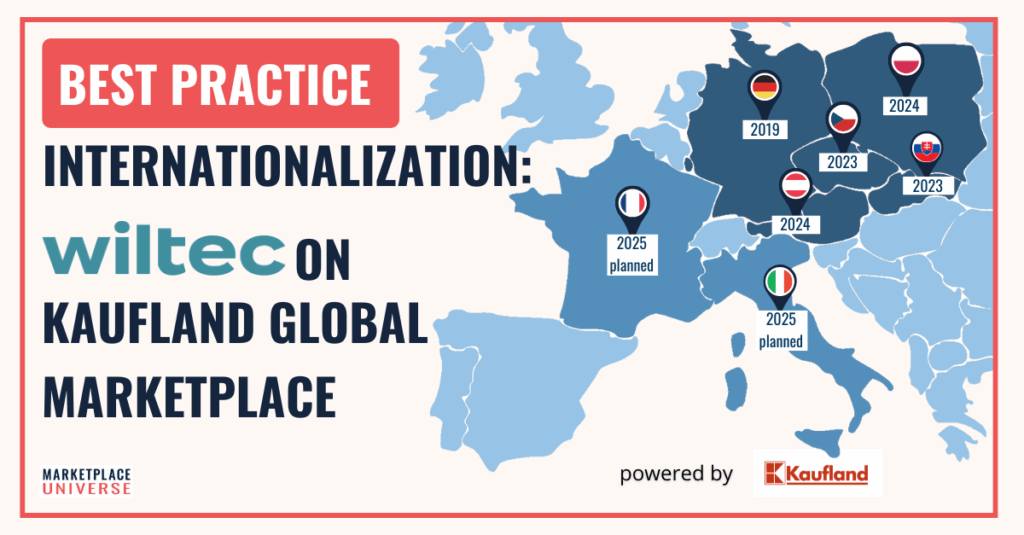
Marketplaces are a popular choice for many retailers and brands looking to expand into international markets. Wiltec, a specialist retailer in DIY, garden, and pet supplies, leverages several platforms for its cross-border commerce strategy – including Kaufland Global Marketplace. This best practice showcases how Wiltec scales internationally with Kaufland.
Regardless of the uncertain future in the US, TikTok is apparently continuing to expand TikTok Shop. According to reports, TikTok Shop is set to launch in Italy in March or April, with Germany, France, Brazil and Japan to follow later in the year. Meanwhile, Lidl has launched initial sales attempts on TikTok Shop in the UK.
Marketplaces are driving sales growth in German e-commerce: After two years of declining sales, online retailing is expected to grow by 1.1 percent in 2024, according to the bevh. This growth stems from marketplaces, which grew by 4.7 percent, while online pure players continued to suffer a decline of 3.6 percent and omnichannel retailers a decline of 2.0 percent. For this year, the bevh expects an increase of 2.5 percent
2024 – an exciting year for the entire marketplace industry draws to a close. Time to look at the greatest news – from ABOUT YOU to Zalando, from Amazon to Temu and many more
You need to load content from reCAPTCHA to submit the form. Please note that doing so will share data with third-party providers.
More InformationYou are currently viewing a placeholder content from Active Campaign. To access the actual content, click the button below. Please note that doing so will share data with third-party providers.
More InformationYou are currently viewing a placeholder content from Vimeo. To access the actual content, click the button below. Please note that doing so will share data with third-party providers.
More InformationYou are currently viewing a placeholder content from YouTube. To access the actual content, click the button below. Please note that doing so will share data with third-party providers.
More InformationYou need to load content from reCAPTCHA to submit the form. Please note that doing so will share data with third-party providers.
More InformationYou are currently viewing a placeholder content from Instagram. To access the actual content, click the button below. Please note that doing so will share data with third-party providers.
More InformationYou are currently viewing a placeholder content from Google Maps. To access the actual content, click the button below. Please note that doing so will share data with third-party providers.
More InformationYou are currently viewing a placeholder content from Google Maps. To access the actual content, click the button below. Please note that doing so will share data with third-party providers.
More InformationYou are currently viewing a placeholder content from X. To access the actual content, click the button below. Please note that doing so will share data with third-party providers.
More Information